India-Made Generic HIV Prevention Shot and Global Health Access
Source:The Hindu ↗
Why It Matters
It highlights India's crucial role as a global generic medicine provider, intersecting with issues of intellectual property rights, international health equity, and access to affordable treatment for low-income countries.
Summary
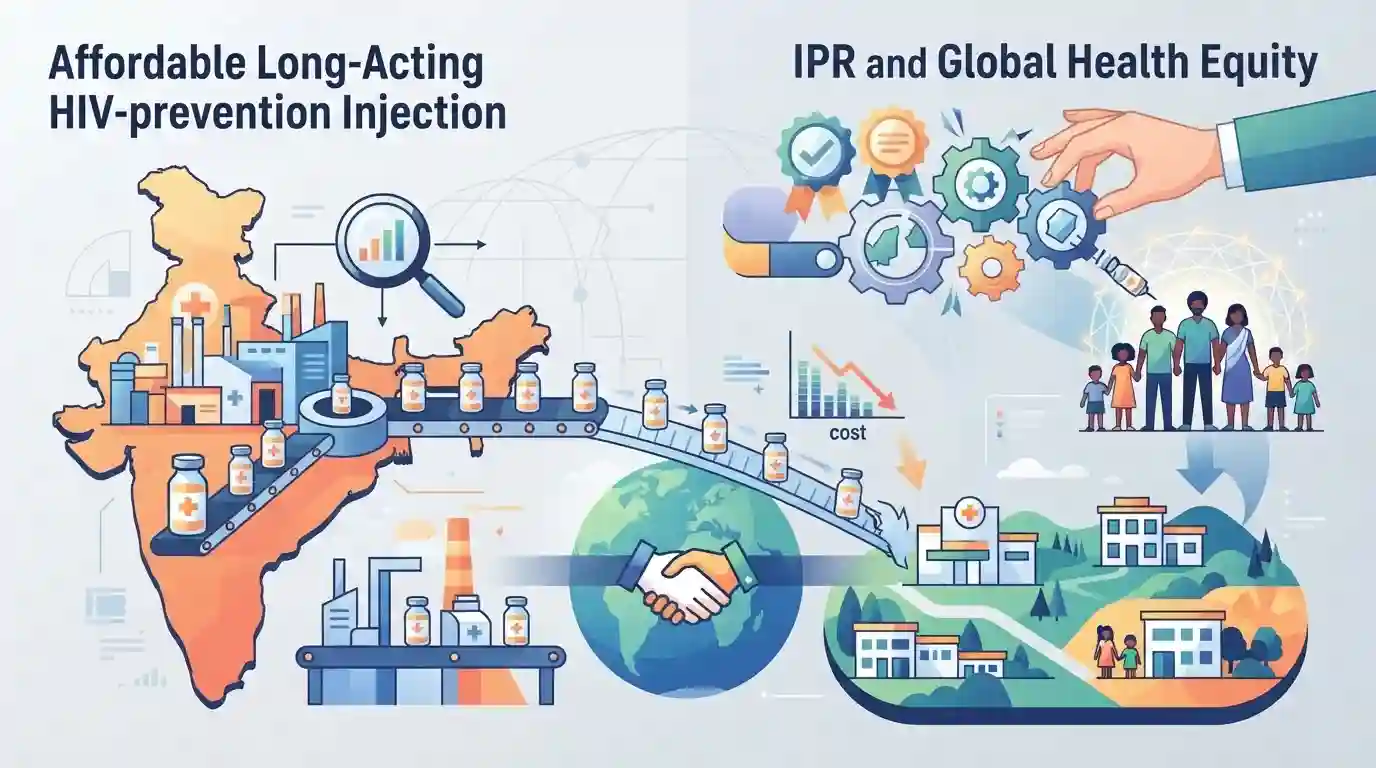
The approval of an India-manufactured generic version of a critical long-acting HIV-prevention injection has raised optimism for expanding affordable healthcare access across low-income nations. This development highlights India's pivotal position as the 'pharmacy of the developing world', lowering costs for life-saving pharmaceuticals through robust generic manufacturing capacities while underscoring ongoing debates surrounding global intellectual property rights and public health equity.
Key Points
- Approval of an India-made generic version of the long-acting HIV-prevention shot (lenacapavir) offers hope for affordable access in low-income countries.
- India's generic pharmaceutical industry plays a critical role in global health equity by producing affordable life-saving therapeutics.
- Access to high-cost advanced drugs remains hindered by intellectual property rights and patent monopolies unless voluntary licensing or patent pool agreements are facilitated.
- Affordability and scale-up are vital for achieving the global public health goal of ending HIV/AIDS as a public health threat by 2030.
Important Terms
TRIPS Agreement

An international legal agreement administered by the WTO that sets minimum standards for the protection and enforcement of intellectual property rights, impacting global access to affordable generic medicines.
UPSC context
UPSC Mains GS Paper II & III: International Relations, Trade, and Public Health (IPR regimes, compulsory licensing, and access to medicines).
World Health Organization
A United Nations specialized agency responsible for international public health, setting normative guidelines, pre-qualifying essential medicines, and coordinating global responses to epidemics like HIV/AIDS.
UPSC context
UPSC Mains GS Paper II: Governance, Social Justice, and International Bodies (Global health governance and disease eradication strategies).
Medicines Patent Pool
A United Nations-backed public health organization that works to facilitate the development, manufacturing, and generic licensing of life-saving medicines for low- and middle-income countries.
UPSC context
UPSC Mains GS Paper II & III: Public Health, Global Equity, and Intellectual Property Rights (Voluntary licensing and affordable healthcare).
Prelims Trap
The World Trade Organization directly grants compulsory licenses to developing countries to manufacture patented generic drugs during public health emergencies.
Aspirants often assume compulsory licensing is issued by the WTO itself; in reality, individual sovereign governments issue them under domestic laws inline with TRIPS flexibilities.
Static Concepts Connected
What are the key flexibilities available under the TRIPS Agreement for public health?
- Compulsory Licensing: Governments can permit production of a patented drug without patentee consent during national emergencies or extreme urgency.
- Parallel Importing: Permits importing generic drugs manufactured under compulsory license from a country with manufacturing capacity to a country lacking it.
- LDC Transitions: Least developed countries are exempt from enforcing pharmaceutical patents under WTO council extensions.
Cross-Topic Patterns
Global Health Equity vs. TRIPS flexibilities
The UN Sustainable Development Goal 3 targets ending epidemics like AIDS by 2030, directly testing the balance between affordable access and pharmaceutical patent protection.

Expect questions linking TRIPS flexibilities, compulsory licensing, and India's role as the pharmacy of the developing world in public health.
Linked PYQs · 1
Linked PYQs · 1
- 2024MainsGS3
What is the present world scenario of intellectual property rights with respect to life materials? Although, India is second in the world to file patents, still only a few have been commercialized. Explain the reasons behind this less commercialization.
