Judicial restraint and the misuse of public interest litigation
Source:The Hindu ↗
Why It Matters
It serves as a strong case study for GS Paper 2 on the misuse of PILs and the doctrine of separation of powers. It demonstrates the judiciary's own awareness of the need to limit judicial intervention in matters that first require executive or administrative action.
Summary
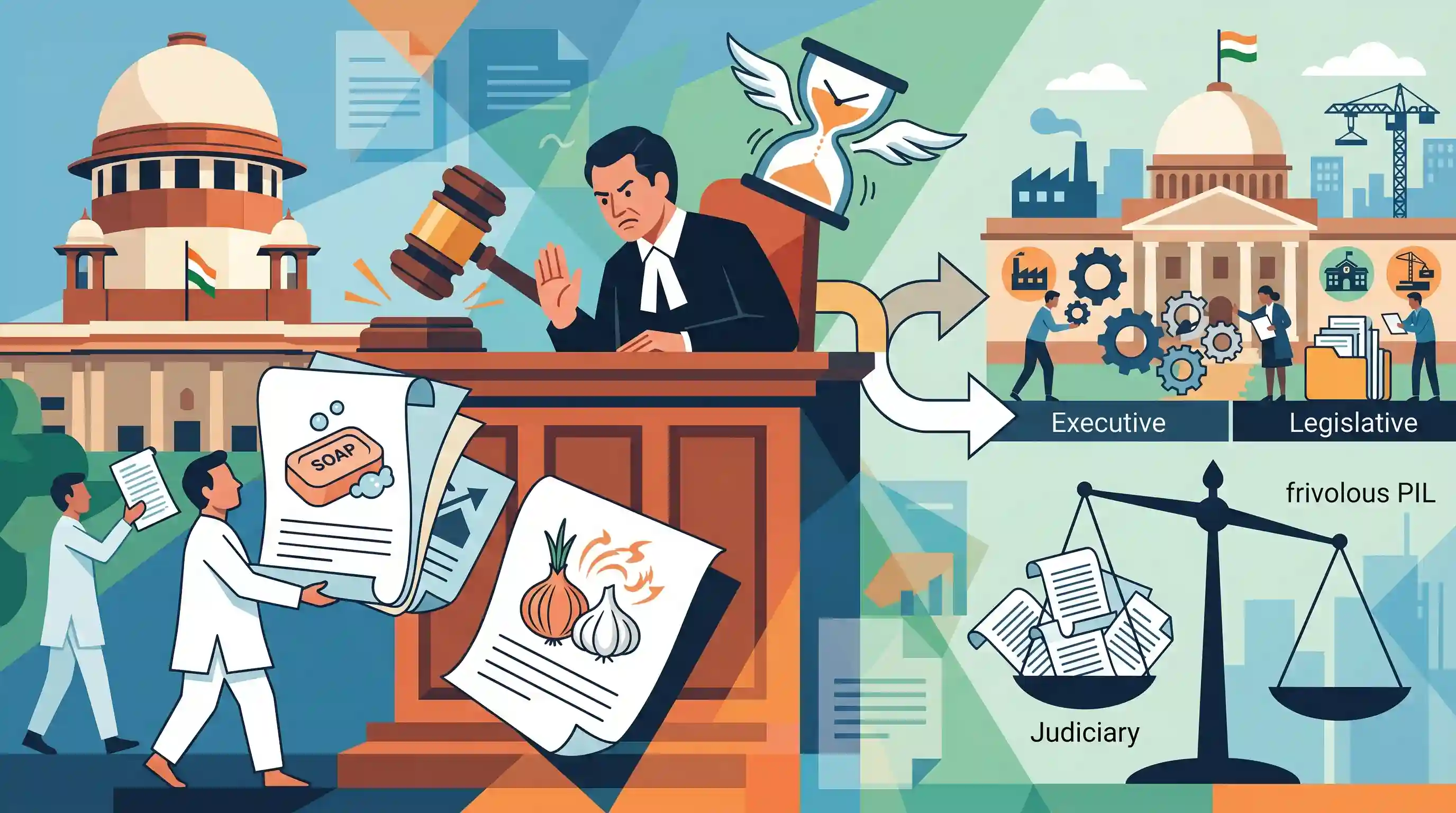
The Supreme Court of India reprimanded a petitioner for repeatedly filing frivolous Public Interest Litigations (PILs) on disparate issues, ranging from chemical regulation in soaps to the negative energy in onions and garlic. Chief Justice Surya Kant directed the petitioner to first approach the relevant executive authorities to address his concerns rather than immediately seeking judicial intervention. The case underscores the ongoing challenges of PIL misuse, which wastes judicial time and risks judicial overreach by expecting courts to routinely issue guidelines to the executive.
Key Points
- The Supreme Court rebuked a petitioner for filing 25 Public Interest Litigations (PILs) on miscellaneous issues, terming them frivolous.
- The Court directed the petitioner to first approach the relevant executive or administrative authorities with grievances instead of rushing directly to the judiciary.
- The petitioner's PIL topics ranged from the use of chemicals in soaps to the 'negative energy' of onion and garlic.
- The incident highlights the growing concern over the misuse of the PIL mechanism, which burdens the judiciary and risks violating the separation of powers.
Important Terms
Public Interest Litigation (PIL)

Litigation filed by a public-spirited individual for the protection of public interest (e.g., environment, human rights). It relaxes "locus standi" to ensure access to justice for the marginalized and underprivileged.
UPSC context
GS Paper II/Polity; tests knowledge of judicial activism, access to justice, and the evolution of Indian constitutional law.
Article 32
A fundamental right guaranteeing the right to move the Supreme Court directly for the enforcement of Part III rights. Dr. Ambedkar described it as the "heart and soul" of the Constitution.
UPSC context
GS Paper II/Polity; essential for understanding constitutional remedies, writ jurisdiction, and the Supreme Court’s role as protector of rights.
Separation of Powers
A constitutional doctrine dividing governmental functions into three branches—Legislature, Executive, and Judiciary—to prevent power concentration and ensure a system of checks and balances.
UPSC context
GS Paper II/Constitutional Principles; tests understanding of the basic structure, inter-organ relationships, and institutional limits.
Judicial Overreach
When the judiciary exceeds its constitutional mandate by interfering in the functions of the legislative or executive branches, such as by formulating policy or creating laws.
UPSC context
GS Paper II/Judiciary; tests the ability to distinguish between legitimate judicial activism and overstepping into governance.
Frivolous Litigation
Baseless or malicious legal claims filed without merit, often to harass defendants or gain publicity. Such litigation contributes significantly to judicial backlogs and wastes court time.
UPSC context
GS Paper II/Judiciary; relevant for discussing judicial pendency, case management, and administrative challenges within the legal system.
Locus Standi
The legal standing or right of a party to appear in court. In PILs, this traditional rule is relaxed to allow anyone to seek justice for others.
UPSC context
GS Paper II/Polity; tests understanding of procedural innovations that expanded judicial reach to the marginalized.
Article 50
A Directive Principle (DPSP) mandating that the State take steps to separate the judiciary from the executive in public services, thereby ensuring judicial independence.
UPSC context
GS Paper II/Governance; tests knowledge of the structural foundations of judicial independence and constitutional mandates.
Prelims Trap
"The Constitution explicitly defines Public Interest Litigation (PIL) and outlines the strict grounds for its filing."
PIL is completely absent from the text of the Constitution. It is entirely a product of judicial innovation (judge-made law) originating in the late 1970s and 1980s.
Static Concepts Connected
What is the rule of 'Locus Standi' and how does PIL alter it?
- Traditional rule: Only a directly aggrieved person whose fundamental or legal rights are infringed can move the constitutional courts.
- PIL exception: Any public-spirited individual or organization can file a petition on behalf of marginalized or unaware groups.
- Jurisdictional basis: Despite lacking a statutory definition, PILs are filed under Article 32 (SC) and Article 226 (HC).
What mechanisms exist to prevent the misuse of Public Interest Litigation?
- Chaufal guidelines (2010): The Supreme Court mandated strict verification of the petitioner's credentials and the bona fide public cause.
- Alternative remedies: Courts generally insist petitioners exhaust available statutory, executive, or administrative grievance channels before invoking writ jurisdiction.
- Exemplary costs: Frivolous or vexatious petitions attract heavy financial penalties to deter "luxury litigation" and conserve judicial time.
Cross-Topic Patterns
PILs and Separation of Powers
Petitions demanding courts dictate routine executive functions risk "Judicial Legislation," crossing the delicate line from judicial activism into judicial overreach.
Exhaustion of Alternative Remedies
The SC's directive mirrors a broader governance push to decongest courts by utilizing administrative channels and tribunals (Article 323A/B) as first-resort grievance redressal mechanisms.

Expect a multi-statement Prelims question testing the absence of PIL in the Constitution against the relaxed rule of locus standi.
Linked PYQs · 2
Linked PYQs · 2
- 2024MainsGS2
Explain the reasons for the growth of public interest litigation in India. As a result of it, has the Indian Supreme Court emerged as the world's most powerful judiciary ?
- 2020MainsGS2
Judicial Legislation is antithetical to the doctrine of separation of powers as envisaged in the Indian Constitution. In this context justify the filing of large number of public interest petitions praying for issuing guidelines to executive authorities.
