Centre Notifies Appointment of Thirty Judges Across Four High Courts
Source:newsonair ↗
Why It Matters
The appointment of judges directly relates to the constitutional framework governing the Indian Judiciary (Article 217). The process underscores the functioning of the Collegium system, the role of the President, and the balance of power between the executive and the judiciary, which are critical areas for Polity questions in MPPSC Prelims.
Summary
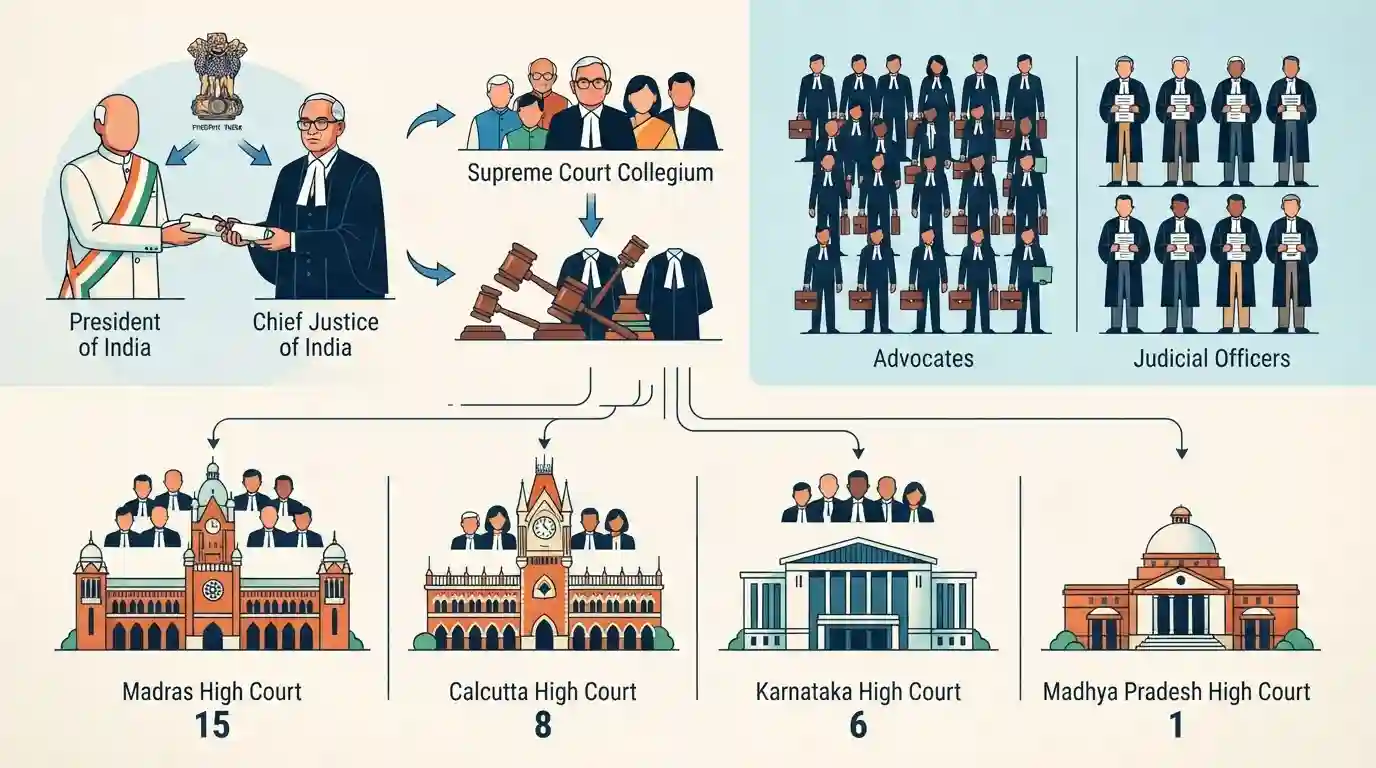
The Ministry of Law and Justice has formally notified the appointment of 30 new judges to four High Courts in India. Appointed by the President in consultation with the Chief Justice of India and the Supreme Court Collegium, the new additions include 20 Advocates and 10 Judicial Officers. The appointments are distributed as follows: 15 judges for the Madras High Court, 8 for the Calcutta High Court, 6 for the Karnataka High Court, and 1 for the Madhya Pradesh High Court.
Key Points
- The Ministry of Law and Justice notified the appointment of 30 judges across four High Courts.
- The President of India appointed the judges in consultation with the Chief Justice of India and the Supreme Court Collegium.
- The appointments comprise 20 Advocates and 10 Judicial Officers.
- The distribution of new judges is: 15 for Madras High Court, 8 for Calcutta High Court, 6 for Karnataka High Court, and 1 for Madhya Pradesh High Court.
Important Terms
Supreme Court Collegium

An extraconstitutional body comprising the Chief Justice of India and four senior-most judges. Evolving from the 'Three Judges Cases,' it recommends the appointment and transfer of judges to the Supreme Court and High Courts.
UPSC context
GS Paper 2 (Polity). Essential for questions on judicial independence, the appointment process, and the separation of powers.
Ministry of Law and Justice
The central government ministry responsible for managing legal affairs and legislative activities. In the judicial appointment process, it formally notifies the appointment of judges once approved by the President.
UPSC context
GS Paper 2 (Polity). Relevant for understanding the executive's procedural role in the separation of powers and judicial appointments.
Madras High Court
Established in 1862 under the Indian High Courts Act 1861, it is one of India's oldest High Courts. Its appellate jurisdiction covers the state of Tamil Nadu and the Union Territory of Puducherry.
UPSC context
GS Paper 2 (Polity). Tests historical foundations of the Indian judiciary and the specific territorial jurisdictions of High Courts.
Calcutta High Court
India's oldest High Court, established in 1862. It exercises broad judicial authority, with territorial jurisdiction covering the state of West Bengal and the Union Territory of Andaman and Nicobar Islands.
UPSC context
GS Paper 1 (History) & GS Paper 2 (Polity). Important for facts regarding colonial-era judicial administration and territorial jurisdictions.
Prelims Trap
"The Supreme Court Collegium, comprising the CJI and four senior-most judges, recommends the appointment of High Court judges."
For High Court appointments, the SC Collegium consists of the CJI and the *two* senior-most judges, unlike the five-member collegium (CJI + 4) used for Supreme Court appointments.
Static Concepts Connected
What is the constitutional process for appointing a High Court Judge?
- Initial Proposal: The Chief Justice of the respective High Court initiates the proposal in consultation with their two senior-most colleagues.
- SC Collegium Vetting: The proposal is vetted by a 3-member SC Collegium (CJI + 2 senior-most judges), which then recommends the names to the Union Government.
- Presidential Appointment: The President of India officially appoints the judge by warrant under their hand and seal as per Article 217, after consulting the Governor.
What are the eligibility criteria for a High Court Judge under Article 217(2)?
- Citizenship & Jurist Exemption: The candidate must be a citizen of India. Unlike the Supreme Court, an "eminent jurist" cannot be appointed to the High Court.
- Judicial Experience: Must have held a judicial office in the territory of India for at least ten years.
- Advocate Experience: Alternatively, the candidate must have been an advocate of a High Court (or two or more such courts in succession) for at least ten years.
Cross-Topic Patterns
Memorandum of Procedure (MoP) delays
The formal notification by the Law Ministry often acts as a friction point. UPSC frequently tests the tension between the Collegium's recommendations and executive clearance timelines governed by the Memorandum of Procedure (MoP).
AIJS vs State-level appointments
Elevating state judicial officers and advocates to HCs contrasts with Article 312's provision for an All India Judicial Service, a systemic reform heavily debated to standardize district and higher judicial recruitment.

Expect a multi-statement question in 2026 contrasting the collegium composition and specific eligibility criteria for SC vs HC judges.
Linked PYQs · 2
Linked PYQs · 2
- 2022MPPSC_PRELIMSGS1
According to which Article of the Indian Constitution, can the President of India (in consultation with the Chief Justice) transfer a Judge of a High Court from one court to another?
- 2018MPPSC_PRELIMSGS1
A Sitting Judge of the High Court or a Sitting District Judge can be appointed as a member of the State Human Rights Commission after consultation with
