MHA Directive on Nodal Officers for Northeast Migrants in NCR
Source:Indian Express ↗
Why It Matters
Discrimination against internal migrants, especially those from the Northeast, poses a challenge to national integration and the constitutional ethos of equality. Establishing dedicated institutional mechanisms like nodal officers demonstrates an essential governance response to the social and cultural frictions arising in rapidly urbanizing areas.
Summary
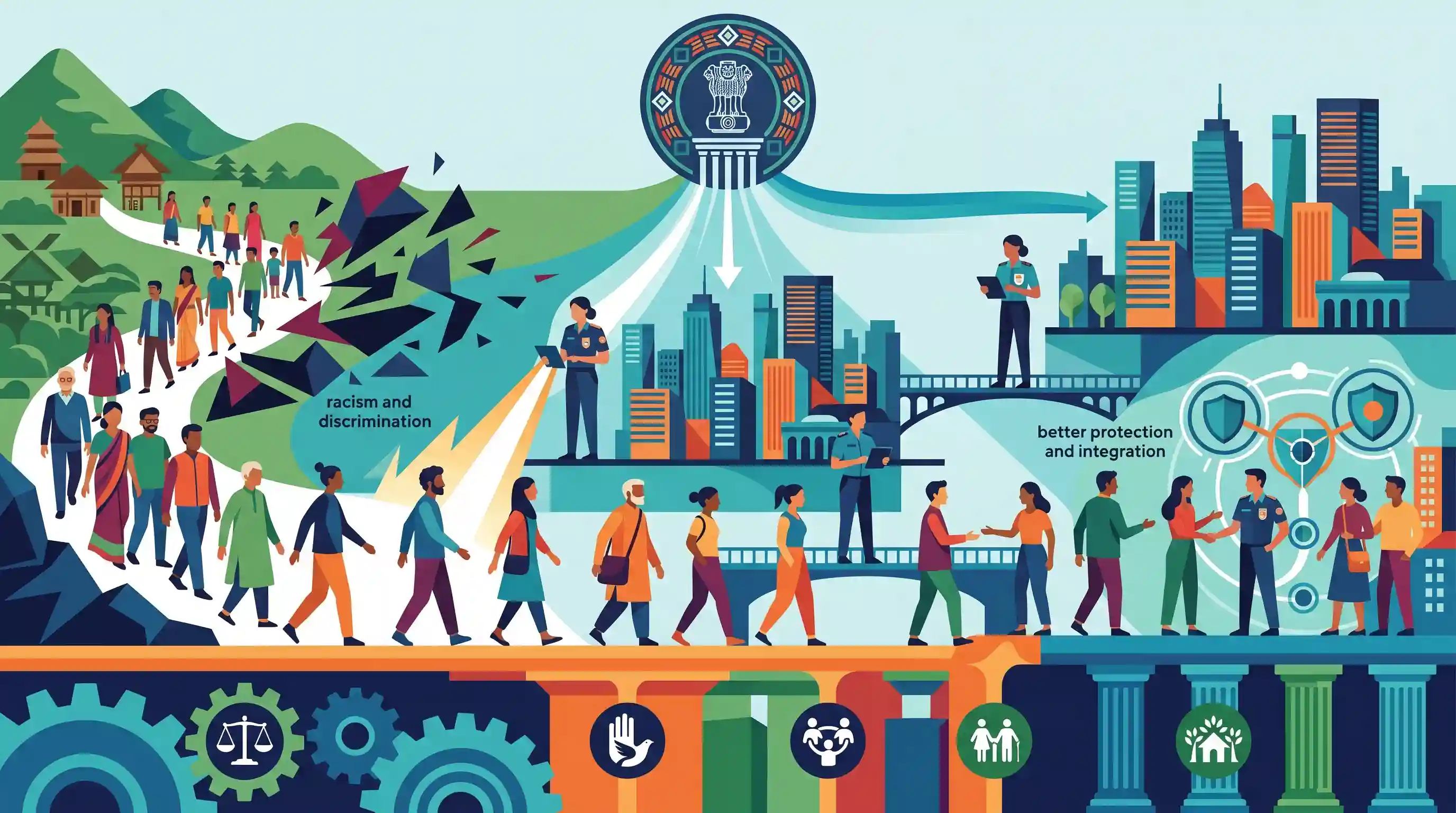
The Ministry of Home Affairs (MHA) has instructed cities within the National Capital Region (NCR) to designate nodal officers to specifically combat racism and discrimination experienced by people from Northeast India. This administrative step seeks to create a dedicated institutional grievance redressal framework, ensuring better protection and integration of internal migrants while upholding their fundamental rights in metropolitan areas.
Key Points
- The Ministry of Home Affairs (MHA) has directed cities in the National Capital Region (NCR) to appoint dedicated nodal officers to address racial discrimination faced by individuals from Northeast India.
- The creation of nodal officers provides an institutional mechanism for grievance redressal and aims to ensure the safety of vulnerable internal migrants.
- The directive is fundamentally linked to the constitutional safeguards against discrimination (Article 15) and the freedom of movement and residence (Article 19).
- This administrative measure aligns with the broader recommendations of the M.P. Bezbaruah Committee, which advocated for systemic interventions to protect Northeast citizens in metropolitan hubs.
Important Terms
Bezbaruah Committee Recommendations

A 2014 panel report suggesting legal amendments (e.g., IPC 153C, 509A), administrative reforms, and social interventions to combat racial discrimination faced by Northeast Indians in metropolitan cities.
UPSC context
GS Paper II: Social Justice/Governance. Essential for questions on protecting vulnerable sections and legal mechanisms against racial discrimination.
Ministry of Home Affairs (MHA)
The central ministry responsible for internal security and domestic policy; it oversees the implementation of welfare measures and security guidelines for Northeast Indian migrants.
UPSC context
GS Paper II & III: Governance and Internal Security. Tests knowledge of the executive's role in coordinating inter-state administrative directives.
SPUNER (Special Police Unit for North Eastern Region)
A specialized Delhi Police cell providing a dedicated grievance framework and emergency assistance to people from the Northeast, serving as a template for other metropolitan units.
UPSC context
GS Paper II/III: Governance and Security. Relevant for examples of community-specific policing and institutional grievance redressal models.
Nodal Officers
Designated administrative officials serving as a central point of contact for specific issues—in this case, handling complaints of racial harassment and ensuring inter-departmental coordination.
UPSC context
GS Paper II: Governance/Administration. Tests understanding of streamlined administrative structures for effective public service delivery and grievance handling.
Grievance Redressal Mechanism
An institutional framework for receiving, investigating, and resolving citizens' complaints; it aims to ensure accountability, transparency, and the protection of fundamental rights in public administration.
UPSC context
GS Paper II: Governance. A core topic regarding the effectiveness of democratic institutions and the Citizen’s Charter.
National Capital Region (NCR)
A multi-state planning region encompassing Delhi and districts from Haryana, Uttar Pradesh, and Rajasthan, used for coordinated development and administrative synchronization in the capital area.
UPSC context
GS Paper I & II: Geography and Governance. Tests knowledge of inter-state administrative zones and urban planning challenges.
Prelims Trap
"The M.P. Bezbaruah Committee was constituted to address border disputes and insurgency in Northeast India."
Aspirants often associate Northeast-specific committees with insurgency, border pacts, or Sixth Schedule issues. The Bezbaruah Committee specifically addressed racial discrimination against Northeasterners in metros.
Static Concepts Connected
Which Fundamental Rights protect citizens against racial discrimination and support internal migration?
- Article 15(1): Prohibits the State from discriminating against any citizen on grounds only of religion, race, caste, sex, or place of birth.
- Article 19(1)(d) & (e): Guarantees citizens the fundamental right to move freely throughout the territory of India and reside or settle in any part, safeguarding internal migrants.
- Reasonable Restrictions: These rights are not absolute; the State can impose reasonable restrictions to protect the interests of the general public or Scheduled Tribes.
What legal and judicial mechanisms address racial profiling and discrimination in India?
- Bezbaruah Committee (2014): Recommended amending the IPC to include specific offenses for racial slurs and racially motivated gestures, making them cognizable and non-bailable.
- Karma Dorjee Case (2016): The Supreme Court held that racial discrimination violates Article 15 and mandated the Union to establish strict monitoring and zero-tolerance mechanisms.
- Absence of Specific Law: India lacks a standalone anti-racism statute. Racially motivated crimes are generally prosecuted under broad hate speech and public mischief laws (e.g., promoting enmity).
Cross-Topic Patterns
Urbanization & Social Exclusion
Links GS1 (Urbanization) with GS2 (Vulnerable sections). It highlights how rapid metropolitan growth often exacerbates phenotypic prejudice, requiring targeted institutional interventions for internal migrants.
Administrative vs Statutory Redressal
Appointing specific "nodal officers" highlights a reliance on executive scaffolding where broad statutory bodies (like NHRC) lack the localized, rapid-response capability needed to protect specific ethnic minorities.

Prelims 2026 may test the exact grounds of Article 15 (religion, race, caste, sex, place of birth) paired with Bezbaruah Committee mandate.
Linked PYQs · 3
Linked PYQs · 3
- 2022MainsGS2
“Right of movement and residence throughout the territory of India are freely available to the Indian citizens, but these rights are not absolute.” Comment.
- 2013MainsGS1
Discuss the various social problems which originated out of the speedy process of urbanization in India.
- 2024MainsGS1
Critically analyse the proposition that there is a high correlation between India's cultural diversities and socio-economic marginalities.
