Apple AI Momentum and Global Tech Market Valuations
Source:The Hindu ↗
Why It Matters
This article provides a real-world case study of how emerging technologies (AI), central bank monetary policies (Fed rate cuts), and geopolitical trade tensions (US-China tariffs) intersect to shape global financial markets and corporate valuations. It is highly relevant for GS-3 topics covering the Indian economy's exposure to global financial trends, S&T developments, and the impact of changing industrial and trade policies on supply chains.
Summary
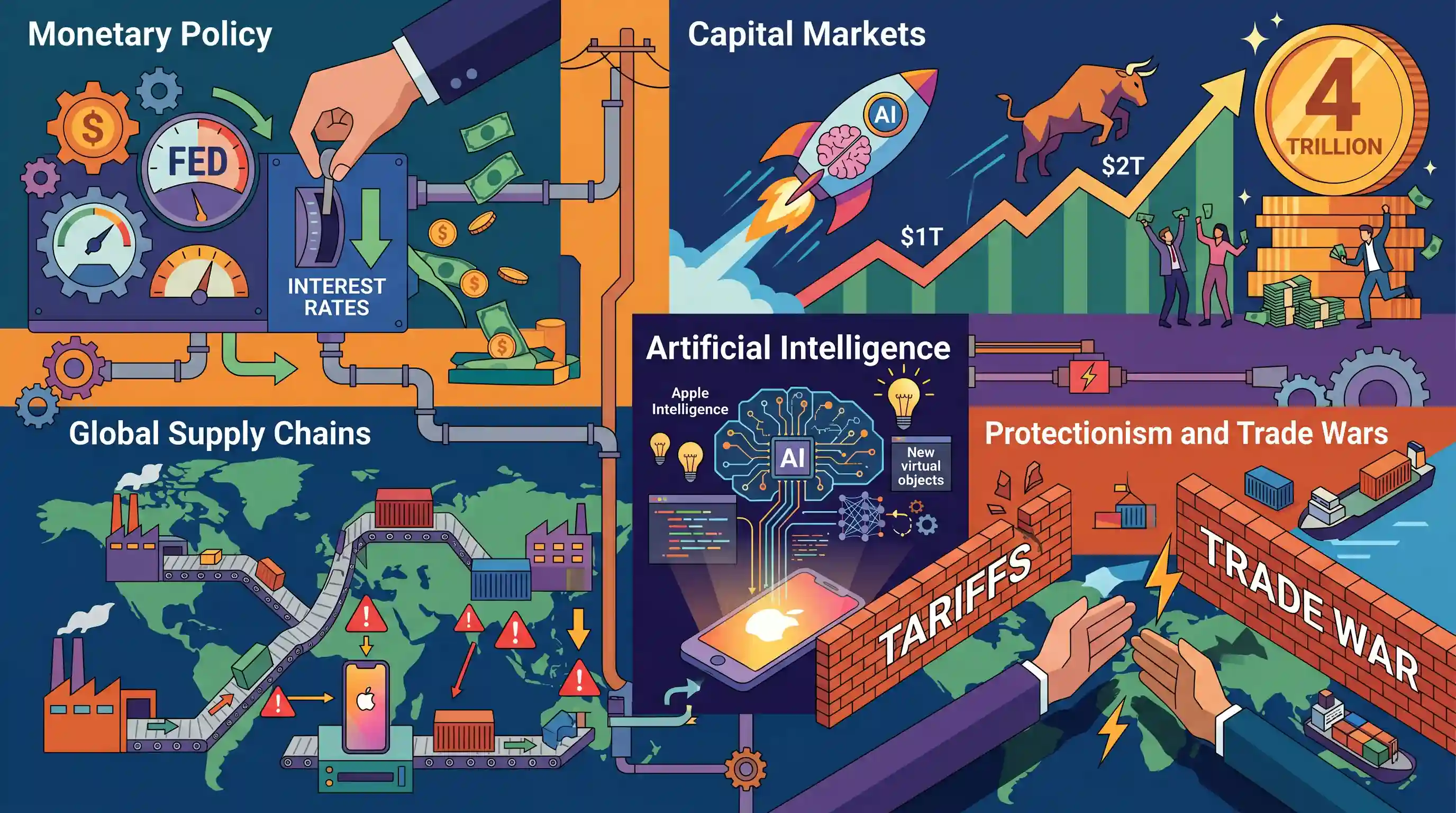
Apple's stock market valuation is approaching a record $4 trillion, propelled by investor confidence in its new AI capabilities ("Apple Intelligence") and anticipated hardware upgrades. This milestone underscores the broader market dominance of Big Tech firms fueled by the generative AI boom, further supported by the US Federal Reserve's monetary easing policies. However, Apple's heavy reliance on Chinese manufacturing leaves it vulnerable to global trade tensions, specifically the potential for renewed US-China tariff wars under the incoming Trump administration, which could disrupt global supply chains.
Key Points
- Apple is nearing a historic $4 trillion market valuation, driven by investor optimism over its AI features (Apple Intelligence) and potential "iPhone supercycles."
- The surge reflects a broader market trend where Big Tech companies (Microsoft, Alphabet, Nvidia) are dominating due to advancements in generative AI.
- Macroeconomic factors, such as the Federal Reserve's monetary easing and interest rate cuts, are further boosting stock market valuations.
- Apple faces significant geopolitical risks, particularly the threat of retaliatory tariffs if US President-elect Donald Trump imposes a 10% tariff on Chinese goods, which could severely impact its China-centric supply chain.
Important Terms
Federal Reserve

The central banking system of the United States. It manages monetary policy and sets interest rates, significantly influencing global liquidity and financial stability.
UPSC context
GS Paper-III (Economy); tests impact of global monetary policy on Indian capital flows and rupee stability.
Apple
A leading multinational technology firm and a key benchmark for Global Value Chains (GVCs), currently diversifying its manufacturing from China to India and Vietnam.
UPSC context
GS Paper-II (IR) and GS-III (Economy); relates to supply chain resilience and the 'China-plus-one' strategy.
Nvidia
A technology company specializing in high-performance Graphics Processing Units (GPUs) that provide the essential hardware infrastructure for training large-scale artificial intelligence models.
UPSC context
GS Paper-III (S&T); highlights the critical role of semiconductor hardware and computing power in the AI revolution.
OpenAI
An AI research organization that pioneered the "Generative AI" boom with ChatGPT, focusing on models capable of creating original text, images, and code.
UPSC context
GS Paper-III (S&T) and Ethics; tests awareness of AI governance, ethics, and technological disruptions.
Microsoft
A dominant global technology firm representing "Big Tech" or "Digital Gatekeepers," wielding immense influence over software, cloud computing, and AI market competition.
UPSC context
GS Paper-III (Economy/S&T); relevant for discussions on digital competition law, antitrust issues, and market dominance.
Prelims Trap
"US Federal Reserve monetary easing and interest rate cuts lead to capital flight from emerging economies."
Monetary easing (cutting interest rates) lowers yields in the US, pushing investors to seek higher returns in emerging markets. It causes FPI inflows, not outflows.
Static Concepts Connected
How does US Federal Reserve monetary easing impact the Indian economy?
- Capital Inflows: Lower US interest rates push foreign portfolio investors (FPIs) to seek higher yields in emerging markets like India.
- Currency Appreciation: The increased influx of US dollars into the Indian market generally strengthens the Indian Rupee (INR) against the USD.
- Trade Balance Impact: A stronger Rupee can make Indian exports less competitive globally, but it helps reduce the imported inflation of essential goods like crude oil.
What are the macroeconomic consequences of retaliatory tariffs in a Trade War?
- Cost-Push Inflation: Tariffs increase the cost of imported raw materials and intermediate goods, leading to higher final prices for consumers.
- WTO Framework Erosion: Unilateral tariff hikes often bypass the Most-Favored-Nation (MFN) principle and undermine the dispute resolution mechanisms of the WTO.
- Supply Chain Relocation: Companies are forced to diversify their manufacturing bases away from targeted nations, accelerating strategies like "China Plus One".
Cross-Topic Patterns
Big Tech monopolies vs Sovereign Regulation
The trillion-dollar market caps of US tech monopolies are accelerating a push for digital sovereignty, prompting nations like India to enforce data localization and launch indigenous programs like the IndiaAI Mission.
Trade Wars and India's PLI Scheme
US-China tariff wars accelerate global supply chain shifts, directly benefiting India's push for electronics manufacturing via the Production Linked Incentive (PLI) scheme and the "China Plus One" strategy.

A multi-statement Prelims question linking US Fed rate cuts, FPI inflows, INR exchange rates, and RBI forex interventions is highly likely.
Linked PYQs · 4
Linked PYQs · 4
- 2022PrelimsGS1
Consider the following statements: 1. Tight monetary policy of US Federal Reserve could lead to capital flight. 2. Capital flight may increase the interest cost of firms with existing External Commercial Borrowings (ECBs). 3. Devaluation of domestic currency decreases the currency risk associated with ECBs. Which of the statements given above are correct?
- 2023PrelimsGS1
Consider the following statements: Statement-I: In the post-pandemic recent past, many Central Banks worldwide had carried out interest rate hikes. Statement-II: Central Banks generally assume that they have the ability to counteract the rising consumer prices via monetary policy means. Which one of the following is correct in respect of the above statements?
- 2023PrelimsGS1
Consider the following markets: 1. Government Bond Market 2. Call Money Market 3. Treasury Bill Market 4. Stock Market How many of the above are included in capital markets?
- 2024MainsGS2
‘The West is fostering India as an alternative to reduce dependence on China's supply chain and as a strategic ally to counter China's political and economic dominance.’ Explain this statement with examples.
