Apple airlifts iPhones from India to bypass US tariff barriers
Source:The Hindu ↗
Why It Matters
The event is a highly practical case study of how global protectionism and the US-China trade war are physically restructuring supply chains. It demonstrates India's potential to capitalize on the 'China Plus One' strategy by improving domestic manufacturing capacity and ease of doing business (customs clearance), which are direct GS3 and GS2 themes.
Summary
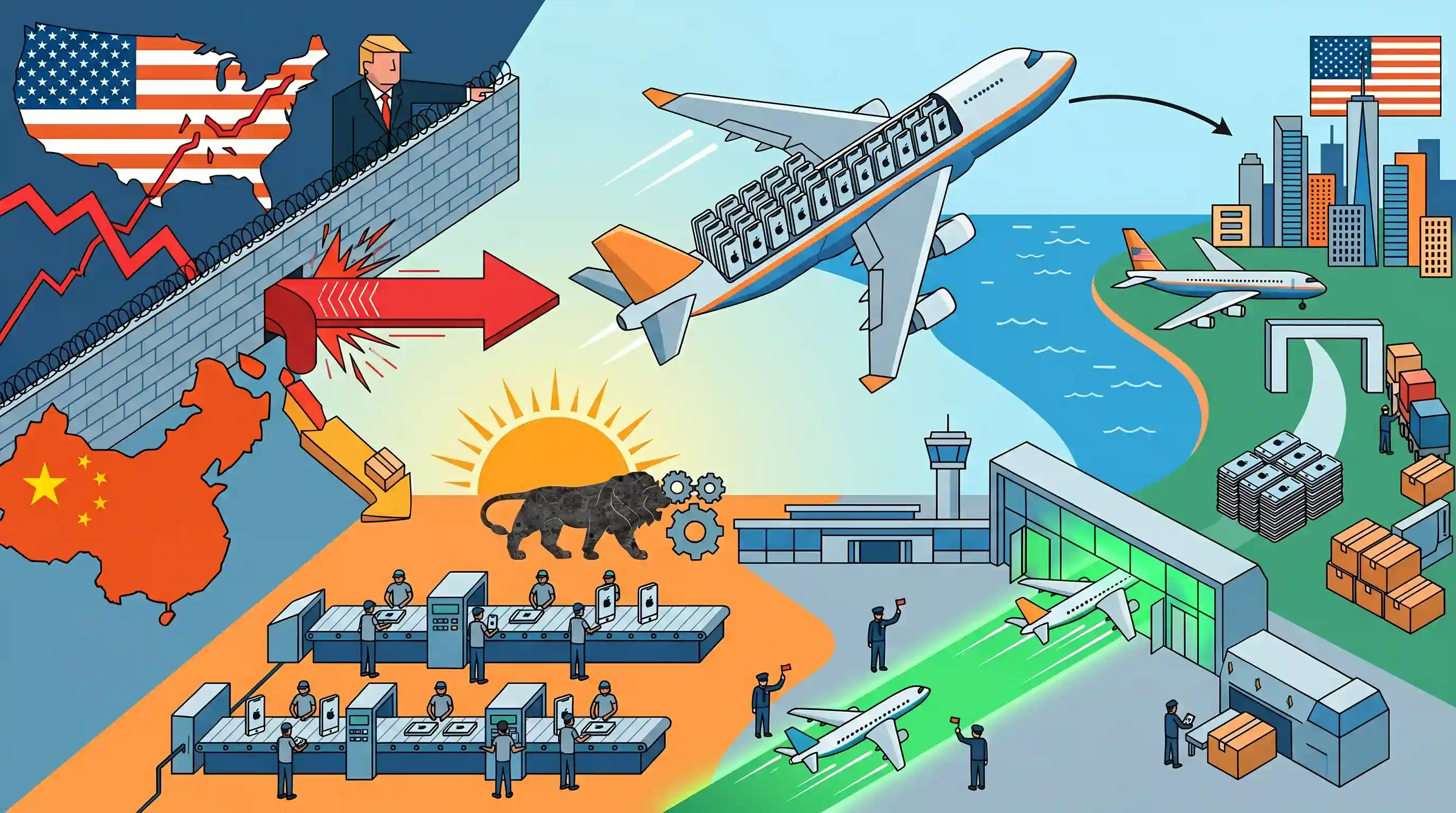
Apple has chartered major cargo flights to transport 600 tons of iPhones from India to the US in an effort to beat Donald Trump's looming 125% tariffs on imports from China. To meet the surge, Foxconn extended operations at its India plant, while Indian authorities created a 'green corridor' at the Chennai airport to dramatically reduce customs clearance times. The massive logistical operation underscores the severe disruptions caused by US-China trade wars and highlights India's strategic opportunity to emerge as a key alternative manufacturing hub under the 'China Plus One' strategy.
Key Points
- Apple chartered multiple cargo flights to airlift 600 tons of iPhones directly from India to the US to bypass Donald Trump's proposed 125% tariffs on Chinese imports.
- To facilitate the massive export push, Foxconn extended Indian factory operations to Sundays, while authorities established a 'green corridor' at Chennai airport to cut customs clearance time from 30 hours to 6 hours.
- The move illustrates multinational corporations actively diversifying supply chains away from China (China Plus One strategy) to mitigate geopolitical risks and tariff barriers.
- The coordination between Apple, Foxconn, and Indian customs highlights improvements in India's ease of doing business and its growing integration into Global Value Chains (GVCs) for electronics manufacturing.
Important Terms
Make in India

A flagship initiative launched in 2014 to transform India into a global manufacturing hub by fostering investment, innovation, and infrastructure across 27 key sectors.
UPSC context
GS Paper III (Economy); tests industrial policy, manufacturing's contribution to GDP, and strategies for 'Atmanirbhar Bharat'.
China Plus One Strategy
A global business strategy where multinational companies diversify their supply chains by establishing manufacturing bases outside of China to mitigate geopolitical and regulatory risks.
UPSC context
GS Paper II (IR) and Paper III (Economy); examines India’s strategic positioning in shifting global trade dynamics.
Global Value Chains (GVCs)
The international fragmentation of production where various stages of manufacturing a product are spread across different countries to optimize cost and efficiency.
UPSC context
GS Paper III (Economy); critical for understanding modern trade, export competitiveness, and India's integration into the global economy.
Protectionism
Economic policy of restricting imports from other countries through methods such as tariffs and quotas to shield domestic industries from foreign competition.
UPSC context
GS Paper III (Economy); relevant for analyzing trade wars, WTO challenges, and the impact of trade barriers on exports.
Ease of Doing Business
A measure of how regulatory environments facilitate the starting and operating of businesses, often improved through simplified administrative and customs procedures.
UPSC context
GS Paper III (Economy); focuses on administrative reforms, regulatory hurdles, and India’s attractiveness as a foreign investment destination.
Tariff
A tax or duty imposed by a government on imported goods, used as a tool of trade policy to regulate international commerce and protect domestic industry.
UPSC context
GS Paper III (Economy); essential for understanding fiscal trade measures, cost of production, and the mechanics of trade wars.
Prelims Trap
The surge in iPhone exports reflects high domestic value addition in India's electronics sector.
India's role in electronics GVCs is primarily final assembly (low value addition). High-value core components like memory chips and displays are still heavily imported.
Static Concepts Connected
What are Trade Diversion and Trade Creation in global economics?
- Trade Creation: Shifts production from a high-cost domestic producer to a more efficient, lower-cost foreign producer due to reduced barriers.
- Trade Diversion: Shifts trade from a more efficient targeted country (e.g., China) to a less efficient alternative (e.g., India) due to discriminatory tariffs or trade blocs.
How does the WTO Trade Facilitation Agreement (TFA) address customs bottlenecks?
- Core Objective: Aims to expedite the movement, release, and clearance of goods to reduce trade costs, bureaucratic red tape, and turnaround delays.
- Risk Management System: Enables 'green channels' where low-risk cargo is cleared automatically, minimizing manual physical inspections at ports.
- AEO Program: Grants pre-approved, trusted companies (Authorized Economic Operators) faster customs clearances and simplified border procedures.
Cross-Topic Patterns
PLI + GVC Integration
The mobile PLI's success highlights India's shift to export-led GVC assembly, though deep backward integration into components remains the next GS3 challenge.
Tariffs + SCRI Framework
The corporate 'China Plus One' movement perfectly dovetails with the intergovernmental Supply Chain Resilience Initiative (SCRI) launched by India, Japan, and Australia.

Expect a 2026 GS3 question evaluating how geopolitical protectionism offers a fleeting window for India's electronics GVC integration.
Linked PYQs · 4
Linked PYQs · 4
- 2023MainsGS3
Faster economic growth requires increased share of the manufacturing sector in GDP, particularly of MSMEs. Comment on the present policies of the Government in this regard.
- 2015MainsGS3
Success of 'Make in India' programme depends on the success of 'Skill India' programme and radical labour reforms." Discuss with logical arguments.
- 2021MainsGS2
“The USA is facing an existential threat in the form of a China, that is much more challenging than the erstwhile Soviet Union.” Explain.
- 2025MainsGS3
India aims to become a semiconductor manufacturing hub. What are the challenges faced by the semiconductor industry in India? Mention the salient features of the India Semiconductor Mission.
