Andhra Pradesh Employees Urge Caution on Presidential Orders
Source:The Hindu ↗
Why It Matters
Highlights the implementation challenges of domicile-based reservations and special constitutional provisions (like Article 371D for AP). It underscores the tension between creating new employment opportunities for locals and protecting the existing service rules, seniority, and benefits of current civil servants.
Summary
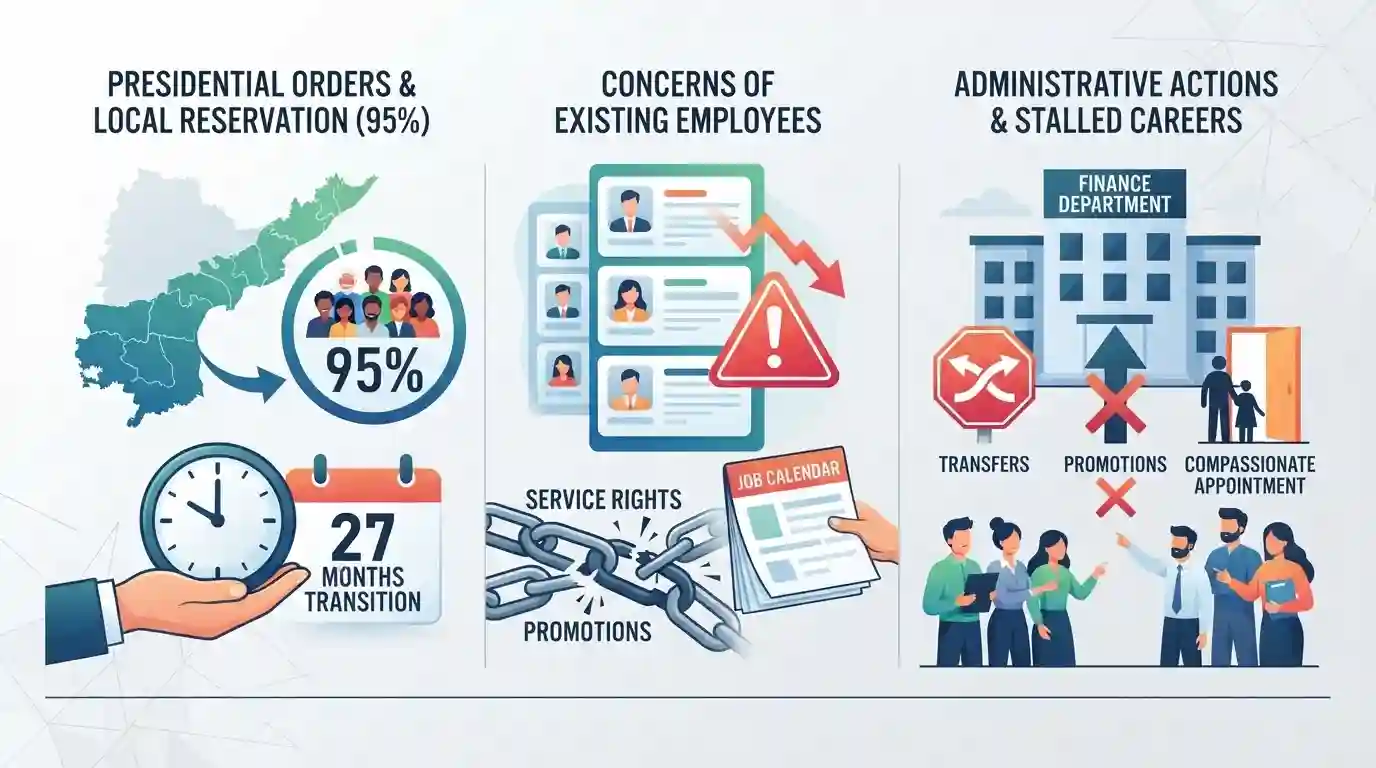
The Andhra Pradesh Joint Action Committee (APJAC) has appealed to the State government to avoid the hasty implementation of Presidential Orders that mandate a 95% reservation for locals in government jobs. APJAC leaders emphasized that the Centre has allowed a 27-month period for this transition. They warned that rushing the process to release a job calendar could jeopardize the service rights, seniority, and promotions of existing employees. Furthermore, they opposed the recent administrative actions by the Finance Department that have stalled promotions, transfers, and compassionate appointments.
Key Points
- The Andhra Pradesh Joint Action Committee (APJAC) urged the State government not to hastily implement the Presidential Orders regarding local reservations.
- The Presidential Orders aim to ensure 95% of government jobs are reserved for local candidates, with 5% allocated to non-locals.
- APJAC leaders pointed out that the Centre provided a 27-month window for the implementation, arguing against a rushed rollout merely to issue a job calendar.
- Hasty implementation could negatively affect the seniority, promotions, and service benefits of existing government employees.
- Concerns were also raised regarding the Finance Department's suspension of promotions, transfers, and compassionate appointments since July 13.
Important Terms
Article 371-D of the Constitution

A special constitutional provision granting the President power to issue orders safeguarding equitable opportunities in public employment and education across regions of Andhra Pradesh and Telangana.
UPSC context
GS Paper II: Indian Constitution, federalism, and special provisions. Tests understanding of regional equity and asymmetric federalism.
Presidential Orders (Article 371-D)
Directives issued by the President of India under Article 371-D that regulate public employment, organize local cadres, and allocate reservations for local candidates in Andhra Pradesh.
UPSC context
GS Paper II: Executive powers and local recruitment regulations. Tests knowledge of the President's role in asymmetric federalism.
Local Cadre
Geographical or administrative groupings of public services (such as District, Zonal, or Multi-Zonal cadres) established to ensure localized recruitment, seniority, and regional equity in state employment.
UPSC context
GS Paper II: Public services and local governance. Tests mechanisms for regional reservation and state administrative planning.
Andhra Pradesh Joint Action Committee (APJAC)
A prominent state-level alliance of government employee unions and associations that serves as a pressure group to negotiate service rules, promotions, and welfare rights with the state government.
UPSC context
GS Paper II: Pressure groups and informal associations. Tests the influence of public-sector unions on administrative policy.
Prelims Trap
"State Legislatures can prescribe residence as a condition for public employment under Article 16(3)."
Under Article 16(3), only Parliament has this power. However, specifically for Andhra Pradesh and Telangana, the President creates equitable employment orders under Article 371-D.
Static Concepts Connected
How does Article 371-D modify public employment in Andhra Pradesh?
- Presidential Order: Empowers the President to mandate equitable opportunities in education and public employment for different parts of the state.
- Local Cadres: Allows organizing civil posts into distinct local cadres (District, Zonal) with direct recruitment preferences for local candidates.
- Overriding Effect: Orders issued under 371-D(10) override other constitutional provisions, insulating these domicile quotas from standard Article 16 challenges.
What are the constitutional rules for domicile-based job reservations?
- General Prohibition: Article 16(2) explicitly prohibits discrimination in state public employment solely on the basis of residence.
- Parliamentary Exception: Article 16(3) allows only Parliament, not State Legislatures, to prescribe residence as a qualification for state government jobs.
- Judicial Limit: The SC ruled that Parliament can mandate residence requirements for an entire State, but not for specific regional sub-divisions.
Cross-Topic Patterns
Domicile Quotas vs Fundamental Rights
Links state job reservations to Article 16(2) and recent private sector domicile quota debates (e.g., Haryana) which test Article 19(1)(g) constraints on freedom of profession.
Asymmetric Federalism (Article 371 Series)
AP's 371-D showcases asymmetric federalism. UPSC frequently tests the exact constitutional authorities (President vs Governor vs Parliament) involved in the special provisions of the Article 371 A-J series.

Expect a Prelims statement contrasting Parliament's Article 16(3) power with the President's special authority over AP under Article 371-D.
Linked PYQs · 3
Linked PYQs · 3
- 2023APPSC_PRELIMSGS1
Which of the following Amendment(s) provide(s) for reservation in jobs and admissions ?
- 2023APPSC_PRELIMSGS1
Which of the following is not a function of the Union Public Service Commission (UPSC)?
- 2023APPSC_PRELIMSGS1
Part V of the Andhra Pradesh Reorganisation Act deals with
