Karnataka Biodiversity Conservation and Endemic Species Status
Source:The Hindu ↗
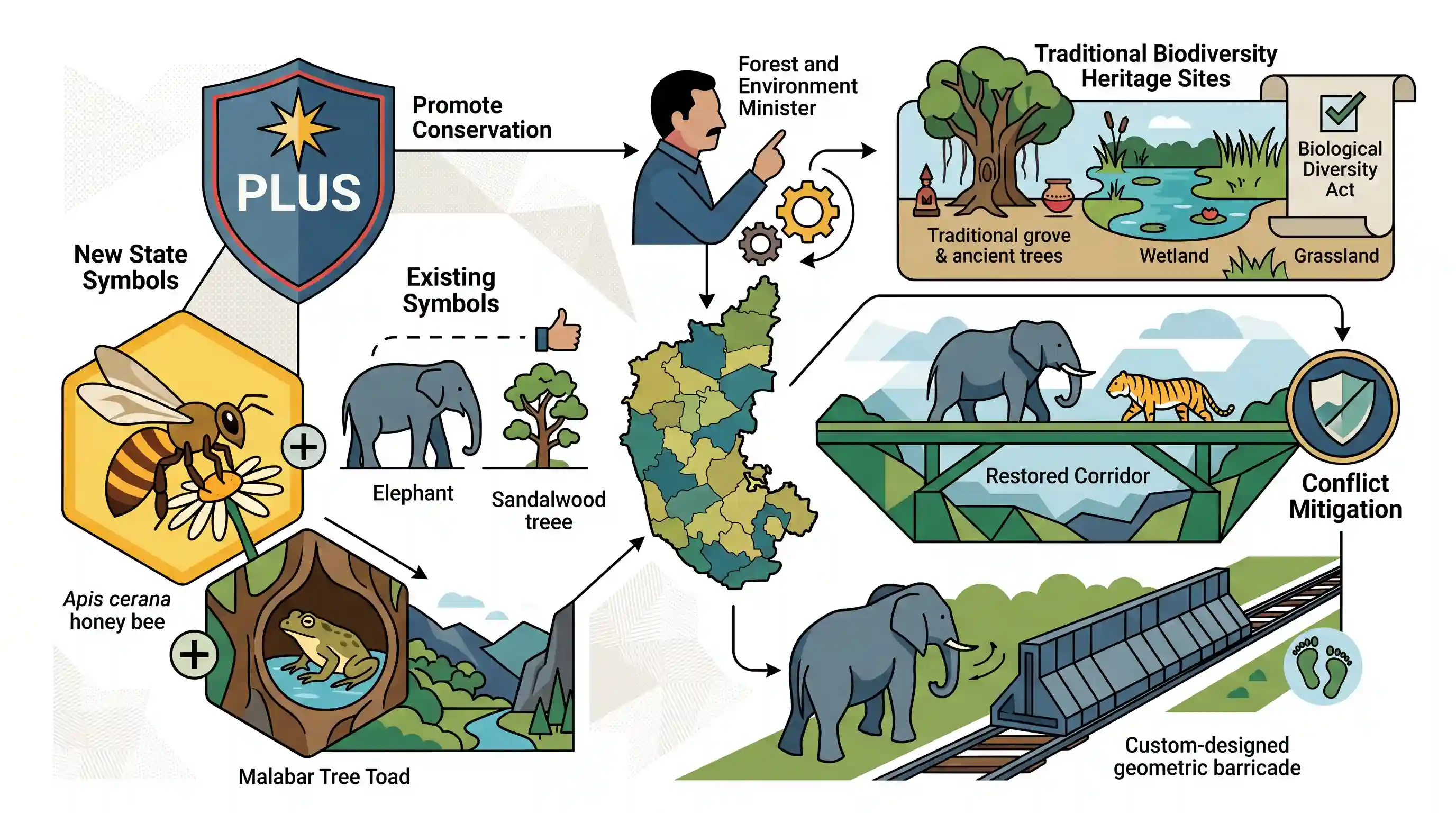
Why It Matters
The declaration of state symbols highlights region-specific endemic species, a common factual testing area for UPSC Prelims. Additionally, the focus on biodiversity heritage sites and restoration of wildlife corridors aligns perfectly with GS3 Environment topics on conservation strategies and human-animal conflict mitigation.
Summary
Karnataka is preparing to designate the Apis cerana as its State insect and the Malabar Tree Toad as its State amphibian to promote conservation. These additions will join existing symbols like the elephant and sandalwood tree. The Forest and Environment Minister highlighted the State's efforts in identifying traditional biodiversity heritage sites under the Biological Diversity Act and emphasized the ongoing work to mitigate man-animal conflict by restoring tiger and elephant corridors and installing railway barricades.
Key Points
- Karnataka will declare the Apis cerana (honey bee) as the State insect and the Malabar Tree Toad as the State amphibian.
- They join the ranks of Karnataka's existing State symbols: sandalwood (tree), elephant (animal), Indian Roller (bird), and Southern Birdwing (butterfly).
- Karnataka has declared four traditional biodiversity heritage sites: Nallur Tamarind Grove, GKVK campus, Ambaragudda, and Mamadapur plant sanctuary.
- To mitigate human-wildlife conflict, the state government has allocated ₹150 crore for railway barricades and is clearing forest encroachments to restore elephant and tiger corridors.
Important Terms
Biological Diversity Act, 2002

Enacted to fulfill the 1992 Convention on Biological Diversity (CBD) goals, this legislation regulates access to biological resources, ensures fair benefit-sharing, and establishes a three-tier institutional structure (NBA, SBBs, and BMCs).
UPSC context
GS Paper 3: Environment/Biodiversity. Crucial for questions on conservation legal frameworks, sustainable resource management, and India's international environmental commitments.
Apis cerana
Commonly known as the Indian Honey Bee, this indigenous social bee is a primary pollinator in South Asia, essential for crop yields and the ‘Sweet Revolution’ apiculture initiative.
UPSC context
GS Paper 3: Agriculture/Biodiversity. Relevant for topics on pollination services, indigenous species protection, and state-level conservation symbols.
Malabar Tree Toad
An endangered, arboreal amphibian endemic to the Western Ghats. Known as an indicator species, its health reflects the integrity of the fragile evergreen forest ecosystems it inhabits.
UPSC context
GS Paper 3: Biodiversity. Important for questions on Western Ghats endemism, indicator species, and the significance of official state fauna designations.
Biodiversity Heritage Sites (BHS)
Notified under Section 37 of the Biological Diversity Act, these are unique, fragile ecosystems (terrestrial or marine) with high endemism or cultural value, managed through community participation.
UPSC context
GS Paper 3: Conservation. Tests knowledge of community-led conservation models and the decentralised legal powers of state governments in protecting unique habitats.
Railway Barricades
A physical mitigation strategy using decommissioned rail tracks to prevent elephants from entering human settlements, aimed at reducing crop raiding and human-elephant fatalities.
UPSC context
GS Paper 3: Environment/HWC. Represents structural solutions for human-wildlife conflict; often debated for its impact on natural migration and connectivity.
Human-Wildlife Conflict (HWC)
Defined as interactions between humans and wildlife leading to negative impacts on either side. Mitigation focuses on corridor restoration, early-warning systems, and community-led coexistence.
UPSC context
GS Paper 3: Environment. A recurring theme in ethics and environment papers regarding the balance between development, habitat preservation, and human safety.
Prelims Trap
Biodiversity Heritage Sites are notified by the Central Government under the Environment (Protection) Act, 1986.
BHS are notified by State Governments in consultation with local bodies under Section 37 of the Biological Diversity Act, 2002, not by the Centre under the EPA.
Static Concepts Connected
What is the legal framework for Biodiversity Heritage Sites (BHS)?
- Statutory backing: Notified under Section 37 of the Biological Diversity Act, 2002.
- Notifying authority: State Governments notify BHS in consultation with local bodies, not the Central Government.
- Management rules: The State Government frames rules for the management and conservation of all BHS.
What is the 3-tier institutional structure of the Biological Diversity Act, 2002?
- National level: National Biodiversity Authority (NBA) advises the Central Government and regulates access to biological resources.
- State level: State Biodiversity Boards (SBBs) advise State Governments and regulate access by Indians for commercial purposes.
- Local level: Biodiversity Management Committees (BMCs) are constituted by local bodies to prepare People's Biodiversity Registers (PBRs).
Cross-Topic Patterns
Western Ghats Endemism & IUCN status
The endangered Malabar Tree Toad highlights Western Ghats endemism. UPSC frequently pairs endemic amphibians or reptiles with questions about specific biosphere reserves, national parks, or eco-sensitive zones.
Mitigating linear infrastructure impacts
Discarded railway barricades and restored corridors in Karnataka showcase state-level innovations in GS3 wildlife conflict mitigation, complementing national efforts like eco-bridges and underpasses.

Expect a Prelims question testing the State Government's exclusive power to notify Biodiversity Heritage Sites under the 2002 Act.
Linked PYQs · 3
Linked PYQs · 3
- 2024PrelimsGS1
The organisms “Cicada, Froghopper and Pond skater" are:
- 2023PrelimsGS1
Consider the following statements: 1. In India, the Biodiversity Management Committees are key to the realization of the objectives of the Nagoya Protocol. 2. The Biodiversity Management Committees have important functions in determining access and benefit sharing, including the power to levy collection fees on the access of biological resources within its jurisdiction. Which of the statements given above is/are correct?
- 2017PrelimsGS1
From the ecological point of view, which one of the following assumes importance in being a good link between the Eastern Ghats and the Western Ghats?
