APEC Summit and Shifting Global Trade Architecture
Source:The Hindu ↗
Why It Matters
It offers critical insights into the shifting landscape of international trade, the erosion of traditional multilateral institutions like the WTO, and the rising prominence of regional frameworks like APEC, which is essential for understanding global economic stability and India's trade strategy.
Summary
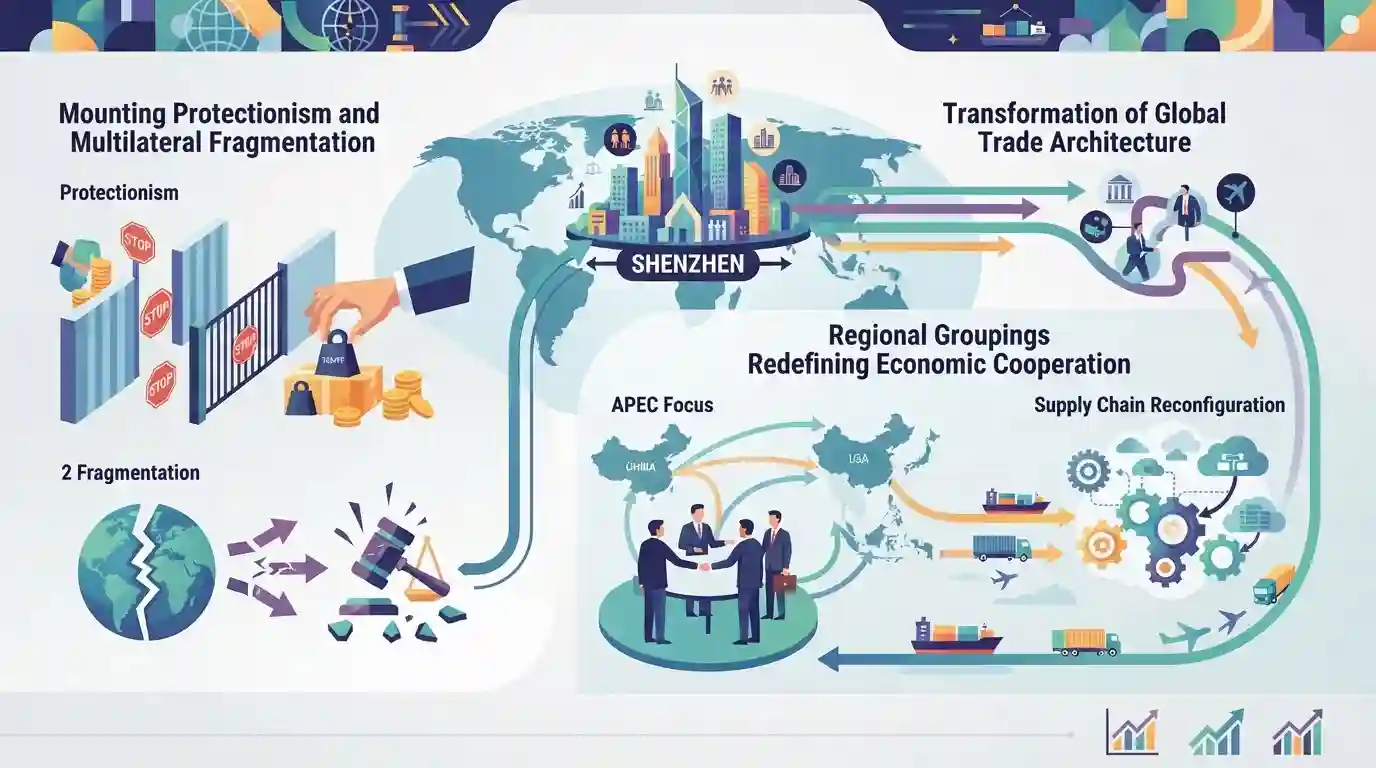
The article discusses the APEC summit held in Shenzhen, analyzing how it reflects the transformation of the global trade architecture. Amid mounting protectionism, fragmentation of multilateral institutions, and reconfiguration of global supply chains, regional groupings are playing a pivotal role in redefining international economic cooperation.
Key Points
- The APEC summit in Shenzhen highlights the shifting dynamics and changing architecture of global trade amidst rising protectionism.
- Regional economic frameworks are evolving as multilateral institutions face paralysis and geopolitical fragmentation.
- Shifting supply chains and new regional trade pacts are altering international commerce patterns, impacting emerging economies.
Important Terms
APEC

An intergovernmental forum for 21 member economies in the Asia-Pacific region that promotes free trade, economic cooperation, and regional integration through non-binding commitments and dialogue.
UPSC context
GS Paper II (International Relations - Groupings) and GS Paper III (Global Economy). Tests regional trade architecture and multilateralism.
World Trade Organization
The sole global international organization dealing with the rules of trade between nations, aiming to ensure that trade flows as smoothly, predictably, and freely as possible.
UPSC context
GS Paper II (International Institutions) and GS Paper III (Global Trade). Tests multilateral trade governance, dispute resolution, and reform.
Static Concepts Connected
What are the core principles and current paralysis issues of the World Trade Organization (WTO)?
- Core Principles: Non-discrimination through Most-Favoured-Nation (MFN) treatment and National Treatment form the bedrock of WTO rules.
- Dispute Paralysis: The Appellate Body remains paralyzed due to blockages in judge appointments, rendering the dispute settlement mechanism dysfunctional.
- Minilateral Shift: Plurilateral agreements and regional trade pacts are increasingly bypassing WTO consensus mechanisms to set new commerce standards.
Cross-Topic Patterns
WTO Paralysis + Plurilateral Trade Corridors
The erosion of WTO Most-Favoured-Nation principles mirrors the rise of plurilateral and bilateral economic corridors like the IMEC and Indo-Pacific Economic Framework.

APEC's shift toward digital trade governance and supply chain resilience will feature in multi-statement questions on minilateralism.
Linked PYQs · 3
Linked PYQs · 3
- 2025MainsGS3
What are the challenges before the Indian economy when the world is moving away from free trade and multilateralism to protectionism and bilateralism? How can these challenges be met?
- 2020MainsGS2
Quadrilateral Security Dialogue (Quad)' is transforming itself into a trade bloc from a military alliance, in present times - Discuss.
- 2018MainsGS2
What are the key areas of reform if the WTO has to survive in the present context of "Trade War', especially keeping in mind the interest of India?
