APEC and Quad Summits Shifting Global Diplomacy Trends
Source:Indian Express ↗
Why It Matters
Crucial for understanding contemporary global geopolitics, minilateralism (Quad, APEC), and India's strategic foreign policy positioning amid evolving US-China-Russia dynamics.
Summary
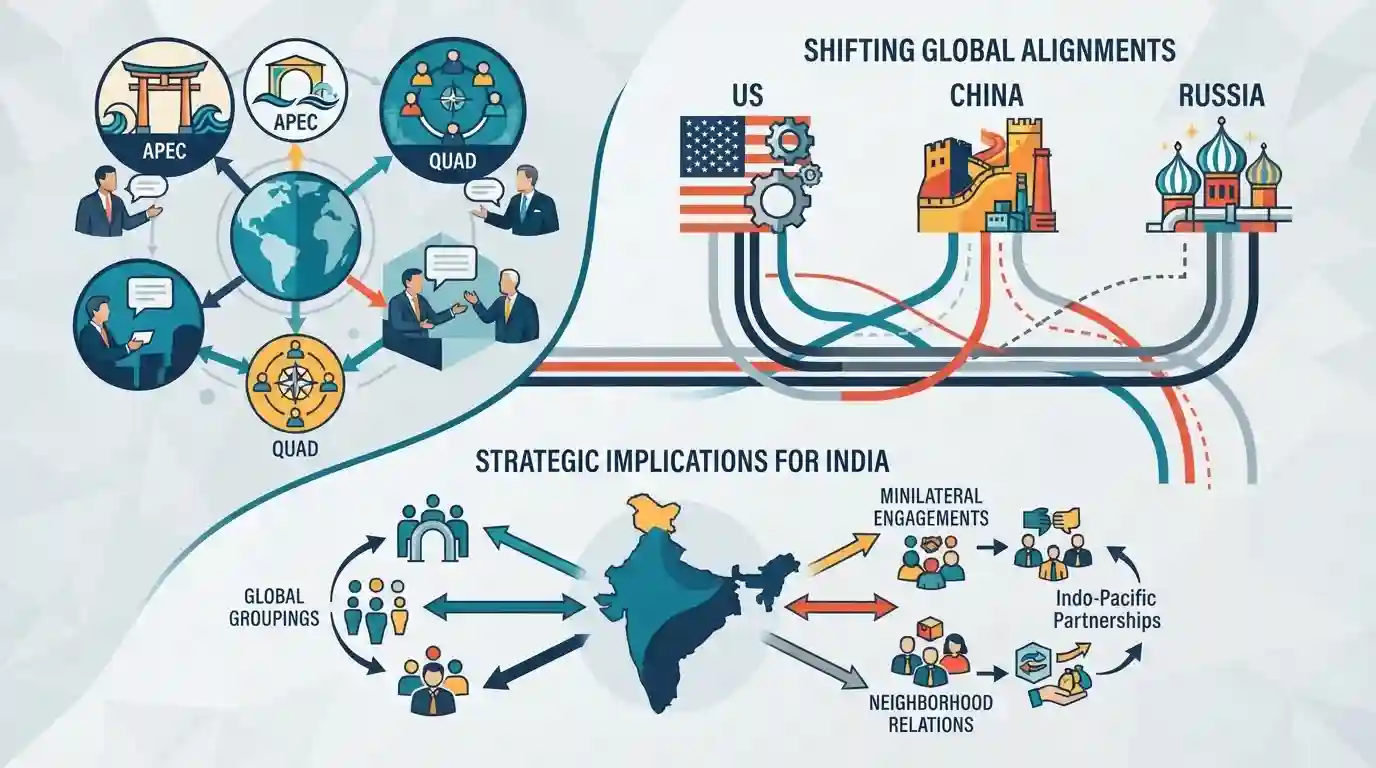
The article analyzes contemporary global diplomacy trends through recent high-level multilateral forums like APEC and Quad summits. It examines the changing nature of international relations driven by shifting alignments among major powers including the US, China, and Russia, and outlines the strategic implications for India's foreign policy and minilateral engagements.
Key Points
- Recent multilateral summits like APEC and Quad reflect major shifts in global diplomacy, characterized by transactional bilateralism and rising US-China strategic competition.
- Leader-level interactions, such as those between Xi Jinping, Donald Trump, and Vladimir Putin, underscore how personal leadership styles shape international relations and alliance management.
- For India, navigating overlapping minilateral platforms requires a careful balancing act amid shifting great power dynamics and regional security priorities in the Indo-Pacific.
Important Terms
Quad

An informal strategic forum consisting of India, the US, Japan, and Australia, aimed at maintaining a free, open, and prosperous Indo-Pacific region through minilateral cooperation.
UPSC context
GS Paper 2 - Bilateral, Regional and Global Groupings involving India and affecting India's interests. Tests Indo-Pacific strategy and minilateralism.
APEC
A regional economic forum established in 1989 to leverage economic interdependence among 21 Asia-Pacific member economies, operating on voluntary and non-binding consensus.
UPSC context
GS Paper 2 - Important International Institutions and Economic Groupings. Relevant for trade policy, regional integration, and India's non-membership status.
Prelims Trap
treaty-based military alliances or mutual defense pacts under the Quad framework
Aspirants often confuse the Quad as a formal treaty-based military alliance akin to NATO, when it is actually an informal minilateral framework avoiding mutual defense commitments.
Static Concepts Connected
What is the core mandate and evolutionary shift of the Quadrilateral Security Dialogue (Quad)?
- Origin context: Informal grouping comprising India, the US, Japan, and Australia, originally catalyzed by coordination following the 2004 Indian Ocean tsunami.
- Strategic shift: Revived in 2017, shifting from naval exercises (Malabar) to broader Indo-Pacific stability, maritime domain awareness, and countering unilateral coercion.
- Non-traditional domains: Expanded beyond security to critical technologies, climate resilience, resilient supply chains, and health security (Quad Vaccine Partnership).
Cross-Topic Patterns
Quad Minilateralism vs Traditional Alliances
While Quad emphasizes soft security and supply chains, overlapping groupings like AUKUS test India's traditional commitment to strategic autonomy outside formal military pacts.
APEC Economic Architecture vs Indo-Pacific Strategy
APEC focuses on trans-Pacific economic integration, contrasting with India's primary focus on RCEP avoidance and bilateral FTAs in the broader Indo-Pacific.

Expect multi-statement questions evaluating India's strategic autonomy vs minilateral alignments in the Indo-Pacific.
Linked PYQs · 2
Linked PYQs · 2
- 2020MainsGS2
Quadrilateral Security Dialogue (Quad)' is transforming itself into a trade bloc from a military alliance, in present times - Discuss.
- 2021MainsGS2
The newly tri-nation partnership AUKUS is aimed at countering China's ambitions in the Indo-Pacific region. Is it going to supersede the existing partnerships in the region? Discuss the strength and impact of AUKUS in the present scenario.
