APCRDA Initiates Grama Sabhas for Amaravati Road Planning
Source:The Hindu ↗
Why It Matters
It provides a contemporary case study on how local self-government bodies (Grama Sabhas) intersect with macro-level urban planning and statutory regional authorities (like APCRDA) during major infrastructure initiatives, such as the development of a state capital and the execution of Land Pooling Schemes.
Summary
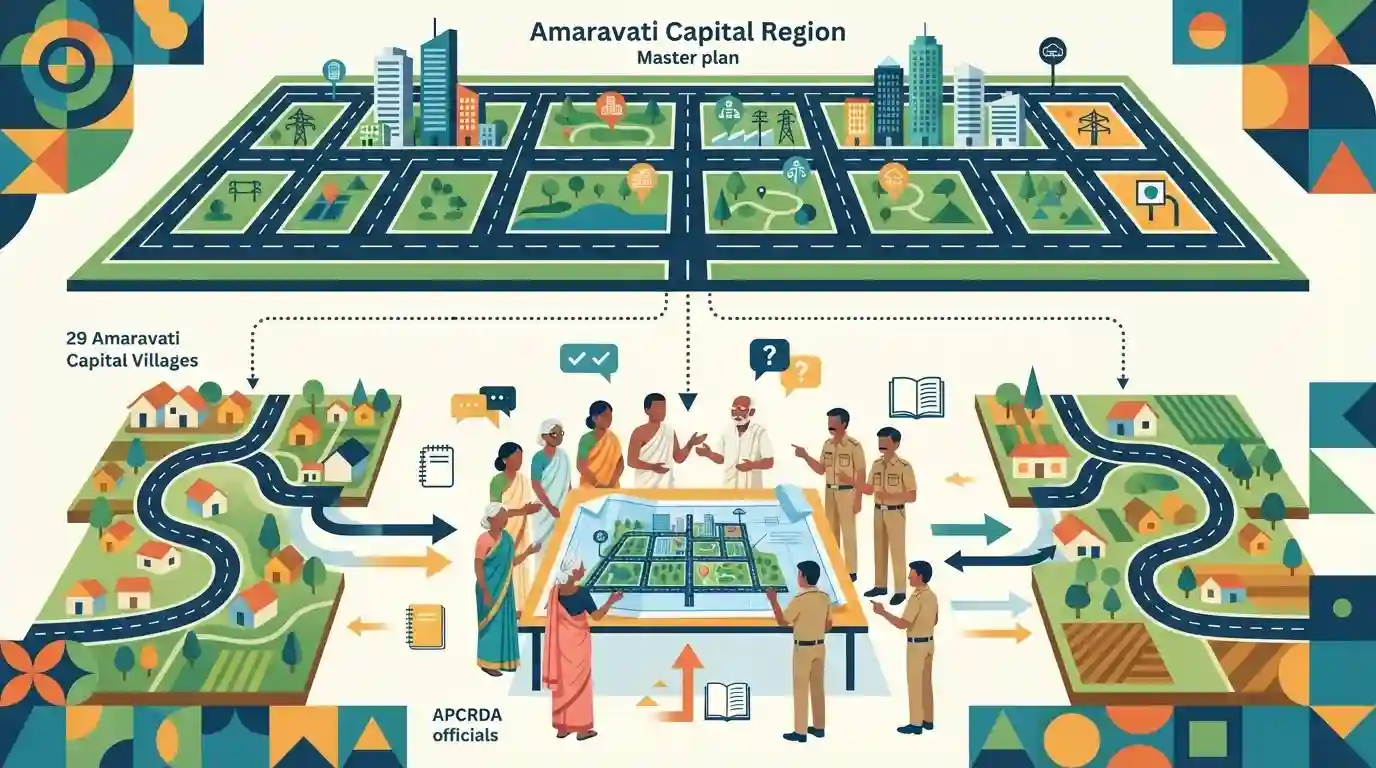
The Andhra Pradesh Capital Region Development Authority (APCRDA) has initiated Grama Sabhas across 29 Amaravati capital villages to integrate existing village roads with the broader Amaravati Master Plan road network in Land Pooling Scheme (LPS) zones. By sharing draft plans with village secretariats to gather local feedback, the initiative highlights the crucial role of decentralized, participatory governance in large-scale urban infrastructure and regional planning.
Key Points
- The APCRDA has launched Grama Sabhas in 29 Amaravati capital villages to finalize village circulation and integration plans.
- The primary goal is to seamlessly integrate existing village road networks with the newly proposed road systems in the Land Pooling Scheme (LPS) zones.
- Draft plans were shared with village secretariats to gather feedback and objections from local residents, demonstrating decentralized participatory planning.
- The initiative highlights the operational synergy required between local self-government institutions (Grama Sabhas) and regional urban development authorities for large-scale infrastructure projects.
Important Terms
Grama Sabha

A village assembly comprising all registered voters within a Panchayat area. It is the foundational body of participatory democracy in India, playing a direct role in reviewing budgets, planning local development, and conducting social audits.
UPSC context
GS-2 (Polity). Central to understanding direct democracy, the 73rd Amendment, and grassroots local self-governance.
Land Pooling Scheme (LPS)
An urban development model where landowners voluntarily assemble fragmented parcels for an authority. The authority builds infrastructure and returns reconstituted, fully serviced plots of higher value to the original owners instead of forcing cash compensation.
UPSC context
GS-3 (Infrastructure). Highly relevant as a sustainable alternative to compulsory land acquisition for urban development.
73rd Constitutional Amendment Act
Enacted in 1992, it granted constitutional status to Panchayati Raj Institutions in India. It mandates a three-tier local governance structure, regular elections, and seat reservations for marginalized groups and women, ensuring decentralization.
UPSC context
GS-2 (Polity). Essential for questions on local governance, democratic decentralization, and political empowerment.
Andhra Pradesh Capital Region Development Authority (APCRDA)
A statutory urban planning agency responsible for the development, administration, and implementation of the Master Plan for Amaravati, including managing infrastructure projects, land pooling schemes, and engaging with local communities.
UPSC context
GS-2/3. Serves as a strong case study for statutory bodies executing large-scale regional planning and urbanization.
Amaravati Master Plan
A comprehensive urban blueprint for developing Andhra Pradesh's greenfield capital. It features integrated road networks, sustainable infrastructure, and designated zones formulated through models like the Land Pooling Scheme and local stakeholder participation.
UPSC context
GS-1/3 (Urbanization). An excellent example for mains answers regarding greenfield city development and participatory urban planning.
Prelims Trap
"Gram Sabha comprises all adult residents living within the Panchayat area."
Under Article 243A, the Gram Sabha strictly consists only of persons registered in the electoral rolls relating to a village, not merely all adult residents.
Static Concepts Connected
How do District and Metropolitan Planning Committees differ constitutionally?
- DPC (Art 243ZD): Mandates at least 4/5ths of members be elected by and from elected Panchayat and Municipality members in the district.
- MPC (Art 243ZE): Mandates at least 2/3rds of members be elected by and from elected Municipality members and Panchayat Chairpersons in the metro area.
What is the core difference between Land Pooling (LPS) and Land Acquisition?
- Mechanism: LPS is a voluntary surrender where owners get a fraction of developed land back; acquisition is a compulsory state purchase.
- Compensation: LPS provides reconstituted plots plus an annuity; the LARR 2013 Act mandates upfront monetary compensation (2x-4x market value) and rehabilitation.
Cross-Topic Patterns
Peri-urban Governance voids
The clash or cooperation between State Development Authorities (like APCRDA) and PRIs highlights the 'peri-urban' governance gap, a recurring GS2 urbanization theme.
Land Pooling vs Tenant Farmers
While Land Pooling bypasses LARR hurdles for landowners, it connects to GS3 agriculture themes by often excluding landless agricultural laborers and tenant farmers from structural asset benefits.

The constitutional distinction between DPC (4/5ths elected) and MPC (2/3rds elected) is a prime candidate for a deceptive Prelims statement.
Linked PYQs · 3
Linked PYQs · 3
- 2024APPSC_PRELIMSGS1
Which of the following source/sources of revenue qualifies/qualify for being given to the Panchayats? I. The tax proceeds that are assigned to the States from the Centre may be again re-distributed to the Panchayats as recommended by the Central Finance Commission. II. Loans from the State Government. III. Under Article 243-I of the Constitution of India, the State Government is empowered to devolve its own funds to the Panchayats even in the absence of the State Finance Commission's recommendations. IV. Internal Resource Generation is facilitated only in the case of Panchayats situated in Scheduled Areas as per the Fifth Schedule. Select the correct answer using the codes given below:
- 2024APPSC_PRELIMSGS1
Consider the following Assertion (A) and Reason (R) and choose the correct code : Assertion (A) : In connection with their own resource collection, the Panchayats at the village level are better placed than the Panchayats at the Intermediate and the District levels. Reason (R) : The Gram Panchayats have their own tax domain whereas the other two tiers have to depend only on tolls, fees and non-tax revenue for internal resource generation. Code :
- 2024APPSC_PRELIMSGS1
In connection with the Urban Infrastructure Development Fund (UIDF), which of the following statement/statements is/are valid? I. The fund will be established through reserved bonds taken from the G-Sec market. II. The fund is to be exclusively availed by private agencies to create urban infrastructure in Tier 2 and Tier 3 cities. III. Eligible activities for UIDF shall be connected to the Missions and Programmes of the Ministry of Housing | Urban Affairs (MoHUA). IV. The fund will be collectively managed by a cluster of Municipal Cooperative Banks. Select the correct answer using the codes given below:
