Visakhapatnam Port Air Pollution and Green Port Guidelines
Source:uni-india ↗
Why It Matters
Highlights the environmental challenges associated with port-led industrialization and the critical role of geographical topography in pollution dispersion, emphasizing sustainable infrastructure policies like the Harit Sagar Guidelines.
Summary
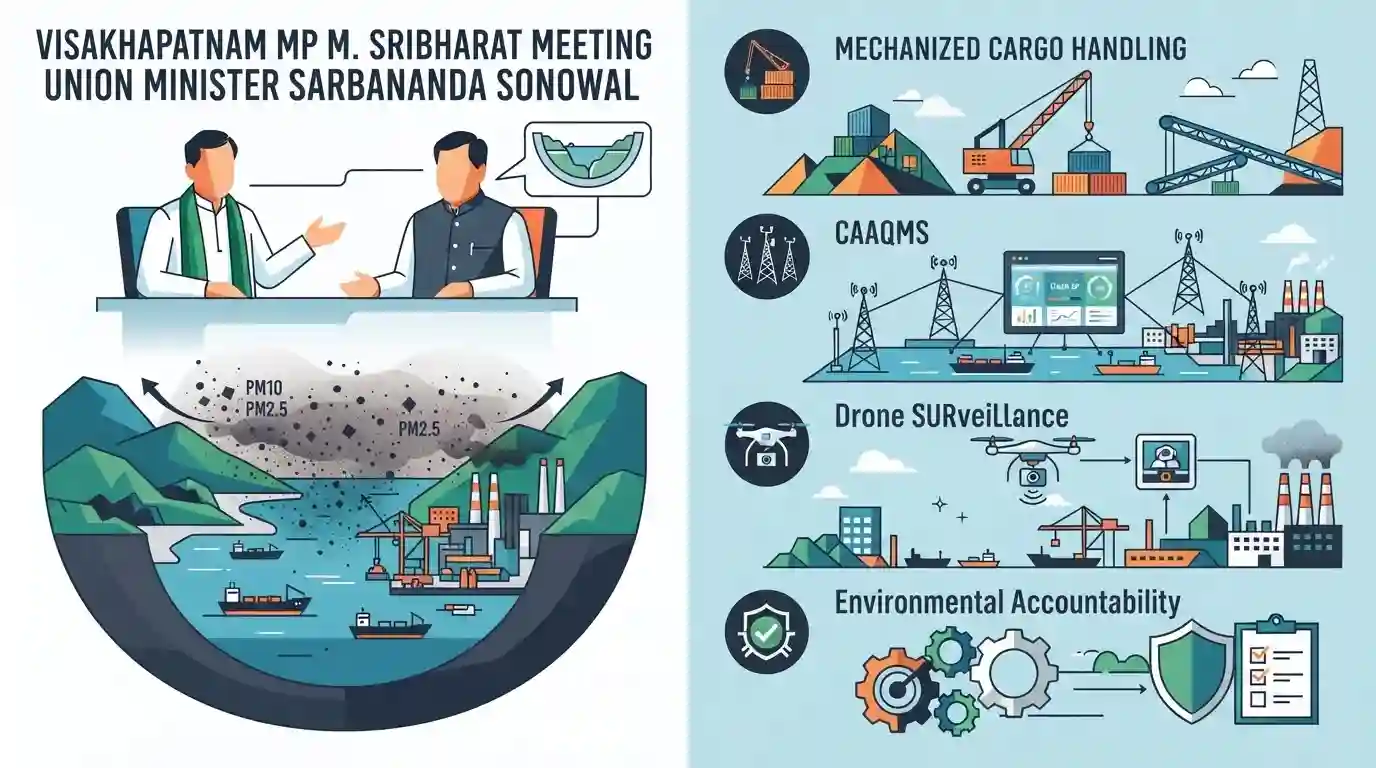
Visakhapatnam MP M. Sribharat met Union Minister Sarbananda Sonowal to seek the Centre's intervention in curbing severe air pollution linked to port operations in Vizag. Highlighting the city's bowl-shaped topography, which traps particulate matter (PM10 and PM2.5), the MP advocated for strict mitigation measures and the speedy implementation of the Harit Sagar – Green Port Guidelines, 2023. Proposed solutions include mechanized cargo handling, Continuous Ambient Air Quality Monitoring Stations (CAAQMS), drone surveillance, and a robust environmental accountability framework.
Key Points
- Visakhapatnam MP M. Sribharat urged the Centre to implement time-bound measures to control air pollution resulting from port operations in the city.
- Vizag’s unique bowl-shaped topography traps airborne pollutants, exacerbating PM10 and PM2.5 levels generated from bulk cargo handling.
- The MP emphasized the urgent implementation of the Harit Sagar – Green Port Guidelines (2023) to balance port-led development with environmental protection.
- Suggested interventions include enclosed conveyor systems, automated dust suppression, Continuous Ambient Air Quality Monitoring Stations (CAAQMS), and drone-based surveillance.
Important Terms
Harit Sagar – Green Port Guidelines, 2023

Environmental guidelines launched by the Ministry of Ports, Shipping, and Waterways to foster carbon neutrality, waste minimization (Reduce, Reuse, Recycle), and renewable energy adoption across Indian ports.
UPSC context
GS Paper III (Infrastructure, Environment); tests strategies for greening national logistics and achieving net-zero emissions.
Ministry of Ports, Shipping and Waterways
The apex Indian union ministry responsible for the formulation and administration of rules, regulations, and programs like Sagarmala to modernize maritime trade and port infrastructure.
UPSC context
GS Paper II (Government Policies) and GS Paper III (Infrastructure); tests knowledge of maritime planning and executive governance.
Visakhapatnam Port Authority
One of India's major maritime port authorities, located on the east coast, functioning under the Major Port Authorities Act, 2021, and critical for mineral exports.
UPSC context
GS Paper III (Infrastructure: Ports); tests understanding of autonomous major port operations and maritime logistics.
Andhra Pradesh Pollution Control Board (APPCB)
A state-level statutory body constituted under the Water (Prevention and Control of Pollution) Act, 1974, responsible for enforcing environmental laws and monitoring ambient quality.
UPSC context
GS Paper II (Statutory Bodies) and GS Paper III (Environment); tests knowledge of environmental compliance mechanisms at state levels.
Adani Gangavaram Port
A deep-draft, all-weather private greenfield port in Andhra Pradesh, equipped with advanced cargo handling facilities and subject to state environmental compliance protocols.
UPSC context
GS Paper III (Infrastructure, Private Investment); tests understanding of private sector contributions to India's maritime logistical capacity.
Prelims Trap
The 'Harit Sagar' Green Port Guidelines (2023) were formulated and are executed by the Ministry of Environment, Forest and Climate Change.
These guidelines were launched by the Ministry of Ports, Shipping, and Waterways (MoPSW) to steer major ports toward sustainable development, not MoEFCC.
Static Concepts Connected
How does a bowl-shaped topography trigger temperature inversion?
- Mechanism: At night, cold, dense air pools in topographic basins. A warmer air layer forms above it, preventing vertical air movement.
- Pollution trapping: This inversion layer acts as an atmospheric lid, keeping particulate matter (PM10 and PM2.5) locked near the surface.
What is the scope of the Harit Sagar Guidelines 2023?
- Nodal ministry: Launched by the Ministry of Ports, Shipping, and Waterways to promote green ecosystems across major Indian ports.
- Key targets: Aims for zero carbon emissions, adoption of renewable energy, continuous environmental monitoring, and zero waste discharge.
Cross-Topic Patterns
Sagarmala vs Coastal Regulation Zones
Socio-economic ambitions of port-led development under Sagarmala frequently clash with coastal ecology, necessitating rigorous Environment Impact Assessment processes.
Global maritime decarbonization goals
Domestic frameworks like Harit Sagar bridge local environmental actions with global shipping decarbonization targets set by the International Maritime Organization (IMO).

Topographical traps (inversions) and MoPSW's Harit Sagar Guidelines are highly likely to form a combined core-concept question in 2026.
Linked PYQs · 4
Linked PYQs · 4
- 2024APPSC_PRELIMSGS1
Which of the following statements are valid in connection with Andhra Pradesh Green Hydrogen and Green Ammonia Policy (2023)? I. The objective is to target Green Energy production up to the capacity of 1 MPTA (Million Tonnes Per Annum) or Green Ammonia production up to the capacity of 2-0 MTPA in the next five years. II. New and Renewable Energy Development Corporation of A.P. Ltd (NREDCAP) shall act as a Nodal Agency under this policy. III. All the Ports in the State have infrastructure for storing liquid nitrogen which can then be utilized for storing Green Hydrogen for exporting to other countries. IV. The Policy prohibits the production of Green Hydrogen/Green Ammonia by using Renewable Energy and/or Biomass from 'Third-Party/Power exchange'. Select the correct answer using the codes given below :
- 2024APPSC_PRELIMSGS1
The Interim Union Budget (FY25) has proposed initiatives to boost India's Green Energy Sector. Which of the following proposals are connected with developing India's Green Energy ? I. Viability Gap Funding (VGF) for utilizing solar energy projects II. To set up coal gasification and liquefaction capacity of 100MT by 2030 III. Optional blending of Compressed Bio Gas (CBG) in Compressed Natural Gas (CNG) for transport and Piped Natural Gas (PNG) for domestic purposes IV. Provision of financial assistance for procurement of biomass aggregation machinery V. Setting up of a payment security system for expanding the bio-manufacturing system in the country Select the correct answer using the codes given below :
- 2012APPSC_PRELIMSGS1
Agent of Air Pollution is
- 2023APPSC_PRELIMSGS1
Arrange the following constituents of the atmosphere in descending order (in terms of their quantity) :
