Andhra Pradesh to launch Operation Clean Sweep for sanitation
Source:The Hindu ↗
Why It Matters
This state-level initiative serves as an excellent case study for Mains answers on the functionality of Urban Local Bodies (GS2), solid waste management challenges (GS3), and pre-monsoon urban flood mitigation strategies (GS3). It highlights the shift toward outcome-oriented, technology-monitored local governance.
Summary
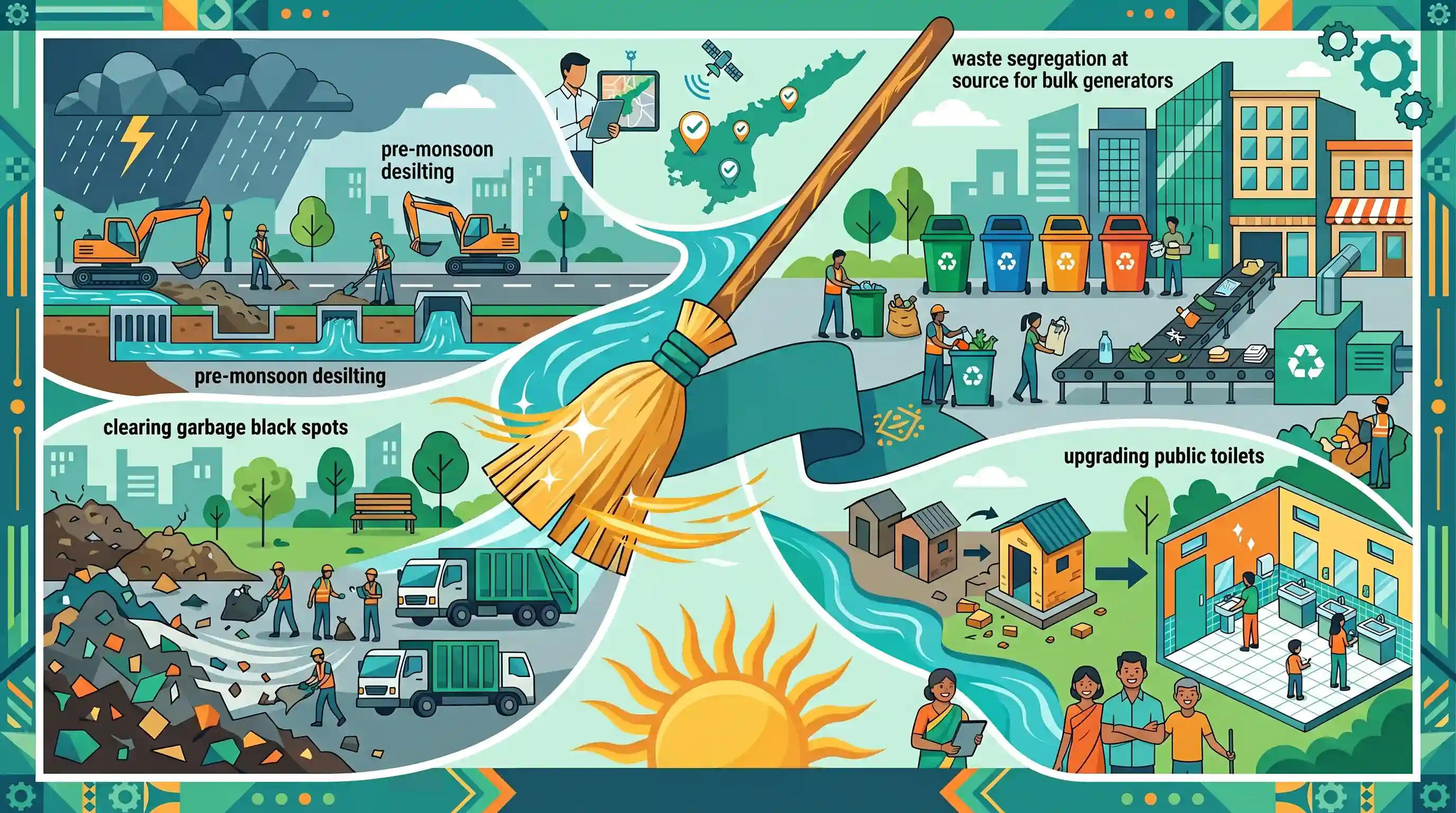
Andhra Pradesh is set to launch 'Operation Clean Sweep', an intensive month-long sanitation drive across all its 123 Urban Local Bodies (ULBs) starting May 23, 2026. Spearheaded by the Municipal Administration and Urban Development Department, the initiative aims to shift urban sanitation from a routine chore to an outcome-oriented mission under the broader 'Swarna Andhra–Swachh Andhra' (SASA) vision. The drive involves a four-phase strategy: clearing garbage black spots, pre-monsoon desilting of stormwater drains to prevent urban flooding, enforcing waste segregation at source for bulk generators, and upgrading public toilets. The mission emphasizes strict geo-tagged monitoring by District Collectors and aims to foster lasting behavioral change among citizens regarding solid waste management and civic hygiene.
Key Points
- The Andhra Pradesh government is launching 'Operation Clean Sweep' across all 123 Urban Local Bodies (ULBs) from May 23 to June 20, 2026.
- The initiative aims to transition urban sanitation from routine daily tasks to a targeted, outcome-oriented mission focusing on visible and sustained cleanliness.
- The program will be executed in four phases: eradication of garbage black spots, pre-monsoon desilting of stormwater drains, enforcement of waste segregation at source (especially for bulk generators), and deep cleaning of public toilets with aesthetic transformation of garbage vulnerable points.
- The campaign aligns with the 'Swarna Andhra–Swachh Andhra' (SASA) vision and heavily emphasizes behavioral change among citizens and institutions.
- Implementation will be strictly monitored through geo-tagged reporting by Municipal Commissioners under the oversight of District Collectors.
Important Terms
Urban Local Bodies (ULBs)

The third tier of governance in cities/towns, constitutionalized by the 74th Amendment Act. They are responsible for 18 functional items including sanitation and solid waste management.
UPSC context
GS-II (Polity/Governance): Tests knowledge of democratic decentralization and the 12th Schedule of the Constitution.
Operation Clean Sweep
A month-long mission-mode sanitation drive in Andhra Pradesh (May 2026) targeting 123 urban centers for intensive garbage clearance, drain desilting, and source segregation enforcement.
UPSC context
GS-II/III (Governance/Environment): A contemporary case study of state-level initiatives in urban waste management and civic hygiene.
Swarna Andhra–Swachh Andhra (SASA)
A long-term state vision aiming to transform Andhra Pradesh into a clean, green, and sustainable model state by 2047, aligned with national Swachh Bharat Mission goals.
UPSC context
GS-II (Govt Policies): Relevant for questions on state-specific development visions and sustainable urban growth.
Solid Waste Management Rules
The statutory framework (2016/2026) governing waste handling, mandating the "Polluter Pays" principle and scientific segregation into wet, dry, sanitary, and special care waste streams.
UPSC context
GS-III (Environment): Core topic for pollution control, waste-to-wealth, and circular economy concepts.
Urban Flooding
Inundation caused by heavy rainfall exceeding the capacity of urban drainage systems; often mitigated by pre-monsoon desilting and clearing of natural nallahs/water bodies.
UPSC context
GS-III (Disaster Management): Tests understanding of climate-induced disasters and proactive mitigation strategies.
Source Segregation
The act of dividing waste into distinct categories (biodegradable, non-biodegradable, etc.) at the point of origin to facilitate scientific recycling and reduce landfill load.
UPSC context
GS-III (Environment): Key technical requirement for efficient municipal waste management and environmental sustainability.
Prelims Trap
"'Operation Clean Sweep' is a Union Ministry of Housing and Urban Affairs initiative under SBM-U 2.0"
Aspirants may confuse this state-level operation with a pan-India initiative under the Swachh Bharat Mission. It is strictly an Andhra Pradesh state government drive.
Static Concepts Connected
What is the constitutional mandate for ULBs regarding urban sanitation?
- 12th Schedule: Added by the 74th Amendment Act, it lists 18 functional items for municipalities, including 'public health, sanitation conservancy and solid waste management' (Item 6).
- Article 243W: Empowers state legislatures to formally endow municipalities with the necessary powers and authority to perform the functions listed in the 12th Schedule.
How do the Solid Waste Management Rules, 2016 regulate 'Bulk Waste Generators'?
- Definition: Includes entities (hotels, RWAs, govt departments) generating over 100kg of waste daily.
- Mandatory Segregation: Must strictly segregate waste at source into three streams: biodegradable (wet), non-biodegradable (dry), and domestic hazardous waste.
- On-site Processing: Required to set up infrastructure to process biodegradable waste within their premises or hand it over to authorized local body agencies.
Cross-Topic Patterns
Solid Waste & Urban Flooding Nexus
Pre-monsoon desilting highlights how unsegregated solid waste choking stormwater drains is a primary driver of urban flooding, linking Solid Waste Management to NDMA urban disaster guidelines.
Geo-spatial Tracking in Local Governance
The mandate for geo-tagged reporting by Municipal Commissioners reflects a growing governance trend of utilizing spatial data technology to enforce accountability and track outcomes in grassroots administration.

SWM Rules 2016 (focusing on 'bulk waste generators') and 12th Schedule sanitation functions are ripe for a mixed-statement Prelims Q.
Linked PYQs · 4
Linked PYQs · 4
- 2024MainsGS2
Analyse the role of local bodies in providing good governance at local level and bring out the pros and cons merging the rural local bodies with the urban local bodies.
- 2020MainsGS2
The strength and sustenance of local institutions in India has shifted from their formative phase of 'Functions, Functionaries and Funds' to the contemporary stage of 'Functionality'. Highlight the critical challenges faced by local institutions in terms of their functionality in recent times.
- 2018MainsGS3
What are the impediments in disposing the huge quantities of discarded solid wastes which are continuously being generated? How do we remove safely the toxic wastes that have been accumulating in our habitable environment?
- 2024MainsGS3
Flooding in urban areas is an emerging climate-induced disaster. Discuss the causes of this disaster. Mention the features of two such major floods in the last two decades in India. Describe the policies and frameworks in India that aim at tackling such floods.
