Steam rice PDS distribution rollout in Andhra Pradesh districts
Source:deccan-chronicle ↗
ఇది ఎందుకు ముఖ్యం
This highlights an intersection between food security reform and advanced technology application (RFID, CBDC) in governance. It is highly relevant for state-specific policy questions and broader GS3 themes encompassing agricultural procurement, PDS leakages, and digital payment frameworks.
సారాంశం
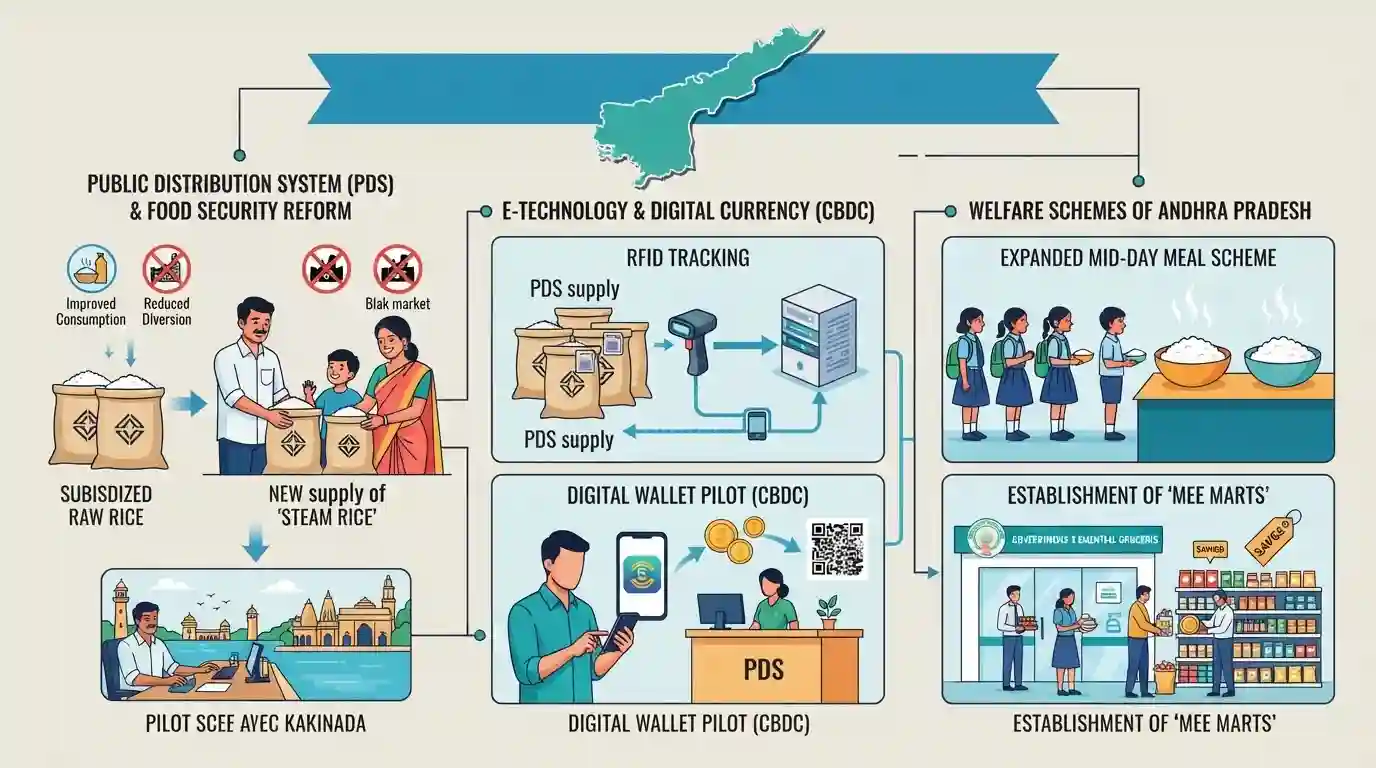
Andhra Pradesh has launched a pioneering initiative to supply 'steam rice' through the Public Distribution System (PDS), aiming to improve consumption patterns and reduce black-market diversions. Piloted in Kakinada, the program addresses beneficiary feedback indicating a strong preference for steam rice over subsidized raw rice. The state is coupling this food security reform with advanced e-governance measures, including RFID tracking of PDS supplies and a CBDC-based digital wallet pilot in select districts. Further welfare steps involve the expansion of the Dokka Seethamma Mid-Day Meal Scheme and the establishment of 'Mee Marts' to provide essential commodities at subsidized rates, helping buffer the public against inflation.
ముఖ్య అంశాలు
- Andhra Pradesh has become the first state in India to distribute steam rice via the Public Distribution System (PDS), starting with a pilot project in Kakinada district.
- The shift to steam rice was initiated because beneficiaries preferred it over raw rice, which was often unused or diverted to the black market despite a heavy subsidy of ₹56 per kilogram.
- The central government has agreed to enhance AP's boiled rice procurement quota by an additional 20,000 metric tonnes to support local farmers and public needs.
- In addition to launching 1,000 Mee Marts with the NCCF for affordable essential commodities, the government is expanding the Dokka Seethamma Mid-Day Meal Scheme.
- Technology integration includes an RFID-based tracking pilot in Kakinada to curb PDS diversions and a trial of a Central Bank Digital Currency (CBDC)-based digital wallet in Krishna and Visakhapatnam.
ముఖ్యమైన పదాలు
Public Distribution System (PDS)

A state-administered food-subsidy mechanism that procures essential commodities and distributes them to vulnerable households through a nationwide network of Fair Price Shops.
UPSC context
GS-3 (Economy). Core to India's food security, NFSA compliance, subsidy management, and technology-led PDS reforms.
Food Corporation of India (FCI)
A statutory body under the Ministry of Consumer Affairs responsible for procuring, storing, and distributing food grains nationwide to maintain buffer stocks and supply the PDS.
UPSC context
GS-3 (Agriculture). Central to topics on Minimum Support Price (MSP), buffer stocking policies, and food security infrastructure.
Mee Marts
An Andhra Pradesh initiative establishing 1,000 retail outlets linked to Fair Price Shops. They offer over 250 daily consumer goods at subsidized rates to counter inflation.
UPSC context
GS-3 (Economy). Showcases modernizing the PDS network and utilizing state interventions for consumer price stabilization.
Dokka Seethamma Mid-Day Meal Scheme
An Andhra Pradesh welfare program providing nutritious meals and millet-based snacks to government school and junior college students to improve attendance and combat malnutrition.
UPSC context
GS-2 (Social Justice). Highlights state-level interventions for education, nutrition, and human capital development.
National Cooperative Consumers' Federation of India (NCCF)
Established in 1965, it is the apex body of consumer cooperatives in India, functioning under the Ministry of Consumer Affairs to distribute essential commodities and stabilize market prices.
UPSC context
GS-3 (Economy). Tests knowledge of cooperative societies, supply chain management, and government mechanisms to control inflation.
ప్రిలిమ్స్ ఉచ్చు
The Digital Rupee used in state welfare digital wallets represents a commercial bank liability.
CBDC (e₹) is a direct liability of the RBI, not a commercial bank. It functions as sovereign digital cash, unlike UPI balances.
అనుసంధానమైన స్థిర భావనలు
How is the Public Distribution System (PDS) structurally governed in India?
- Joint Responsibility: Centre procures, stores, and allocates food grains; States identify beneficiaries and distribute them through Fair Price Shops.
- Local Oversight: Listed as one of the 29 functional items in the 11th Schedule, devolving operational oversight to Panchayati Raj Institutions.
- Tech Integration: Transitioning to 'End-to-End Computerization' via Aadhaar-seeded ePoS, GPS, and RFID tracking to eliminate ghost beneficiaries and black-market diversions.
What is the mandate and structure of the NCCF?
- Apex Cooperative: Serves as the apex body of consumer cooperatives across India to procure, distribute, and stabilize prices of essential commodities.
- Legal Status: Registered under the Multi-State Co-operative Societies Act, 2002, functioning as a cooperative society rather than a statutory corporation.
- Nodal Ministry: Operates directly under the Ministry of Consumer Affairs, Food and Public Distribution.
అంతర-అంశ నమూనాలు
CBDC + Purpose-Bound Subsidies
Integrating CBDC into state welfare bridges monetary policy tech with fiscal subsidy delivery, enabling programmable 'purpose-bound' money that structurally prevents scheme diversion.
PDS Tech vs PRI Social Audits
PDS is Item 28 in the 11th Schedule. Top-down tech interventions like RFID and e-wallets frequently intersect with the constitutional mandate for bottom-up Panchayat-level social audits.

A 2026 multi-statement Prelims question will likely blend CBDC's core features (RBI liability) with its programmable welfare use-cases.
అనుసంధాన PYQలు · 4
అనుసంధాన PYQలు · 4
- 2024APPSC_PRELIMSGS1
With regard to the progress of Digital Payments in India, which of the following statement/statements is/are valid? I. Promotion of Digital Payments has been transferred from the Ministry of Electronics and Information Technology (MeitY) to the Department of Financial Services. II. e-RUPI is an institution-based voucher management system instead of being person and purpose specific. III. 'Hello! UPI' is an AI voice-enabled payment feature built by a consortium of private sponsored startups recognised by the NPCI. IV. 'UPI LITE X' addresses challenges of remote areas by enabling offline UPI payments. Select the correct answer using the codes given below:
- 2023APPSC_PRELIMSGS1
Which of the following subjects are listed in the 11th Schedule? I. Women and Child Development II. Public Distribution System III. Libraries IV. Slum Improvement and Upgradation V. Markets and Fairs Choose the correct answer using the codes given below:
- 2024APPSC_PRELIMSGS1
In the context of India's fight against poverty, consider the following statements: I. Unlike the Global Multidimensional Poverty Index (MPI), the National Multidimensional Poverty Index (MPI) developed by NITI Aayog does not make use of 'Alkire-Foster' (AF) methodology. II. The urban population witnessed a larger decline in poverty as compared to the rural population. III. Pradhan Mantri Garib Kalyan Package (PMGKP) includes the coverage of food grain entitlements. IV. The Multidimensional Poverty Index (MPI) is computed by adding the incidence of multidimensional poverty and the intensity of poverty. Which of the above statement/statements is/are valid?
- 2019APPSC_PRELIMSGS1
In relation to Andhra Pradesh, which of the following applications has received CSI Nihilent Best e-governance Award during the year 2017 - 18 ?
