Electric Mobility Policy Guidelines Revised to Attract Investment
Source:the-hans-india ↗
ఇది ఎందుకు ముఖ్యం
Understanding state-level industrial and sectoral policies is crucial for APPSC GS1 Economic Development. Questions frequently test specific targets, mechanisms, and guidelines of key AP state policies, such as the EV Policy, Industrial Policy, and Green Hydrogen policies.
సారాంశం
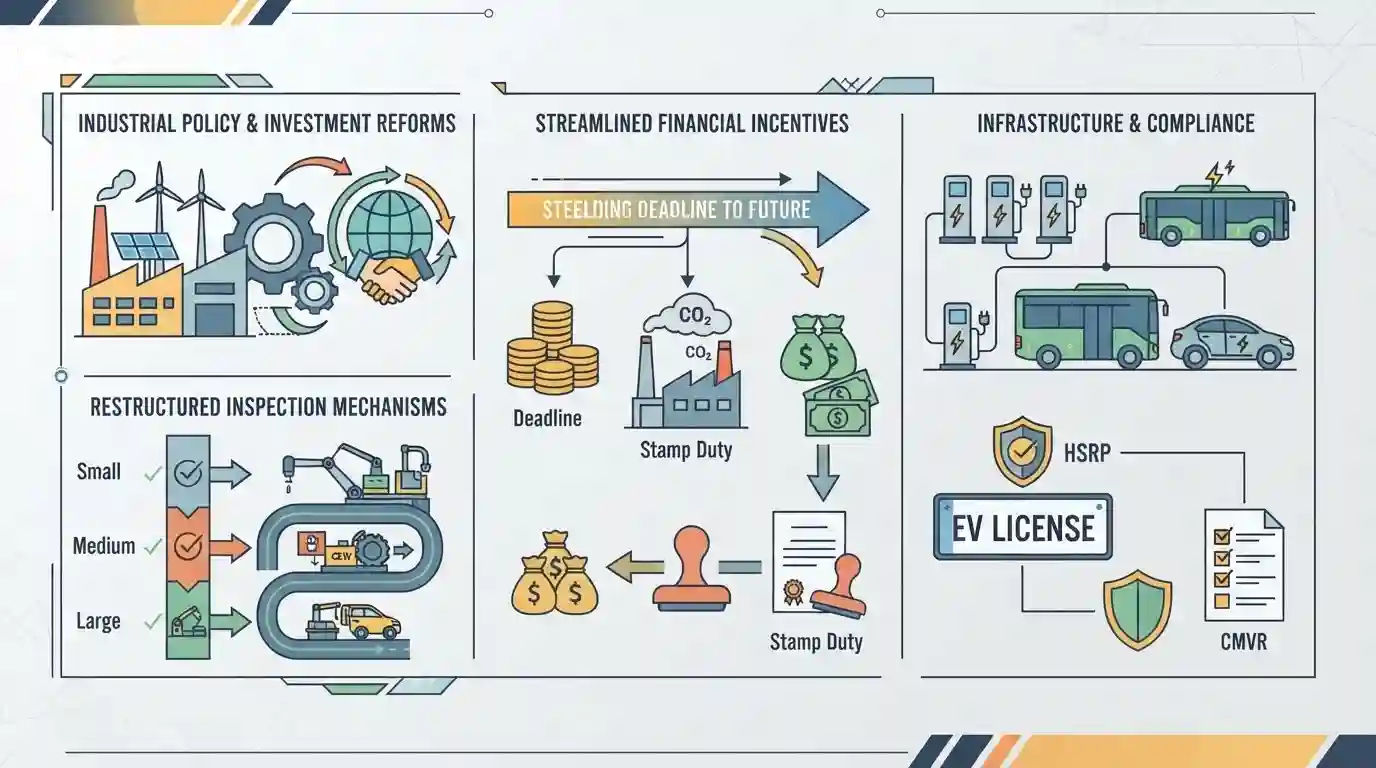
The Andhra Pradesh State government has introduced key modifications to the operational guidelines of the Sustainable Electric Mobility Policy (4.0) 2024-29 to remove procedural hurdles and attract investments in EV manufacturing and charging infrastructure. The updated guidelines restructure inspection mechanisms into three investment tiers, extend the deadline for claiming financial incentives such as decarbonisation subsidies and stamp duty reimbursements, and mandate CMVR compliance for EV purchase incentives linked to High Security Registration Plates.
ముఖ్య అంశాలు
- The AP government has revised operational guidelines for its Sustainable Electric Mobility Policy (4.0) 2024-29 to expedite EV sector investments.
- Inspection and monitoring mechanisms have been restructured into three tiers based on investment size: up to Rs 1 crore, Rs 1 crore to Rs 10 crore, and above Rs 10 crore.
- Investors now have six months from either the date of commercial production or the issuance of these guidelines to claim investment subsidies, decarbonisation subsidies, and reimbursements for stamp duty and land conversion fees.
- To claim EV purchase incentives, vehicle categorization will align with Central Motor Vehicle Rules (CMVR), and claims must be submitted within six months of acquiring a High Security Registration Plate (HSRP).
ముఖ్యమైన పదాలు
Sustainable Electric Mobility Policy (4.0) 2024-29

An Andhra Pradesh industrial policy aiming for carbon-neutral transport by 2047. It offers subsidies, land-fee waivers, and mandates EV infrastructure, like a 25% capital subsidy for charging stations and EV purchase incentives.
UPSC context
Relevant for GS Paper 3 (Industrial Policy & Sustainable Development), detailing state-level strategies to attract EV investments and reduce emissions.
Central Motor Vehicle Rules (CMVR)
Notified by the MoRTH under the Motor Vehicles Act, 1988, these rules govern safety, emission standards, licensing, registration, and administrative requirements for motor vehicles in India, ensuring national compliance.
UPSC context
GS Paper 3 (Infrastructure) and GS Paper 2 (Governance). Crucial for understanding regulatory frameworks on road safety and environmental norms.
High Security Registration Plates (HSRP)
Standardised, tamper-evident vehicle number plates introduced by the Indian government. Made of aluminium with a chromium hologram and laser-etched ID, they prevent counterfeiting and aid law enforcement tracking.
UPSC context
GS Paper 2 & 3. Tests awareness of transport governance, national security measures, and regulatory compliance under CMVR.
Decarbonisation Subsidy
Financial incentives offered to industries and manufacturers to promote clean, low-carbon production methods. In AP\'s EV policy, it targets green manufacturing and offsets capital costs for sustainable practices.
UPSC context
GS Paper 3 (Environment & Economy). Evaluates knowledge of economic tools used to achieve climate change targets and promote green investments.
ప్రిలిమ్స్ ఉచ్చు
State electric vehicle purchase subsidies are disbursed strictly through the Central Government's FAME or PM E-DRIVE frameworks.
States launch their own EV policies (like AP's Mobility Policy 4.0) offering independent purchase incentives, land conversion waivers, and decarbonisation subsidies distinct from central schemes.
అనుసంధానమైన స్థిర భావనలు
What are Scope 1, 2, and 3 emissions in carbon accounting?
- Scope 1: Direct emissions from owned or controlled sources, such as fuel burned by a state-run bus fleet.
- Scope 2: Indirect emissions from the generation of purchased electricity, steam, heating, and cooling consumed by the reporting entity.
- Scope 3: All other indirect emissions that occur in a company's or government's value chain (e.g., outsourced transport, waste disposal).
How are High Security Registration Plates (HSRP) regulated?
- Statutory Basis: Mandated under the Central Motor Vehicles Rules (CMVR), 1989, standardizing registration plates to prevent vehicle theft and fraud.
- Security Features: They include a chromium-based hologram, a unique laser-branded serial number, and a non-reusable snap-on lock.
- Link to Subsidies: State EV purchase subsidies often require strict CMVR and HSRP compliance to ensure standardized categorization and legitimate claims.
అంతర-అంశ నమూనాలు
Competitive Federalism in Green Transport
States are bypassing central schemes by creating tailored mobility hubs (like AP's river transport in Rajahmundry) and tweaking inspection tiers to attract green tech investments, reflecting competitive federalism.
Grid Density as an Urban Planning Tool
AP's mandate of 1 EV charger per 3x3 km grid bridges urban mobility with smart city infrastructure planning, a recurring theme linking GS-1 (Urbanization) and GS-3 (Energy).

Questions linking state-specific decarbonization targets (Scope 1) with Central vehicle frameworks (CMVR/HSRP) are highly probable for GS-3.
అనుసంధాన PYQలు · 3
అనుసంధాన PYQలు · 3
- 2024APPSC_PRELIMSGS1
The Interim Union Budget (FY25) has proposed initiatives to boost India's Green Energy Sector. Which of the following proposals are connected with developing India's Green Energy ? I. Viability Gap Funding (VGF) for utilizing solar energy projects II. To set up coal gasification and liquefaction capacity of 100MT by 2030 III. Optional blending of Compressed Bio Gas (CBG) in Compressed Natural Gas (CNG) for transport and Piped Natural Gas (PNG) for domestic purposes IV. Provision of financial assistance for procurement of biomass aggregation machinery V. Setting up of a payment security system for expanding the bio-manufacturing system in the country Select the correct answer using the codes given below :
- 2024APPSC_PRELIMSGS1
Which of the following statements are valid in connection with Andhra Pradesh Green Hydrogen and Green Ammonia Policy (2023)? I. The objective is to target Green Energy production up to the capacity of 1 MPTA (Million Tonnes Per Annum) or Green Ammonia production up to the capacity of 2-0 MTPA in the next five years. II. New and Renewable Energy Development Corporation of A.P. Ltd (NREDCAP) shall act as a Nodal Agency under this policy. III. All the Ports in the State have infrastructure for storing liquid nitrogen which can then be utilized for storing Green Hydrogen for exporting to other countries. IV. The Policy prohibits the production of Green Hydrogen/Green Ammonia by using Renewable Energy and/or Biomass from 'Third-Party/Power exchange'. Select the correct answer using the codes given below :
- 2024APPSC_PRELIMSGS1
Which of the following statement/statements is/are incorrect regarding the Andhra Pradesh Industrial Policy 2023 - 27? I. To achieve a minimum contribution of 25% by industry in the State GDP II. To provide end-to-end facilitation in 2 weeks III. To envisage ten (10) priorities of accomplishment IV. To focus on becoming a 'Plug and Play State' for investments V. Ensuring land allotment by APIIC within a period of 2 weeks upon receipt of application Select the answer using the codes given below :
