AP Pushes Record Feeder-Level Solarisation for Agriculture
Why It Matters
Feeder-level solarisation is a major policy push transforming rural power infrastructure, agricultural subsidies, and renewable energy targets in Andhra Pradesh.
Summary
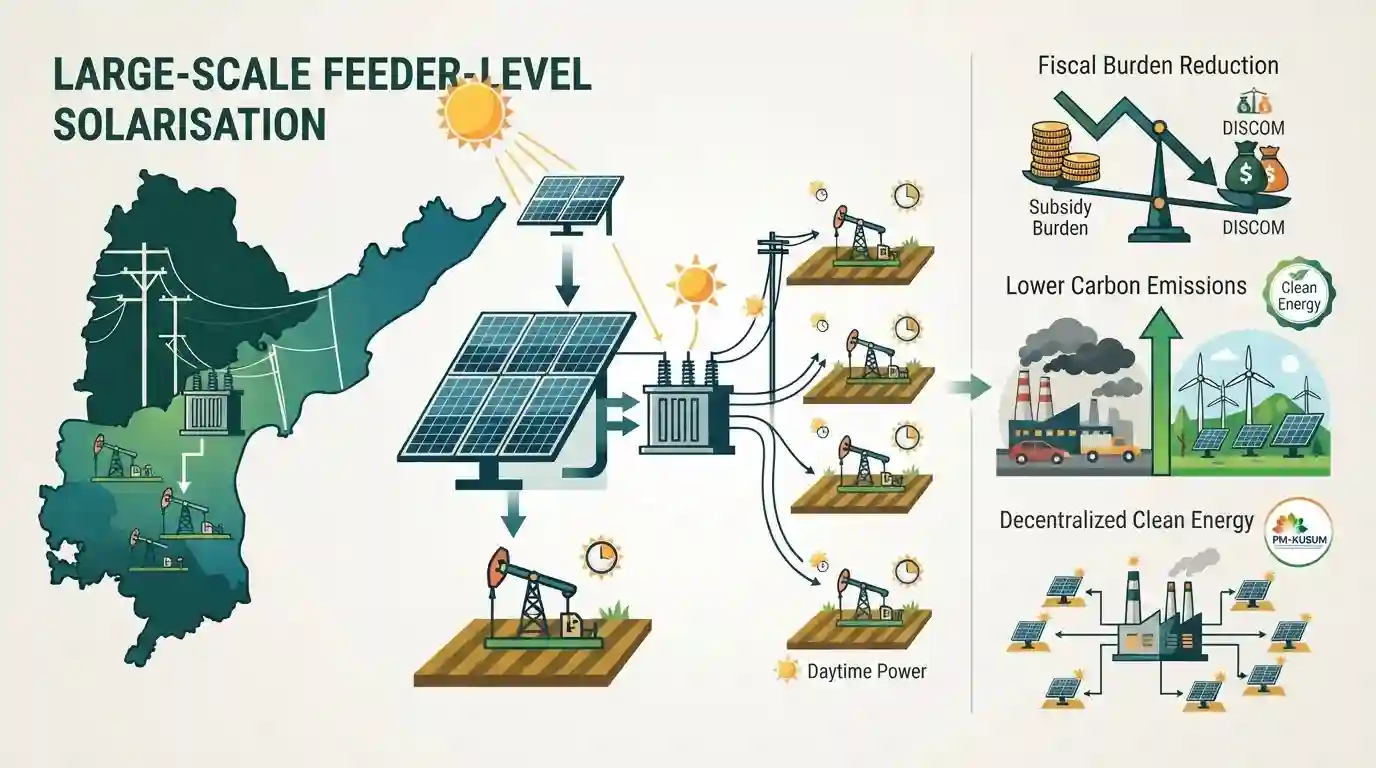
Andhra Pradesh has initiated large-scale feeder-level solarisation to supply uninterrupted daytime power to agricultural pumpsets. This initiative aims to reduce the fiscal burden of agricultural electricity subsidies on power distribution companies (DISCOMs), cut carbon emissions, and promote decentralized clean energy under national renewable frameworks like PM-KUSUM.
Key Points
- Andhra Pradesh is advancing record feeder-level solarisation to provide reliable daytime power to agricultural consumers.
- The initiative aligns with national clean energy frameworks such as the PM-KUSUM scheme, reducing reliance on conventional thermal power for agriculture.
- Feeder solarisation helps lower DISCOM subsidy burdens by utilizing decentralized solar generation and promoting renewable energy adoption in rural areas.
Important Terms
PM-KUSUM Scheme

A central sector scheme by the Ministry of New and Renewable Energy aimed at ensuring energy security for farmers, increasing farm incomes, and promoting decentralized solar power installations across rural India.
UPSC context
Important for UPSC GS Paper-III (Energy Security, Agriculture, Government Schemes). Tested on components like feeder-level solarisation and subsidies.
NREDCAP
The New and Renewable Energy Development Corporation of Andhra Pradesh Ltd. is the designated state nodal agency executing renewable energy and energy conservation programmes in Andhra Pradesh.
UPSC context
Crucial for APPSC Group 1 & 2 (AP Economy, State Schemes & Infrastructure). Tests state-level institutional mechanisms for clean energy.
Feeder-Level Solarisation
A framework under PM-KUSUM Component-C where individual agricultural power feeders are supplied directly by dedicated decentralized solar power plants, providing reliable daytime electricity to pumpsets.
UPSC context
Relevant for APPSC/UPSC Prelims & Mains (Power Sector Reforms, DISCOM Finances, and Decentralized Renewable Energy).
Static Concepts Connected
What are the key components of the PM-KUSUM scheme?
- Component A: Component A involves setting up 10,000 MW of decentralized grid-connected renewable power plants on barren land.
- Component B: Component B focuses on installation of 17.5 lakh standalone solar agriculture pumps.
- Component C: Component C supports solarisation of 35 lakh grid-connected agricultural pumps, including feeder-level solarisation.
Cross-Topic Patterns
PM-KUSUM + State DISCOM Financial Restructuring
Decentralized agricultural solarization under PM-KUSUM directly affects state DISCOM finances, balancing fiscal deficit management with green energy targets.

PM-KUSUM Component-C feeder solarisation targets, DISCOM subsidy burden reduction, and NREDCAP's role will likely feature in AP-specific prelims.
Linked PYQs · 1
Linked PYQs · 1
- 2024APPSC_PRELIMSGS1
Which of the following statements are valid in connection with Andhra Pradesh Green Hydrogen and Green Ammonia Policy (2023)? I. The objective is to target Green Energy production up to the capacity of 1 MPTA (Million Tonnes Per Annum) or Green Ammonia production up to the capacity of 2-0 MTPA in the next five years. II. New and Renewable Energy Development Corporation of A.P. Ltd (NREDCAP) shall act as a Nodal Agency under this policy. III. All the Ports in the State have infrastructure for storing liquid nitrogen which can then be utilized for storing Green Hydrogen for exporting to other countries. IV. The Policy prohibits the production of Green Hydrogen/Green Ammonia by using Renewable Energy and/or Biomass from 'Third-Party/Power exchange'. Select the correct answer using the codes given below :
