Sewage treatment plants installation in AP government hospitals
Source:deccanchronicle ↗
Why It Matters
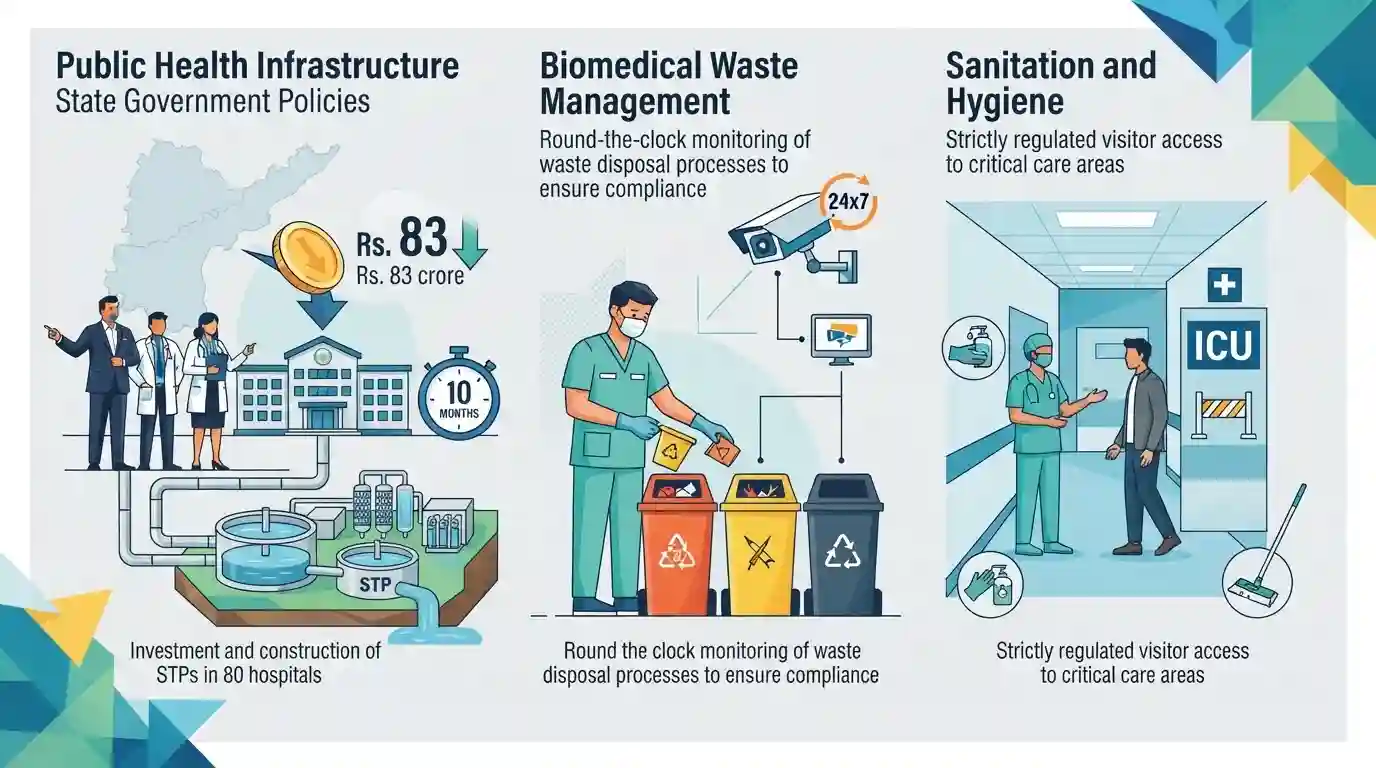
Highlights the proactive measures taken by the state government to upgrade sanitation infrastructure in public hospitals, properly manage biomedical waste, and control hospital-acquired infections, which are vital components of public health governance.
Summary
The Andhra Pradesh government has announced plans to construct Sewage Treatment Plants (STPs) in 80 government hospitals across the state, allocating Rs. 83 crore for the project. Health Minister Satya Kumar Yadav emphasized completing the project within 10 months and ensuring proper disposal of biomedical waste with 24x7 CCTV monitoring. Furthermore, visitor entry, particularly to ICUs, will be strictly regulated to minimize the spread of infectious diseases, highlighting the government's focus on improving public health infrastructure and sanitation.
Key Points
- The Andhra Pradesh government plans to establish Sewage Treatment Plants (STPs) in 80 government hospitals at an estimated cost of Rs. 83 crore.
- Health Minister Satya Kumar Yadav mandated the completion of the STP constructions within 10 months.
- Strict instructions were issued for the proper disposal of biomedical waste and continuous monitoring via CCTV cameras.
- Visitor entry to hospitals, starting with ICUs, will be regulated to prevent the spread of infectious diseases.
- The Minister directed that AP Vaidya Vidhana Parishad (APVVP) meetings should be held regularly every three months.
Important Terms
Biomedical Waste Management

The process of safely segregating, collecting, treating, and disposing of infectious and hazardous waste generated during healthcare, treatment, and medical research activities.
UPSC context
GS Paper 3 (Environment). Evaluates understanding of pollution control frameworks, waste management rules, and public health safeguards.
Sewage Treatment Plant (STP)
An infrastructure facility that removes biological and chemical contaminants from municipal or hospital wastewater, ensuring safe environmental discharge and preventing waterborne diseases.
UPSC context
GS Paper 3 (Environment). Tests knowledge on wastewater management, pollution mitigation, and infrastructure development.
AP Vaidya Vidhana Parishad (APVVP)
A former statutory body in Andhra Pradesh that managed secondary-level hospitals. It was repealed in 2023 and merged into the Directorate of Secondary Health.
UPSC context
GS Paper 2 (Governance). Relevant as a case study on structural reforms and streamlining state public health administration.
Public Health Infrastructure
The foundational physical, organizational, and technological systems required to prevent disease outbreaks, deliver medical care, and maintain sanitary environments for the population.
UPSC context
GS Paper 2 (Social Justice). Critical for evaluating government policies concerning healthcare access, disease control, and sanitation.
Prelims Trap
"The Bio-Medical Waste Management Rules 2016 deal only with solid hospital waste; liquid effluents are excluded."
Liquid waste (like lab fluids and microbiological waste) is explicitly classified as biomedical waste under the 2016 Rules and requires mandatory on-site pre-treatment before discharge.
Static Concepts Connected
What are the key features of the Bio-Medical Waste Management Rules, 2016?
- Expanded coverage: The rules expanded coverage to include vaccination camps, blood donation camps, and surgical camps, rather than just established hospitals.
- Phasing out plastics: Mandated the phase-out of chlorinated plastic bags, gloves, and blood bags to prevent toxic emissions (like dioxins) during incineration.
- Liquid waste pre-treatment: Established strict guidelines for the pre-treatment of laboratory and microbiological liquid waste on-site before mixing it with other wastewater.
How do hospital effluents contribute to Antimicrobial Resistance (AMR)?
- Antibiotic residues: Sub-lethal concentrations of active antibiotics discharged in untreated hospital sewage create selective pressure, allowing resistant bacteria to thrive.
- Horizontal gene transfer: Untreated wastewater serves as a mixing ground where resistance genes transfer between different bacterial species via horizontal gene transfer.
- Superbug proliferation: The combination of antibiotics, heavy metals, and residual disinfectants in hospital runoffs accelerates the emergence of multi-drug resistant "superbugs" in the environment.
Cross-Topic Patterns
Hospital STPs & One Health AMR Strategy
Managing hospital effluents links directly to the environmental pillar of the 'One Health' approach, preventing the creation of antimicrobial resistance (AMR) reservoirs in local water bodies.
Biomedical Liquid Waste & EPA 1986
State-level hospital infrastructure projects must adhere to overarching Central Pollution Control Board (CPCB) standards for biomedical liquid waste, framed under the Environment (Protection) Act, 1986.

Expect a multi-statement question on AMR drivers in 2026, specifically targeting hospital effluents and the Bio-Medical Waste Rules 2016.
Linked PYQs · 2
Linked PYQs · 2
- 2024APPSC_PRELIMSGS1
In connection with the Urban Infrastructure Development Fund (UIDF), which of the following statement/statements is/are valid? I. The fund will be established through reserved bonds taken from the G-Sec market. II. The fund is to be exclusively availed by private agencies to create urban infrastructure in Tier 2 and Tier 3 cities. III. Eligible activities for UIDF shall be connected to the Missions and Programmes of the Ministry of Housing | Urban Affairs (MoHUA). IV. The fund will be collectively managed by a cluster of Municipal Cooperative Banks. Select the correct answer using the codes given below:
- 2019APPSC_PRELIMSGS1
Which sector comprises water supply?
