Concert promotion framework and financial incentives for tourism
Source:news-arena-india ↗
ఇది ఎందుకు ముఖ్యం
This demonstrates how a State Government integrates niche segments (concert tourism) into broader economic and infrastructural development strategies. It highlights practical applications of Viability Gap Funding (VGF) and PPP models, mapping directly to syllabus areas concerning state-specific economic policies and infrastructure investment.
సారాంశం
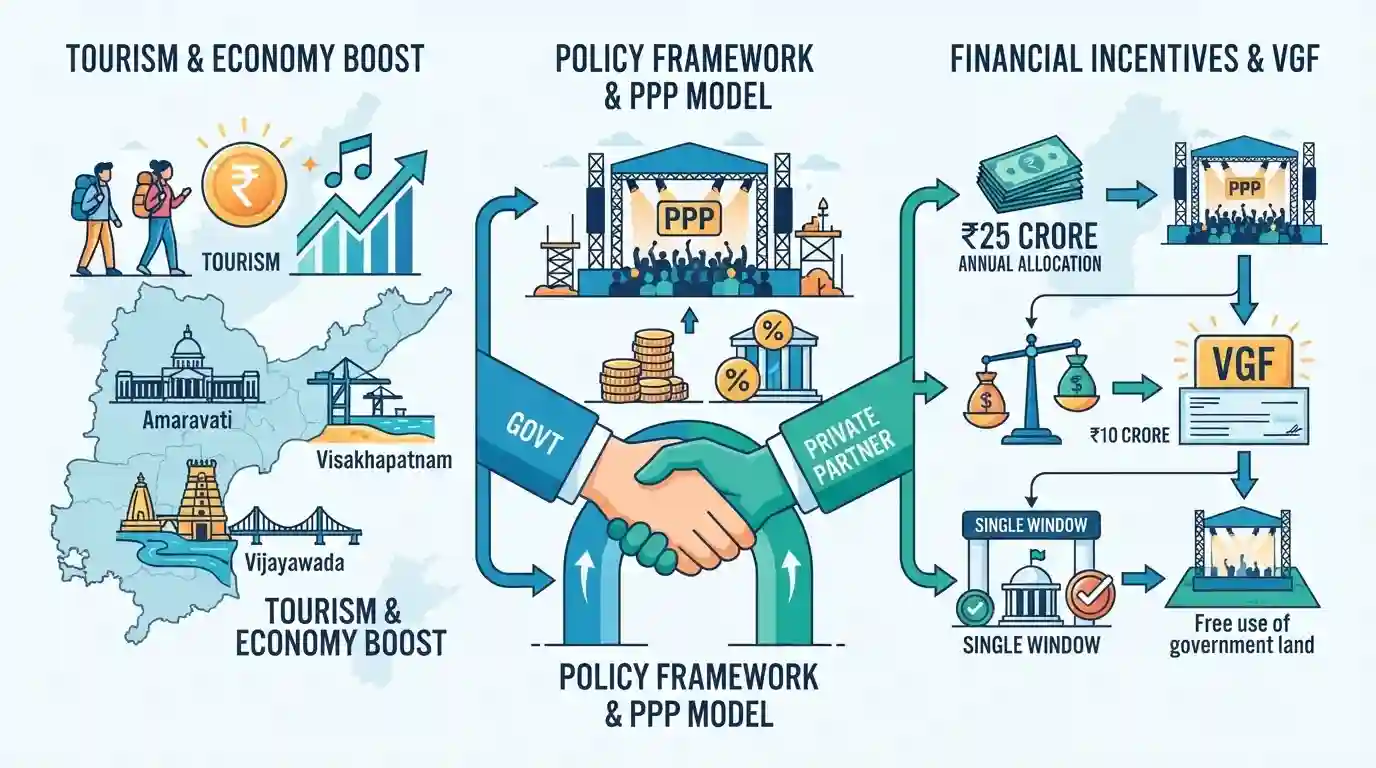
The Andhra Pradesh government has approved a Concert Promotion Framework under the Tourism Policy 2024-29 to develop the state into a global concert tourism hub. With a focus on Amaravati, Visakhapatnam, and Vijayawada, the policy introduces a Public-Private Partnership (PPP) model to develop large-scale concert venues. Organizers will receive major financial incentives including Viability Gap Funding (VGF) up to ₹10 crore for large events. The initiative is bolstered by an annual allocation of ₹25 crore, single-window clearances via the AP Tourism Authority, and free government ground usage to boost tourism and the local economy.
ముఖ్య అంశాలు
- Andhra Pradesh has approved a Concert Promotion Framework under its Tourism Policy 2024-29 to position the state as a premier global hub for concert tourism.
- The policy targets locations like Amaravati, Visakhapatnam, and Vijayawada for building global standard, purpose-built concert venues accommodating 10,000 to 50,000 people under the PPP model.
- The government is offering Viability Gap Funding (VGF) of up to ₹5 crore for events with 10,000 capacity and up to ₹10 crore for larger global concerts with 50,000 capacity.
- An annual budget of ₹25 crore is earmarked for concert subsidies, and organizers will get single-window clearances within 21 days along with free government-owned grounds.
ముఖ్యమైన పదాలు
Concert Promotion Framework

An initiative under Andhra Pradesh's Tourism Policy 2024-29 to establish Amaravati, Visakhapatnam, and Vijayawada as global concert hubs by offering financial incentives and developing venues via PPP.
UPSC context
GS-3 (Tourism). Illustrates state-level policy innovations to boost the services sector, local economy, and niche tourism.
Tourism Policy 2024-29
Andhra Pradesh's state policy aimed at attracting private investment, creating infrastructure, and generating employment by granting industry status to tourism and offering sweeping fiscal incentives.
UPSC context
GS-3 (Economic Development). Relevant for understanding state-led economic growth, employment generation strategies, and sectoral investment policies.
Viability Gap Funding (VGF)
A government capital grant provided to support socially and economically vital infrastructure or initiatives that fall marginally short of commercial viability for private investors.
UPSC context
GS-3 (Investment Models). A critical infrastructure financing concept frequently tested in UPSC Prelims and Mains.
Public-Private Partnership (PPP)
A cooperative arrangement between a government entity and private sector companies to finance, build, and operate projects, such as large-scale concert venues in Andhra Pradesh.
UPSC context
GS-3 (Infrastructure). Essential for understanding alternative financing models utilized to bridge state infrastructure deficits.
Andhra Pradesh Tourism Authority (APTA)
The state’s nodal agency responsible for promoting tourism, marketing destinations, and implementing the Tourism Policy 2024-29, including executing single-window clearances for investors and organizers.
UPSC context
GS-2 (Governance). Acts as an example of a dedicated institutional mechanism ensuring ease of doing business in the tourism sector.
ప్రిలిమ్స్ ఉచ్చు
Viability Gap Funding (VGF) for public-private partnership projects in India can only be sanctioned and funded by the Central Government.
While the Department of Economic Affairs (DEA) administers a national VGF scheme for infrastructure, state governments are fully empowered to design, fund, and disburse their own VGF frameworks from state budgets.
అనుసంధానమైన స్థిర భావనలు
What is Viability Gap Funding (VGF) in the Indian context?
- Core Objective: A one-time grant support mechanism targeting infrastructure projects that are economically justified but financially unviable due to long gestation periods.
- Funding Limits: Under the central scheme, the Central Government typically provides up to 20% of the Total Project Cost (TPC), often matched by another 20% from the state/sponsoring authority.
- PPP Synergy: It is specifically designed to leverage private capital under Public-Private Partnership (PPP) models, ensuring service delivery in sectors with capped user tariffs.
What are the implications of granting 'Industry Status' to the Tourism/Hospitality sector?
- Utility Tariffs: Allows tourism units to access electricity and water at industrial rates, which are significantly lower than standard commercial tariffs.
- Credit Access: Enables easier access to institutional credit and long-term loans from commercial banks at competitive interest rates, similar to the manufacturing sector.
- Fiscal Benefits: Unlocks state-level fiscal benefits, including waivers on land-use conversion charges, stamp duty reimbursements, and state GST concessions.
అంతర-అంశ నమూనాలు
Orange Economy and service sector GVA
Utilizing creative industries and entertainment events (the Orange Economy) to boost GVA, shifting state tourism focus from traditional heritage to high-yield niche services.
Competitive federalism and sub-national incentives
States leveraging competitive federalism through tailored state-level VGF and SGST concessions to secure private capital in service-sector niches.

Mains 2026 may contrast traditional infrastructure PPPs with service-sector VGF models to test evolving state-level economic strategies.
అనుసంధాన PYQలు · 4
అనుసంధాన PYQలు · 4
- 2024APPSC_PRELIMSGS1
Which of the following statement/statements is/are incorrect regarding the Andhra Pradesh Industrial Policy 2023 - 27? I. To achieve a minimum contribution of 25% by industry in the State GDP II. To provide end-to-end facilitation in 2 weeks III. To envisage ten (10) priorities of accomplishment IV. To focus on becoming a 'Plug and Play State' for investments V. Ensuring land allotment by APIIC within a period of 2 weeks upon receipt of application Select the answer using the codes given below :
- 2024APPSC_PRELIMSGS1
Tourism in India has turned out to be a key service sub-sector. Which of the following statements are valid regarding the Tourism sector in India ? I. NIDHI is a technology-driven system meant for providing services to Hospitality and Travel industry. II. The Government has resolved to make India a one trillion USD tourism economy by 2047 with 100 million international investors. III. The Hotel Occupancy Rate has been rapidly increasing alongside a consistent rise in the average daily rate and revenue per available room. IV. India's Services Purchasing Managers' Index (PMI) has been in the expanding zone. Select the correct answer using the codes given below :
- 2024APPSC_PRELIMSGS1
The Interim Union Budget (FY25) has proposed initiatives to boost India's Green Energy Sector. Which of the following proposals are connected with developing India's Green Energy ? I. Viability Gap Funding (VGF) for utilizing solar energy projects II. To set up coal gasification and liquefaction capacity of 100MT by 2030 III. Optional blending of Compressed Bio Gas (CBG) in Compressed Natural Gas (CNG) for transport and Piped Natural Gas (PNG) for domestic purposes IV. Provision of financial assistance for procurement of biomass aggregation machinery V. Setting up of a payment security system for expanding the bio-manufacturing system in the country Select the correct answer using the codes given below :
- 2024APPSC_PRELIMSGS1
The strategic objective of Asset Monetization Programme may be explained as :
