Andhra Pradesh High Court Quashes ST Certificate Cancellation
Source:livelaw ↗
Why It Matters
It highlights crucial administrative law principles regarding arbitrary re-enquiries and protects the procedural rights of Scheduled Tribes against arbitrary cancellation of caste certificates.
Summary
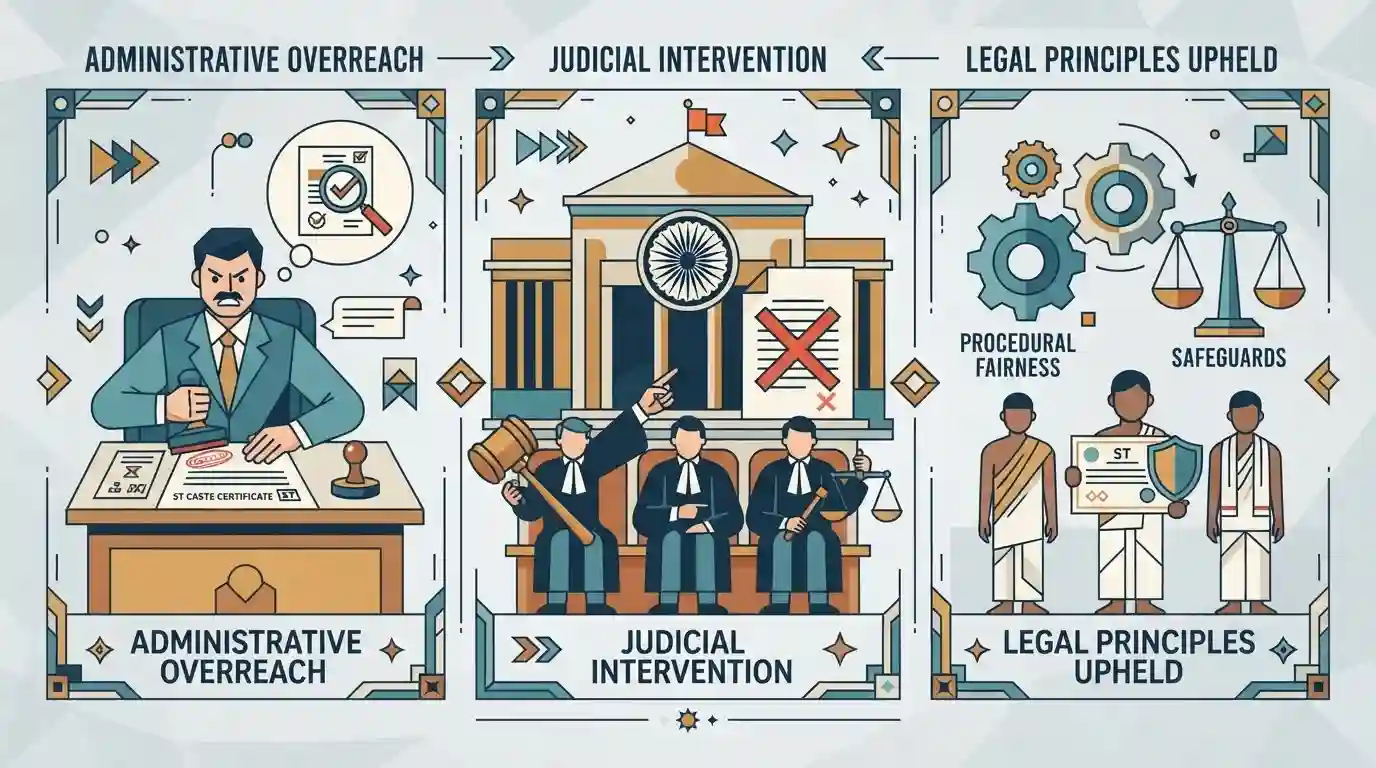
The Andhra Pradesh High Court set aside an order cancelling a Scheduled Tribe (ST) caste certificate, holding that a re-enquiry cannot be conducted by authorities in the absence of a fresh complaint or new material on record. The court underscored the importance of procedural fairness and safeguards in administrative decisions affecting social status certificates.
Key Points
- The Andhra Pradesh High Court set aside the cancellation of a Scheduled Tribe (ST) caste certificate, criticizing authorities for initiating a re-enquiry without a fresh complaint or bringing any additional material on record.
- The court emphasized that administrative or quasi-judicial re-enquiry into caste status cannot be arbitrary or initiated repeatedly without valid legal grounds or new substantive evidence.
- The judgment reinforces procedural safeguards and legal protections for marginalized communities against arbitrary revocation of statutory social status certificates.
Static Concepts Connected
What is the constitutional mechanism for specifying Scheduled Tribes under Article 342?
- Notification Power: Presidential Order specifies tribes or tribal communities in consultation with the Governor of the concerned State.
- Parliamentary Role: Parliament alone by law can include or exclude any tribe or tribal community from the Presidential list.
Cross-Topic Patterns
Judicial Review & Administrative Due Process
AP High Court decisions on administrative re-enquiries tie directly into Article 226 writ jurisdiction and principles of natural justice tested in public administration.
Constitutional Safeguards for Scheduled Tribes
Caste certificate cancellations directly impact affirmative action benefits, engaging constitutional protections under Articles 15, 16, and 342 for Scheduled Tribes.

AP High Court rulings on administrative re-enquiry of ST certificates may be tested in Group-1 Mains under judicial review and natural justice.
Linked PYQs · 3
Linked PYQs · 3
- 2023APPSC_PRELIMSGS1
The National Commission for Scheduled Castes, while investigating any matter or inquiring into any complaint, has the powers on the following matters : I. It can receive evidences on affidavits. II. It can requisition any public record from any court or office. III. It can issue summons for the examination of witnesses and documents. Choose the correct answer using the codes given below :
- 2023APPSC_PRELIMSGS1
Which of the following is not the function of the National Commission for Scheduled Castes?
- 2024APPSC_PRELIMSGS1
With reference to the Ninth Schedule of the Constitution of India, consider the following statements: I. It was intended to protect Central and State laws that are included in it from judicial review on the ground of violation of Fundamental rights. II. The entries included in it are not restricted to the subject of land reforms and abolition of the zamindari system alone. III. Article 31B carries a retrospective effect but it has ceased to be operative after the 'I.R. Coelho Case' (2007). IV. The entries incorporated in it are only done so, by the power of the Central Government. Which of the statements given above are correct?
