Andhra Pradesh High Court Sets Aside Local Body BC Quota
Source:newindianexpress ↗
Why It Matters
Crucial for understanding the constitutional limitations on reservations in local bodies, judicial review, and governance in Andhra Pradesh.
Summary
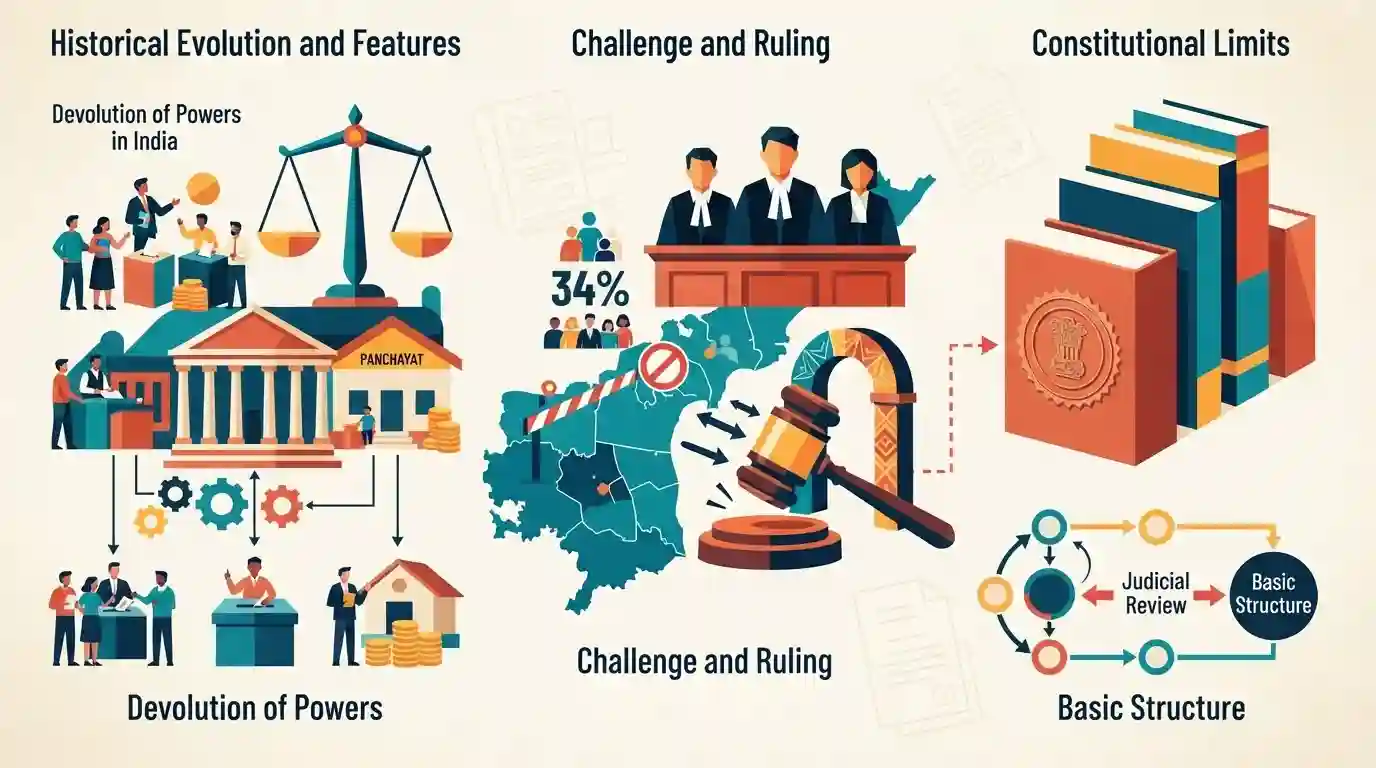
The Andhra Pradesh High Court delivered a significant ruling setting aside the 34% Backward Classes (BC) quota in local body polls, bringing focus back on legal and constitutional limits on reservations for local government institutions in the state.
Key Points
- The Andhra Pradesh High Court set aside the 34 percent reservation quota for Backward Classes (BC) in local body polls.
- The court reiterated adherence to constitutional and legal parameters regarding reservations and the upper ceilings governing local governance bodies.
- The ruling impacts the framework of reservations and political representation for backward classes in Andhra Pradesh local elections.
Important Terms
Andhra Pradesh High Court

The highest judicial authority in Andhra Pradesh, exercising original and appellate jurisdiction under Article 226 of the Constitution, including the power of judicial review over executive orders and state legislation.
UPSC context
Relevant for APPSC Group 1 & 2 (Indian Polity - Judiciary, Judicial Review, and Centre-State relations under AP Reorganisation aspects).
Prelims Trap
The 50% ceiling on reservations applies strictly to public employment and educational institutions, and does not extend to local government bodies.
Aspirants often assume that the 50% reservation cap established in Indira Sawhney applies only to public employment and education, missing its extension to local body elections by the Supreme Court.
Static Concepts Connected
What are the constitutional provisions and procedural requirements governing reservations in local self-government bodies in India?
- Constitutional Basis: Article 243-D and 243-T provide for the reservation of seats for SCs, STs, and women in Panchayats and Municipalities respectively.
- Triple Test: The Supreme Court in Vikas Kishanrao Gawali (2021) laid down a 'triple-test' requiring empirical data through a dedicated commission before fixing Backward Class quotas in local bodies.
- 50% Ceiling: Total reservations for SCs, STs, and BCs combined in local bodies cannot breach the overall 50% ceiling mandated by judicial pronouncements.
Cross-Topic Patterns
Local Body Reservations and the 50% Ceiling
Local body reservation limits connect directly to the 73rd and 74th Constitutional Amendment Acts and the imperative for empirical data mandated in Vikas Kishanrao Gawali (2021).
Judicial Review in State Electoral Processes
Judicial intervention in local body electoral schedules highlights the tension between executive policy and constitutional mandates enforced by High Courts under Article 226.

APPSC questions on local body quotas will test the triple-test requirement from Vikas Kishanrao Gawali case alongside the 50% ceiling.
Linked PYQs · 1
Linked PYQs · 1
- 2019APPSC_PRELIMSGS1
Regarding the Article 15 of the Constitution of India, find the wrong answer.
