Amaravati economic region implementation committee notified by AP
Source:The Hindu ↗
Why It Matters
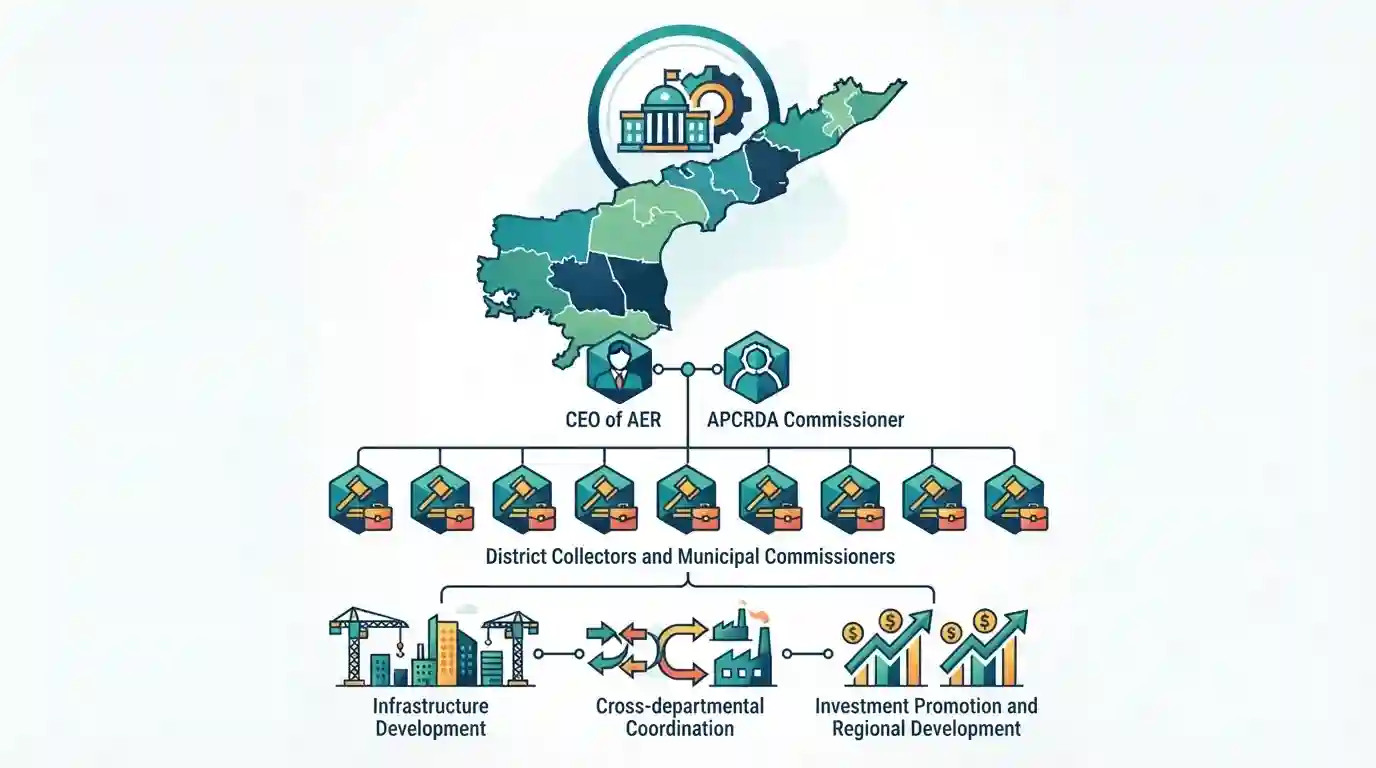
The notification highlights Andhra Pradesh's strategy to cluster nine districts into a unified Amaravati Economic Region (AER) for integrated planning. This administrative structure is crucial for APPSC aspirants to understand state governance mechanisms, specifically how state bodies like APCRDA coordinate with district administrations (ULBs and UDAs) to drive industrialization and infrastructure growth.
Summary
The Government of Andhra Pradesh has officially notified the formation of the Implementation Committee for the Amaravati Economic Region (AER) under G.O Rt No.945. Aimed at fostering balanced regional development, urbanisation, and sustainable economic growth, the AER encompasses nine districts. The committee is chaired by the CEO of AER and convened by the APCRDA Commissioner. District Collectors of the nine constituent districts, along with municipal commissioners, serve as members to coordinate cross-departmental implementation, infrastructure development, and investment promotion across the region.
Key Points
- The Andhra Pradesh Government constituted an Implementation Committee for the Amaravati Economic Region (AER) to promote balanced regional economic development.
- The committee is chaired by the CEO of AER, with the APCRDA Commissioner serving as the Member-Convener.
- It covers nine districts: NTR, Krishna, Eluru, West Godavari, Guntur, Palnadu, Bapatla, Prakasam, and Markapuram, with their District Collectors acting as committee members.
- The primary mandate is to ensure convergence among Urban Local Bodies (ULBs), Urban Development Authorities (UDAs), and State Departments for infrastructure creation, industrialisation, and investment promotion.
Important Terms
Amaravati Economic Region Implementation Committee

A newly constituted unified institutional body covering nine Andhra Pradesh districts. Chaired by the AER CEO, it coordinates spatial planning, land use, infrastructure execution, and investment promotion to develop the region.
UPSC context
GS Papers 2 & 3 (Governance, Urban Planning). Tests understanding of decentralized administration, inter-departmental coordination, and infrastructure execution.
Andhra Pradesh Capital Region Development Authority (APCRDA)
A statutory urban planning agency established in 2014 to oversee the development of the Amaravati capital region. It manages regional planning, voluntary land pooling schemes, and infrastructure execution, acting as the AER convener.
UPSC context
GS Paper 2 (Statutory Bodies) and GS 3 (Urbanization). Illustrates legal frameworks for capital city development and land aggregation models.
Amaravati Economic Region (AER)
A 44,962 sq km strategic development zone spanning nine districts in Andhra Pradesh. It aims to integrate Amaravati's urban growth with surrounding agro-industrial and mineral corridors, creating a globally competitive economic cluster.
UPSC context
GS Paper 3 (Economic Development). Demonstrates spatial planning where urban capitals drive holistic regional growth rather than isolated development.
City Economic Region (CER) Framework
A NITI Aayog policy model that conceptualizes cities and surrounding districts as unified economic zones. It promotes integrated spatial planning, infrastructure funding, and multi-sectoral industrial growth beyond traditional municipal boundaries.
UPSC context
GS Paper 3 (Urbanization, Planning). Highly relevant for questions on NITI Aayog's strategies for sustainable urbanization and regional economic integration.
Prelims Trap
The Amaravati Economic Region (AER) Implementation Committee is chaired by the Chief Minister of Andhra Pradesh.
Aspirants often assume high-profile economic planning committees are chaired by either the Chief Minister or District Collectors. In this notification, the committee is chaired by the CEO of AER.
Static Concepts Connected
What is the constitutional mandate and role of District Planning Committees (DPCs)?
- Constitutional Basis: Article 243ZD of the Constitution mandates the creation of DPCs in every state to consolidate plans prepared by Panchayats and Municipalities.
- Composition Rules: At least four-fifths of the members of a DPC must be elected by, and from amongst, the elected members of the district panchayat and municipalities.
- Planning Conflict: DPCs are intended to bridge rural-urban planning gaps, though they are frequently bypassed by state-level parastatals and specialized regional authorities.
How do statutory Urban Development Authorities (UDAs) differ from Urban Local Bodies (ULBs)?
- Legal Character: ULBs are constitutionally mandated local self-governments (74th Amendment), whereas UDAs are statutory parastatal bodies created by specific state legislations for spatial planning.
- Representation: ULBs are democratically elected bodies, while UDAs are run by state-appointed bureaucrats, technical experts, and political nominees.
- Financial Structure: ULBs have constitutional taxation powers, whereas UDAs depend heavily on land monetization, development charges, and direct state budget allocations.
Cross-Topic Patterns
Regionalism vs. Grassroots Decentralization
State-notified economic regions often bypass constitutional 74th Amendment bodies, reflecting the structural tension between centralized macroeconomic planning and decentralized local governance.
Urbanization as a Macroeconomic Tool
Using regional bodies to drive GSDP links urban governance directly to state-level fiscal health, transitioning cities from service providers to primary drivers of capital accumulation.

Union City Economic Region (CER) framework and state-led regional zoning models likely to be tested under GS3 Urbanization in 2026.
Linked PYQs · 2
Linked PYQs · 2
- 2019APPSC_PRELIMSGS1
What is the name of the project launched with the objective of computerization of Urban, Local bodies ?
- 2024APPSC_PRELIMSGS1
Which of the following statement/statements is/are valid regarding the socio-economic status of Andhra Pradesh ? I. Andhra Pradesh won the Best State Award of ICAR - National Research Center for Banana (NRCB) for export promotion. II. Andhra Pradesh GSDP growth rate has been registering a decline in recent times owing to repeated lower returns in certain sub-sectors of the Service Sector. III. For the FY 2024 - 25, the Revenue Deficit is budgeted higher than the Fiscal Deficit in terms of percentage of Andhra Pradesh GSDP. IV. The technology used by the Government of Andhra Pradesh while conducting resurvey of landholdings is referred to as 'Continuously Operating Reference Stations (CORS)' technology. Select the correct answer using the codes given below :
