Andhra Pradesh Forms High Power Committee for Tiger Protection
Source:The Hindu ↗
Why It Matters
State-level environmental committees signal key regional policy priorities. Protecting tiger habitats such as the Nallamala forest (which houses India's largest tiger reserve, Nagarjunasagar-Srisailam) is vital for biodiversity and frequently appears in APPSC geography and environment questions.
Summary
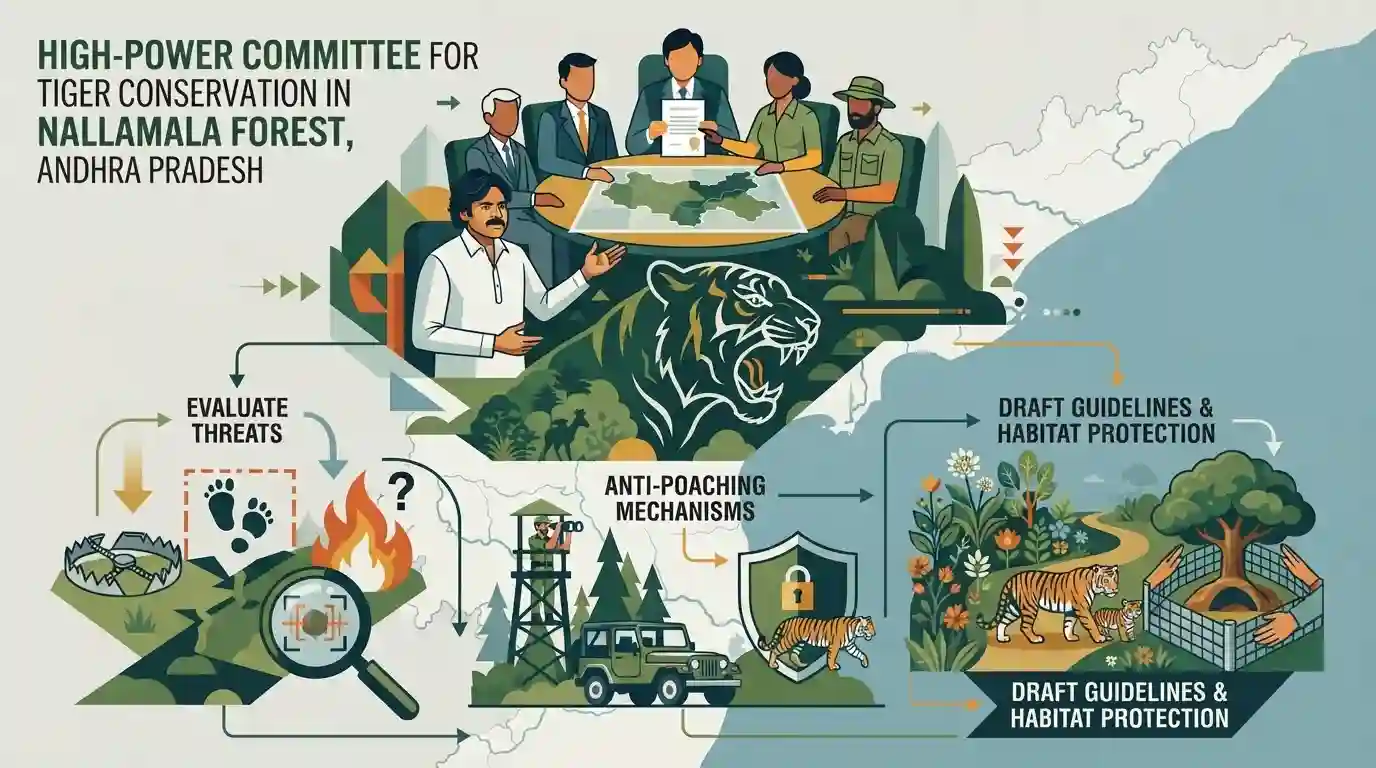
The Andhra Pradesh government has established a five-member High-Power Committee (HPC) to enhance tiger conservation across the state. The initiative, directed by Deputy Chief Minister and Minister for Environment and Forests K. Pawan Kalyan, follows the suspicious death of a tigress in the Nallamala forest. The committee—comprising state forest officials, WWF representatives, and wildlife experts—will evaluate threats to tiger populations, study anti-poaching mechanisms, and draft comprehensive guidelines to safeguard tigers and their natural habitats.
Key Points
- The Andhra Pradesh government has formed a five-member High-Power Committee (HPC) to boost tiger conservation efforts in the state.
- The committee was constituted under the directions of Deputy Chief Minister K. Pawan Kalyan following the suspicious death of a tigress in the Nallamala forest.
- The HPC is tasked with conducting a field study on preventing poaching, identifying threats to tiger populations, and formulating a comprehensive action plan for habitat preservation.
- The panel comprises senior forest department officials, wildlife scientists, and representatives from the World Wide Fund for Nature (WWF) and Hyderabad Conservation for Tiger Society.
Important Terms
Nagarjunasagar-Srisailam Tiger Reserve (NSTR)

India's largest tiger reserve, spanning across the Nallamala hill ranges in Andhra Pradesh and Telangana, with the Krishna River flowing through its rugged gorges.
UPSC context
GS Paper III (Environment); tests key geographical locations, river basins, and flagship species conservation efforts.
World Wide Fund for Nature (WWF)
An international non-governmental organization founded in 1961, headquartered in Switzerland, dedicated to wilderness preservation, biodiversity conservation, and reducing the human footprint on the environment.
UPSC context
GS Paper III (Environment); tests major international environmental NGOs, global conservation programs, and biodiversity reports.
Nallamala Forest
One of South India's largest contiguous, undisturbed forest stretches in the Eastern Ghats, hosting diverse dry deciduous flora, the Chenchu tribe, and the Nagarjunasagar-Srisailam Tiger Reserve.
UPSC context
GS Paper I & III (Geography and Environment); tests knowledge of Eastern Ghats ecology, forest types, and PVTGs like Chenchus.
Hyderabad Tiger Conservation Society (HyTiCoS)
A grassroots non-profit organization focused on conserving tigers, prey populations, and forest ecosystems in Telangana and Andhra Pradesh through research, monitoring, and community collaboration.
UPSC context
GS Paper III (Environment); tests role of civil society organizations, community participation, and regional conservation partnerships.
High-Power Committee (HPC) on Tiger Conservation
A specialized five-member panel constituted by the Andhra Pradesh government to review tiger protection, evaluate threats, study anti-poaching, and formulate scientific conservation guidelines.
UPSC context
GS Paper III (Environment); tests state-level administrative bodies, policy interventions, and wildlife crisis management strategies.
Prelims Trap
The National Tiger Conservation Authority (NTCA) is a statutory body constituted under the Environment (Protection) Act, 1986.
The NTCA is a statutory body constituted under the Wildlife (Protection) Act, 1972 (via its 2006 amendment), and not under the Environment (Protection) Act, 1986.
Static Concepts Connected
What is the statutory framework and mandate of the National Tiger Conservation Authority (NTCA)?
- Statutory Basis: Established under the Wildlife (Protection) Act, 1972, following the 2006 amendment to provide statutory backing to Project Tiger.
- Leadership: Chaired by the Union Minister of Environment, Forest and Climate Change, providing top-down administrative coordination.
- Core Mandate: Approves Tiger Conservation Plans, lays down normative standards for tiger reserves, and presents annual audit reports to Parliament.
What are the key geographical and ecological features of the Nagarjunasagar Srisailam Tiger Reserve (NSTR)?
- Geographic Scale: It is India's largest tiger reserve by geographical area, sprawling across the Nallamala hill ranges of the Eastern Ghats in Andhra Pradesh.
- River Basin: The reserve is bisected by the Krishna River, which carves deep gorges through the dry deciduous forest landscape.
- Corridor Connectivity: Adjoined by the Gundla Brahmeswaram Wildlife Sanctuary, which acts as a crucial southern ecological buffer and corridor.
Cross-Topic Patterns
Linear Infrastructure vs. Tiger Corridors
Linear infrastructure expansion through the Nallamala forest intersects critical tiger corridors, illustrating the classic GS-3 friction between infrastructure development and conservation.
Federalism and Wildlife Governance
State-level initiatives like AP's High-Power Committee operating alongside the central NTCA highlight the federal, concurrent dynamics of forest and wildlife management.

Map-based questions linking Eastern Ghats tiger reserves (NSTR) with river systems (Krishna) and adjacent sanctuaries are highly likely in 2026.
Linked PYQs · 3
Linked PYQs · 3
- 2023APPSC_PRELIMSGS1
Match the following Tiger Reserves with their States (location) : | Tiger Reserves | States | |---|---| | a. Periyar | I. Chhattisgarh | | b. Sariska | II. Rajasthan | | c. Buxa | III. West Bengal | | d. Indravati | IV. Kerala | Choose the correct answer using the codes given below : Code: a b c d
- 2024APPSC_PRELIMSGS1
Match the following : | List-I (Wildlife Sanctuary in Andhra Pradesh) | List-II (Region) | |---|---| | A. Coringa | I. Kurnool | | B. Gundla Brahmeswaram | II. Kadapa | | C. Rollapadu | III. East Godavari | | D. Sri Lankamalleswara | IV. Kurnool and Prakasam | Choose the correct answer using the codes given below : Code: A B C D
- 2023APPSC_PRELIMSGS1
According to the Indian Forest Act, 1927, which of the following is the most appropriate sequence which shows the degree of protection between different forest types ?
