Agency district collectors as government agents and tribal rights
Source:deccan-chronicle ↗
Why It Matters
The governance of Scheduled Areas under the Fifth Schedule, tribal land rights, and the specific judicial and executive powers of District Collectors in these regions are recurrent themes in Polity. The debate over whether an executive order (G.O.) or a legislative Act is required to amend procedural laws in Scheduled Areas provides crucial conceptual clarity for Prelims and Mains.
Summary
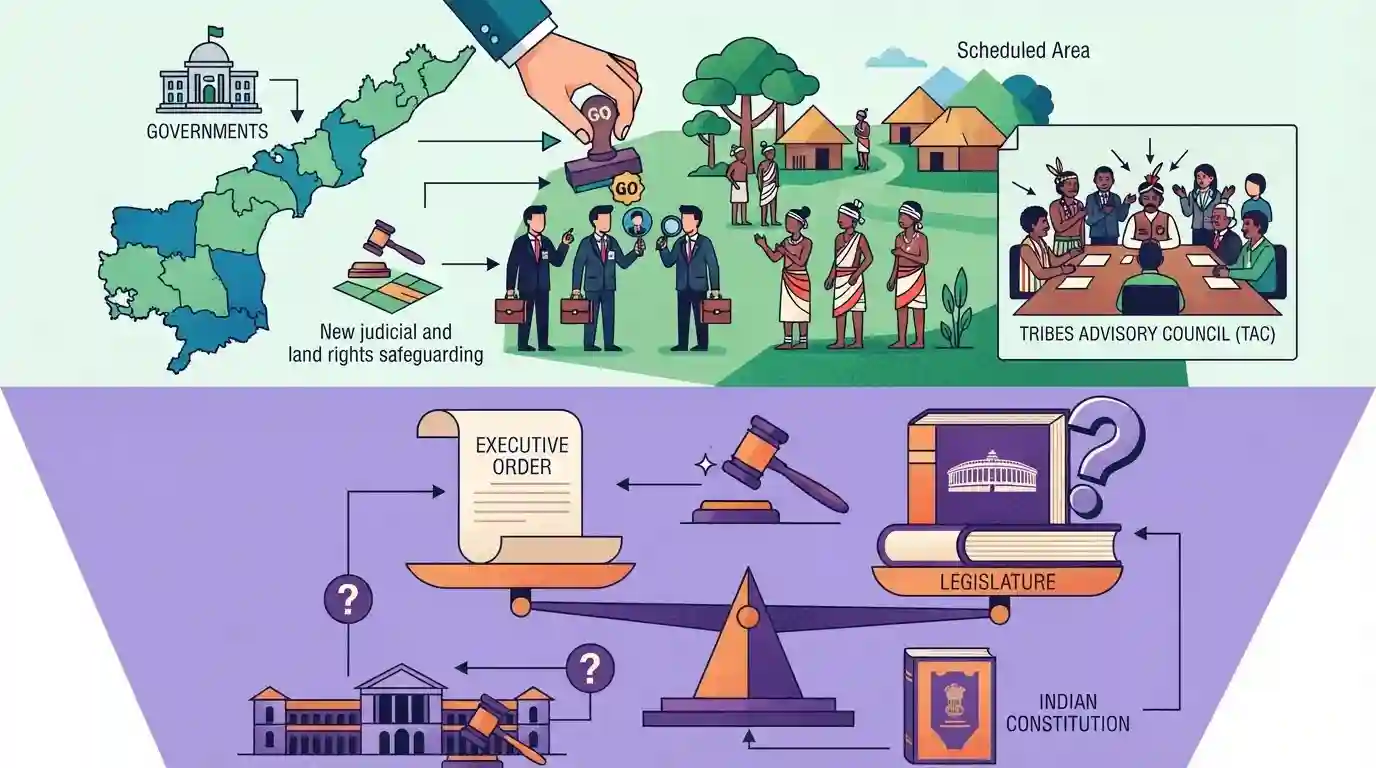
The Andhra Pradesh government has officially designated the District Collectors of newly formed districts with Scheduled Areas as the 'Agent to Government' to empower them in adjudicating civil matters and safeguarding tribal land rights. While the move is supported by the AP Tribes Advisory Council, legal questions have been raised regarding the constitutional validity of implementing such jurisdictional changes through an executive order instead of a proper legislative process under Schedule V.
Key Points
- The Andhra Pradesh government has issued G.O. 26 to designate district collectors of the newly formed 'Agency districts' as 'Agent to Government'.
- This designation empowers District Collectors to adjudicate civil disputes within Scheduled Areas, specifically to prevent non-tribals from illegally acquiring tribal lands.
- The government plans to amend the AP Agency Rules, 1924, and the Civil Procedure Code, 1908, following the approval of the AP Tribes Advisory Council.
- Legal experts content that under the Fifth Schedule of the Indian Constitution, amending these rules requires a legislative Act passed by the State Assembly and assented to by the President, rather than a mere executive Government Order (G.O.).
Important Terms
Schedule V of the Indian Constitution

A constitutional schedule governing the administration of Scheduled Areas and Scheduled Tribes in non-Northeast states, providing special safeguards for tribal land, autonomy, and local governance.
UPSC context
GS Paper II: Indian Constitution and tribal administration. Tests federal provisions, executive powers of the Governor, and tribal autonomy.
Andhra Pradesh Tribes Advisory Council
A constitutional body constituted under the Fifth Schedule to advise the Governor on matters concerning the welfare, advancement, and governance of Scheduled Tribes within the state.
UPSC context
GS Paper II: Institutional safeguards for vulnerable sections. Tests understanding of Fifth Schedule structures, gubernatorial powers, and tribal representation.
AP Agency Rules, 1924
A colonial-era regulatory framework made applicable in Andhra Pradesh to administer civil justice, land rights, and dispute resolution through designated administrative agents in tribal 'agency' tracts.
UPSC context
GS Paper II: Historical-legal frameworks for vulnerable sections. Tests knowledge of special administrative laws for tribal regions.
Code of Civil Procedure (CPC), 1908
The primary legislation regulating the procedure of civil courts in India, which is often modified or excluded in Scheduled Areas to respect customary tribal dispute resolution systems.
UPSC context
GS Paper II: Indian judiciary and legal structures. Tests comprehension of civil laws versus special exemptions granted to scheduled tribal tracts.
G.O. 26
An executive order issued by the Andhra Pradesh government in 2026 designating District Collectors of agency-related districts as 'Agent to Government' to adjudicate civil matters.
UPSC context
GS Paper II: Executive actions and separation of powers. Tests understanding of delegating judicial roles to civil services in tribal zones.
Prelims Trap
The Governor can amend or suspend the application of central/state laws to Scheduled Areas via a simple executive Government Order (G.O.).
Under Paragraph 5 of the Fifth Schedule, any regulation by the Governor that overrides, amends, or repeals central or state laws requires mandatory consultation with the TAC and the explicit assent of the President of India.
Static Concepts Connected
What are the key administrative rules under the Fifth Schedule of the Indian Constitution?
- Presidential Authority: The President holds the exclusive power to declare, alter, increase, or decrease the boundaries of a Scheduled Area.
- Governor's Power: The Governor may direct that any central or state act does not apply to a Scheduled Area, or applies with specified exceptions/modifications.
- Presidential Assent: Any regulations made by the Governor restricting land transfer or money-lending must be consulted with the TAC and approved by the President.
What is the composition and role of the Tribes Advisory Council (TAC)?
- Mandate: Established under Paragraph 4 of the Fifth Schedule in states with Scheduled Areas, and optionally in states with STs but no Scheduled Areas.
- Composition: Consists of a maximum of 20 members, of whom three-fourths (3/4) must be Scheduled Tribe representatives in the State Legislative Assembly.
- Functional Role: Serves a purely advisory role to the Governor on matters concerning the welfare and advancement of the Scheduled Tribes in the state.
Cross-Topic Patterns
Executive orders vs Fifth Schedule procedure
Highlights tensions between swift executive decentralization (district creation) and the mandatory constitutional procedures (TAC consultation + Presidential assent) required to modify judicial powers in Scheduled Areas.
Separation of powers in tribal pockets
Designating District Collectors with civil judicial powers under historic colonial agency rules tests Article 50's directive principles regarding the separation of executive and judicial functions.

UPSC may test the exact constitutional boundaries of the Governor's regulation-making power vs. President's power in Scheduled Areas.
Linked PYQs · 3
Linked PYQs · 3
- 2023APPSC_PRELIMSGS1
According to the Scheduled Castes and Scheduled Tribes Orders (Amendment) Act, 1976, how many Scheduled Tribes are notified in the State of Andhra Pradesh?
- 2023APPSC_PRELIMSGS1
The National Commission for Scheduled Castes, while investigating any matter or inquiring into any complaint, has the powers on the following matters : I. It can receive evidences on affidavits. II. It can requisition any public record from any court or office. III. It can issue summons for the examination of witnesses and documents. Choose the correct answer using the codes given below :
- 2023APPSC_PRELIMSGS1
Which of the following is not the function of the National Commission for Scheduled Castes?
