Guntakal Ballari Rail Line Expansion Project Approved
Source:deccan-chronicle ↗
Why It Matters
Enhancing railway capacity under the PM-Gati Shakti initiative is a vital component of India's multi-modal connectivity and logistics strategy. For APPSC aspirants, this regional infrastructure project highlights the state's expanding rail network, its economic implications, and coordination between state and central governments.
Summary
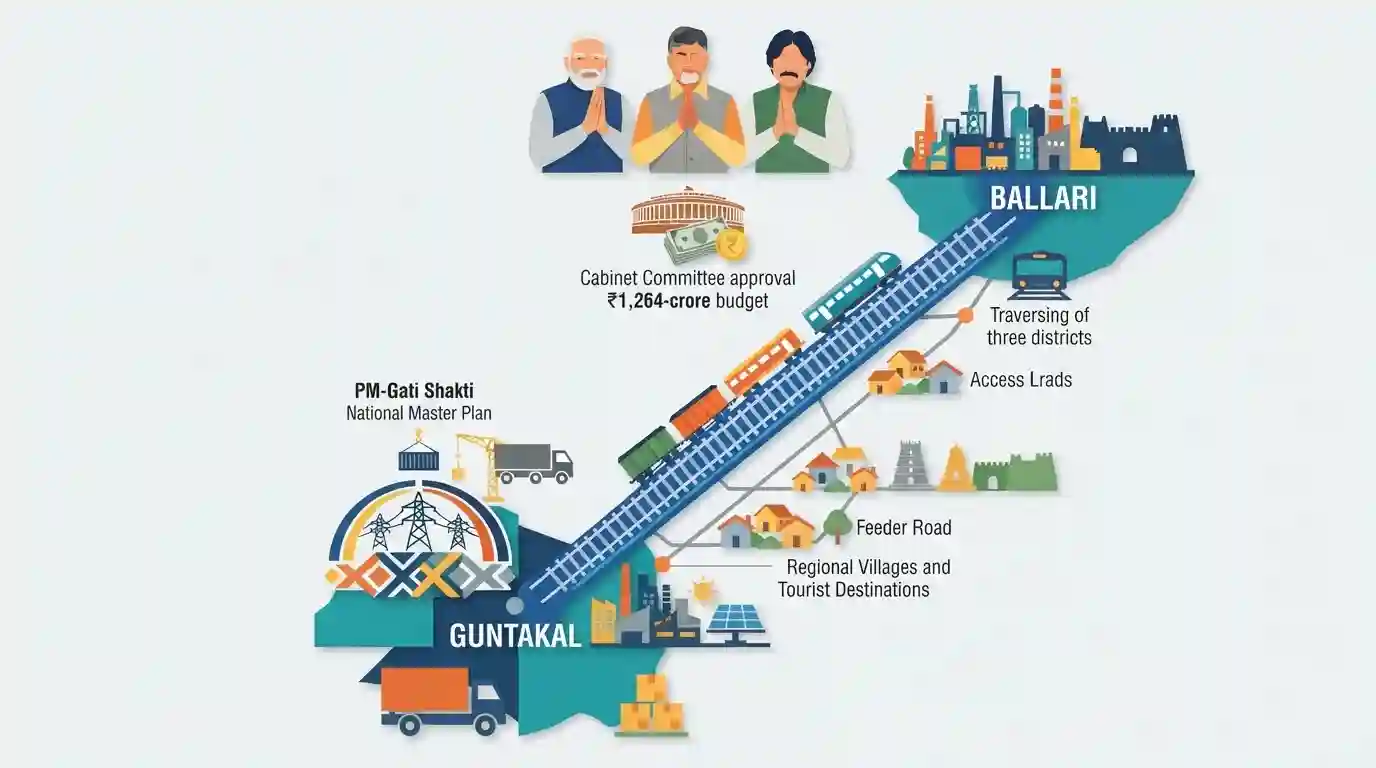
The Cabinet Committee on Economic Affairs, chaired by Prime Minister Narendra Modi, has approved a ₹1,264-crore project to add 3rd and 4th railway lines between Guntakal in Andhra Pradesh and Ballari in Karnataka. Structured under the PM-Gati Shakti National Master Plan, the 46-km expansion traverses three districts, aiming to boost multi-modal connectivity, lower logistical costs, and provide seamless access to regional villages and tourist destinations. AP Chief Minister N. Chandrababu Naidu and Deputy CM Pawan Kalyan expressed their gratitude to the Centre for prioritizing the region's infrastructure.
Key Points
- The Cabinet Committee on Economic Affairs (CCEA) has greenlit the construction of the 3rd and 4th railway lines between Guntakal and Ballari.
- The project is estimated to cost ₹1,264 crore and will add 46 km to the railway network across three districts in Andhra Pradesh and Karnataka.
- Executed under the PM-Gati Shakti National Master Plan, the initiative aims to enhance multi-modal connectivity and streamline logistics.
- The expansion will connect 99 villages and improve accessibility to key regional tourist and pilgrimage sites.
Important Terms
PM-Gati Shakti National Master Plan

A digital master plan integrating over 16 ministries to coordinate multimodal infrastructure projects. It aims to eliminate departmental silos, reduce logistics costs, and provide seamless, last-mile connectivity across India.
UPSC context
Crucial for GS Paper 3 (Infrastructure/Economy). Tests knowledge of logistics efficiency, government planning, and supply chain optimization initiatives.
Cabinet Committee on Economic Affairs (CCEA)
An extra-constitutional, high-level standing committee chaired by the Prime Minister. It makes critical decisions on economic policies, price controls, and approves major public sector investments and infrastructure projects.
UPSC context
Relevant for GS Paper 2 (Polity & Governance) and GS 3 (Economy). Focuses on executive decision-making and infrastructure project approvals.
Multi-modal Connectivity
The seamless integration of multiple transportation modes—such as railways, roadways, waterways, and air—to efficiently move goods and people, facilitating last-mile access and lowering overall freight costs.
UPSC context
Key concept in GS Paper 3 (Economy & Logistics). Important for analyzing how integrated transport reduces costs and boosts global competitiveness.
Prelims Trap
"PM Gati Shakti focuses on process reforms, whereas the National Logistics Policy dictates physical infrastructure network expansion."
UPSC often swaps the features of complementary schemes. Gati Shakti is for GIS-based physical infrastructure mapping, while NLP handles soft infrastructure like process reforms.
Static Concepts Connected
What is the composition and mandate of the Cabinet Committee on Economic Affairs (CCEA)?
- Chairmanship: Chaired by the Prime Minister, making it the highest executive decision-making body for key economic matters.
- Mandate: Approves large public sector investments (typically above ₹1,000 crore), sets agricultural MSPs, and reviews economic trends.
- Extra-constitutional status: It is an extra-constitutional body, formed under the Government of India Transaction of Business Rules, 1961.
Why is the Ballari-Sandur region significant in India's economic geography?
- Iron Ore Hub: Contains massive deposits of high-grade hematite iron ore, which drive the regional steel industry.
- Steel Production: Anchors major steel plants like the JSW Vijayanagar works, requiring extensive rail logistics for bulk raw material movement.
- Logistical Reliance: Located in the dry Deccan Plateau tract where heavy reliance on bulk rail transport is crucial due to the absence of navigable waterways.
Cross-Topic Patterns
Logistics costs + Mineral hubs
Railway debottlenecking in mineral-rich areas like Ballari aligns perfectly with the National Logistics Policy's macroeconomic target to reduce India's logistics costs from 14% to a global benchmark of 8% of GDP.
Gati Shakti + Whole-of-Government Approach
Linking PM Gati Shakti's GIS mapping with CCEA project approvals demonstrates the transition from traditional departmental silos to a 'whole-of-government' approach in infrastructure planning.

Expect a 2026 Prelims question contrasting PM Gati Shakti's GIS physical mapping with the National Logistics Policy's soft infra reforms.
Linked PYQs · 2
Linked PYQs · 2
- 2024APPSC_PRELIMSGS1
Which of the following statement/statements is/are valid regarding the National Infrastructure Pipeline (NIP)? I. NIP includes only economic infrastructure projects but not social infrastructure projects. II. NIP is aimed to focus on key greenfield projects alone. Brownfield projects are excluded from the NIP's coverage. III. NIP aims to offer investment opportunities in India's infrastructure sector, and to attract investments into India. IV. India Investment Grid (IIG) as a platform has ceased to facilitate the NIP and instead 'Invest India' is presently facilitating NIP. Select the correct answer using the codes given below:
- 2024APPSC_PRELIMSGS1
In connection with transport and infrastructure in Andhra Pradesh, which of the following statement/statements is/are valid? I. Andhra Pradesh's first riverine project has been proposed between Muktayala and Madipadu on Krishna river. II. The Bhogapuram Greenfield International Airport had been started with a corpus fund that is sourced from National Investment and Infrastructure Fund (NIIF). III. Infrastructure investments in Andhra Pradesh are strictly implemented only with reference to strategic investments like ports and industrial corridors, but not with reference to community assets. IV. Rail Over Bridges (ROBs) are being developed in Andhra Pradesh under the Setu Bandhan Scheme. Select the correct answer using the codes given below :
