Industry body flags GST implementation challenges and anomalies
Source:The Hindu ↗
Why It Matters
Provides tangible, sector-specific examples of indirect taxation challenges (e.g., ITC withdrawal, unutilized cess, misclassification of goods) that create bottlenecks in sectors like food processing, hospitality, and automobile retail. Useful for GS-3 answers on GST reforms and MSME challenges.
Summary
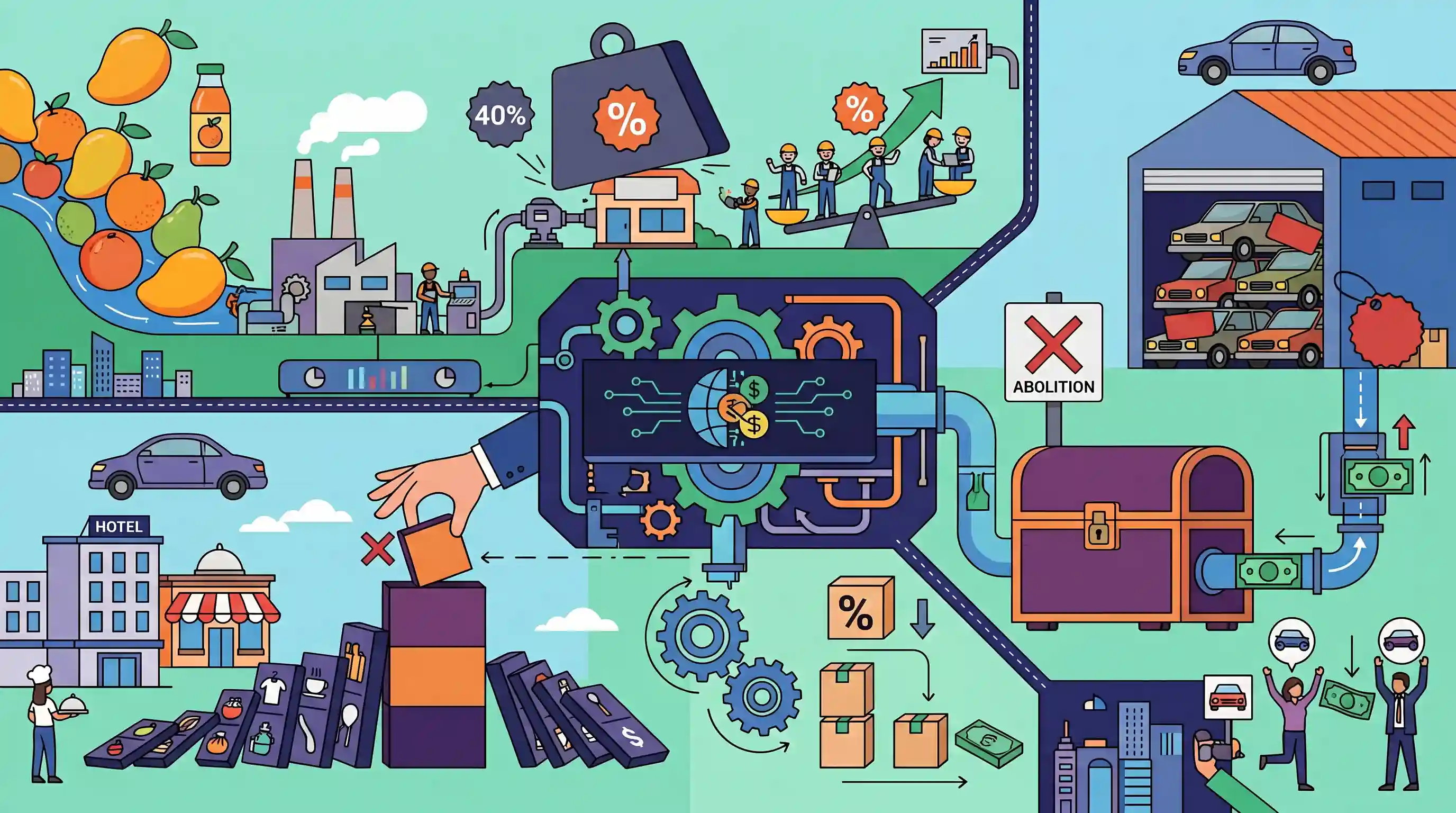
The A.P. Chambers of Commerce and Industry Federation has submitted a representation to the GST Council outlining practical grievances with the newly rolled out GST 2.0 framework. Key demands include reducing the 40% GST rate on fruit pulp-based beverages to 18% to protect food-processing MSMEs in agrarian states, restoring Input Tax Credit (ITC) for the hospitality sector to prevent tax cascades, and allowing refunds for unutilized compensation cess on old automobile inventories following the cess's abolition.
Key Points
- The A.P. Chambers of Commerce requested the GST Council to resolve Input Tax Credit (ITC) anomalies and unutilized cess under the GST 2.0 framework.
- Reclassification of fruit pulp-based beverages under a 40% GST rate (including cess) heavily impacts agrarian MSMEs; the industry seeks a reduction to 18%.
- The hospitality sector faces financial strain due to the withdrawal of ITC after the GST on rooms under ₹7,500 was reduced from 12% to 5%.
- Following the abolition of the GST compensation cess on automobiles, auto dealers are requesting refunds or adjustments for the cess paid on older inventory to avoid irrecoverable losses.
Important Terms
GST Council

A constitutional body under Article 279A, chaired by the Union Finance Minister, tasked with making recommendations on GST rates, exemptions, and administrative rules.
UPSC context
GS Paper II (Constitutional Bodies) and GS Paper III (Indian Economy). Tests knowledge of cooperative federalism and fiscal policy.
GST 2.0
The next phase of GST reforms focusing on rate rationalization (streamlining multiple slabs into fewer rates like 5% and 18%) and technology-driven compliance to simplify the tax regime.
UPSC context
GS Paper III (Indian Economy). Relevant for questions on indirect tax reforms and ease of doing business.
Input Tax Credit (ITC)
A mechanism allowing businesses to deduct tax paid on purchases (inputs) from the tax due on sales (outputs), ensuring tax is only paid on value addition.
UPSC context
GS Paper III (Economy). Fundamental for understanding the architecture of GST and its impact on business working capital.
Tax Cascading
A "tax on tax" effect where taxes are levied at multiple stages of production without credits for previous taxes, leading to compounding costs and higher final prices.
UPSC context
GS Paper III (Economy). Tests understanding of the inefficiencies in pre-GST/legacy tax systems compared to value-added taxation.
GST Compensation Cess
A surcharge on luxury and sin goods intended to compensate states for revenue losses post-GST implementation, currently extended until March 2026 to repay pandemic-era loans.
UPSC context
GS Paper III (Government Budgeting/Fiscal Policy). Important for understanding Centre-State financial relations and the GST transition.
MSMEs (Micro, Small, and Medium Enterprises)
Small-scale businesses defined by specific investment and turnover limits that are vital for employment and exports but often sensitive to tax compliance burdens.
UPSC context
GS Paper III (Indian Economy, Industry). Focuses on sectoral challenges and the impact of policy changes on small businesses.
Prelims Trap
"Input Tax Credit (ITC) is universally available to all GST-registered businesses to eliminate the cascading effect."
False. Certain concessional GST slabs, such as the 5% rate for budget hospitality or composition scheme opt-ins, explicitly prohibit businesses from claiming Input Tax Credit.
Static Concepts Connected
What is the structure and voting mechanism of the GST Council?
- Constitutional Body: Established under Article 279A via the 101st Constitutional Amendment Act, 2016. It is chaired by the Union Finance Minister.
- Voting Weights: The Centre holds a 1/3rd voting weight, while all States combined hold a 2/3rd weight in the Council.
- Majority Threshold: All decisions require a 3/4th (75%) majority of the weighted votes of the members present and voting.
How does Input Tax Credit (ITC) prevent the 'cascading effect'?
- Cascading Effect: Also known as 'tax on tax', cascading occurs when taxes are levied on a product's value that already includes previously paid taxes, inflating final prices.
- ITC Mechanism: ITC allows a business to deduct the GST already paid on its raw materials (inputs) from its final tax liability on the sold goods (output).
Cross-Topic Patterns
Food Processing GST vs Agri Objectives
High GST slabs on value-added agricultural products (like fruit pulp beverages) contradict the PM SAMPADA Yojana's goal of boosting agro-processing and reducing post-harvest agricultural losses.
GST Compensation Cess & Fiscal Federalism
The abolition of the GST compensation cess reignites debates over vertical fiscal imbalance, as states push for a larger share of the divisible pool to offset revenue transitions.

Expect a multi-statement Prelims question testing the exceptions to Input Tax Credit (ITC) and GST Council voting weights in 2026.
Linked PYQs · 5
Linked PYQs · 5
- 2019MainsGS3
Enumerate the indirect taxes which have been subsumed in the Goods and Services Tax (GST) in India. Also, comment on the revenue implications of the GST introduced in India since July 2017.
- 2020MainsGS3
Explain the rationale behind the Goods and Services Tax (Compensation to States) Act of 2017. How has COVID-19 impacted the GST compensation fund and created new federal tensions?
- 2025MainsGS3
Examine the scope of the food processing industries in India. Elaborate the measures taken by the government in the food processing industries for generating employment opportunities.
- 2020MainsGS3
What are the challenges and opportunities of food processing sector in the country? How can income of the farmers be substantially increased by encouraging food processing?
- 2023MainsGS3
Faster economic growth requires increased share of the manufacturing sector in GDP, particularly of MSMEs. Comment on the present policies of the Government in this regard.
