Andhra Pradesh Cabinet approves circular economy and waste policy
Source:The Hindu ↗
Why It Matters
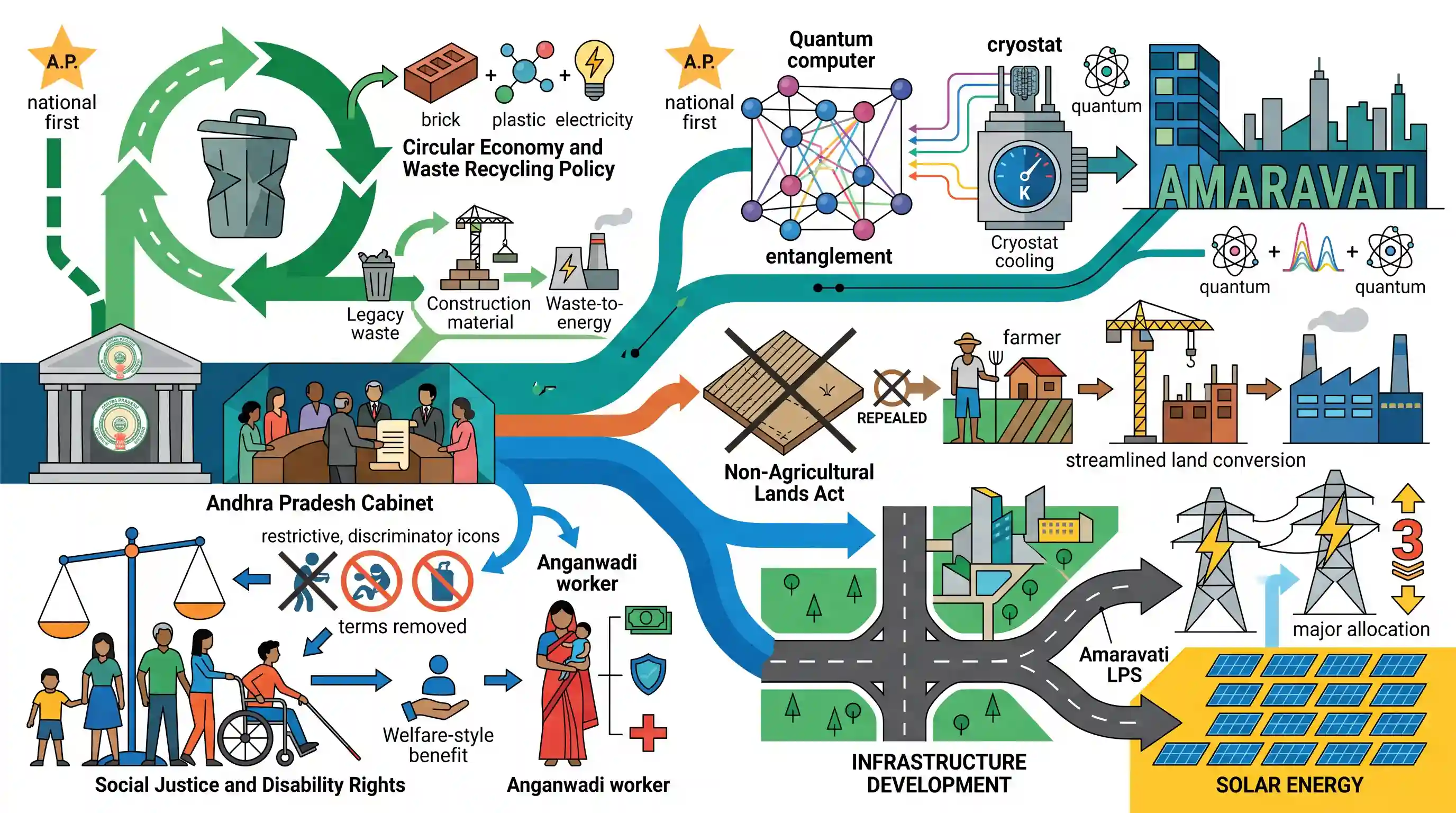
The article highlights progressive state-level policy formulation across multiple critical UPSC domains—environmental sustainability through a formal circular economy framework, cutting-edge science and technology via quantum computing deployment, and governance reforms focusing on infrastructure scaling and the removal of discriminatory legal language.
Summary
The Andhra Pradesh Cabinet passed multiple landmark policies, featuring India's first state-level Circular Economy and Waste Recycling Policy and an agreement to install a physical quantum computer in Amaravati—also a national first. The cabinet additionally streamlined land conversion by repealing the Non-Agricultural Lands Act, advanced social justice by amending the Beggary Prohibition Act to remove discriminatory terms against persons with disabilities, and launched new welfare benefits for Anganwadi workers alongside major infrastructure and solar energy allocations.
Key Points
- The AP Cabinet approved the pioneering Circular Economy and Waste Recycling Policy (2025-30) to establish a comprehensive "waste-to-wealth" ecosystem.
- Andhra Pradesh will become the first state in India to host a physical quantum computer at the Amaravati Quantum Computing Centre (AQCC) via an IBM quantum system.
- The state repealed the AP Non-Agricultural Lands Act (2006) to streamline land conversions, introducing external development charges to fund trunk infrastructure.
- In a move for social justice, the AP Beggary Prohibition Act was amended to remove discriminatory language against persons with disabilities, and old manual scavenging legislation was repealed as it is superseded by Central laws.
- Various other measures were passed, including 1,200 acres allotted to Adani Solar Energy and the introduction of gratuity for retiring Anganwadi workers.
Important Terms
AP Circular Economy and Waste Recycling Policy (2025-30)

India's first state-level framework for 'waste-to-wealth' transformation, promoting industrial symbiosis and MSME growth in the recycling sector from 2025 to 2030.
UPSC context
GS-III (Environment/Economy): Relevant for sustainable development and national efforts toward a circular economy.
Amaravati Quantum Computing Centre (AQCC)
A state-led facility in Andhra Pradesh hosting India’s first physical 133-qubit IBM quantum computer to drive research in AI, drug discovery, and cybersecurity.
UPSC context
GS-III (Science & Technology): Tests knowledge of indigenous technology hubs and the National Quantum Mission.
AP Non-Agricultural Lands Assessment (NALA) Act
Legislation (repealed in 2025) that regulated agricultural land conversion; its removal aims to eliminate red tape and improve the state's Ease-of-Doing Business ranking.
UPSC context
GS-II & GS-III: Important for land governance, administrative reforms, and Ease of Doing Business.
AP Beggary Prohibition (Amendment) Act
A 2025 reform that replaced derogatory terms like 'leper' and 'lunatic' with respectful language, aligning state law with the Rights of Persons with Disabilities Act.
UPSC context
GS-II (Social Justice): Focuses on disability rights and the removal of stigmatizing language in legislation.
Industrial Symbiosis
A process where industries collaborate to use each other’s waste or by-products as raw materials, a core pillar of Andhra Pradesh’s new recycling policy.
UPSC context
GS-III (Economy/Environment): Tests understanding of sustainable industrialization and resource efficiency models.
Central Research Institute for Yoga and Naturopathy (CRIYN)
A Central-government-funded apex body under the Ministry of AYUSH, established in Guntur to advance research and higher education in traditional medicine systems.
UPSC context
GS-II (Health): Relates to government initiatives for the development of traditional healthcare sectors.
Prelims Trap
Anganwadi workers hold the status of formal State Government civil servants, entitling them to gratuity.
Anganwadi workers are honorary scheme volunteers, not civil servants. However, a landmark Supreme Court ruling clarified they fall under the 'employee' definition strictly for the Payment of Gratuity Act.
Static Concepts Connected
Are Anganwadi workers entitled to statutory gratuity under Indian labour laws?
- Honorary Status: Originally classified as part-time scheme volunteers under ICDS, lacking formal civil servant status and associated central or state government benefits.
- SC Ruling: A landmark 2022 Supreme Court judgment declared that Anganwadi centers are "establishments" and workers are entitled to benefits under the Payment of Gratuity Act, 1972.
What defines the physical infrastructure and operation of a quantum computer?
- Superposition & Qubits: They use qubits instead of binary bits, allowing data to exist as both 0 and 1 simultaneously, enabling massive parallel calculations.
- Decoherence & Cooling: Physical quantum hardware requires extreme sub-zero temperatures (near absolute zero) and vacuum shielding to prevent environmental noise from collapsing the fragile quantum state.
Cross-Topic Patterns
Decolonizing disability terminology in laws
AP’s amendment of the Beggary Act reflects a national governance pattern, driven by the RPwD Act 2016, to audit and expunge ableist or archaic colonial terms from both central and state legislations.
State-led Frontier Tech Partnerships
AP hosting a physical IBM quantum computer demonstrates states bypassing traditional Central institutions to directly partner with global tech giants, decentralizing India's frontier technology infrastructure.

Expect a multi-statement Prelims question merging the Payment of Gratuity Act with the legal definition of honorary Anganwadi workers.
Linked PYQs · 2
Linked PYQs · 2
- 2022PrelimsGS1
Which one of the following is the context in which the term "qubit" is mentioned ?
- 2023MainsGS2
“Development and welfare schemes for the vulnerable, by its nature, are discriminatory in approach.” Do you agree? Give reasons for your answer.
