AP Cabinet Clears Pedestrian Safety and Universal Access Policy
Source:The Hindu ↗
Why It Matters
This is highly relevant for APPSC Group 1 as it outlines crucial ongoing state-level governance reforms, major infrastructure funding models (PPP and VGF), regional irrigation projects (Handri-Neeva), and important upcoming cultural events (Godavari Pushkaralu). The withdrawal of the Disha Bill highlights the state's legal alignment with new central criminal codes.
Summary
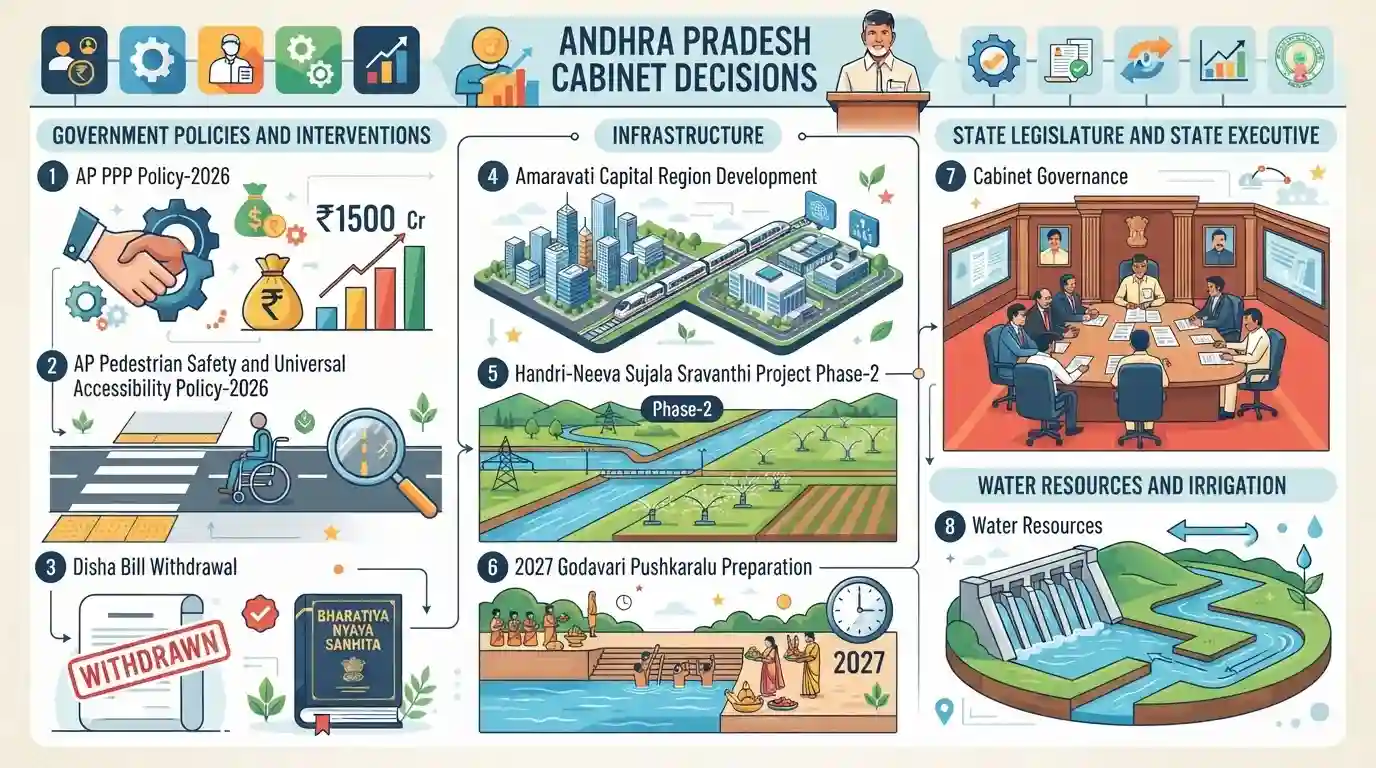
The Andhra Pradesh Cabinet under Chief Minister N. Chandrababu Naidu has approved a series of significant policy measures and infrastructure projects. Key among them are the AP PPP Policy-2026 backed by a ₹1,500 crore Viability Gap Funding, and the pioneering AP Pedestrian Safety and Universal Accessibility Policy-2026 focusing on road safety audits. The Cabinet also resolved to withdraw the Disha Bill, 2019 in light of the new Bharatiya Nyaya Sanhita. Furthermore, approvals were granted for the Phase-2 of the Handri-Neeva Sujala Sravanthi irrigation project, early preparations for the 2027 Godavari Pushkaralu, and major developments in the Amaravati capital region including a new railway line and a tech park.
Key Points
- The AP Cabinet approved the AP PPP Policy-2026 and allocated ₹1,500 crore for Viability Gap Funding (VGF) to attract private investments in transport, logistics, and infrastructure.
- The Andhra Pradesh Disha Bill, 2019 was withdrawn following the nationwide enforcement of the new criminal codes, including the Bharatiya Nyaya Sanhita (BNS).
- The Cabinet passed the AP Pedestrian Safety and Universal Accessibility Policy-2026 to ensure pedestrian rights, scientific road safety audits, and encroachment-free footpaths.
- Approved key infrastructural and cultural allocations: Phase-2 of the Handri-Neeva Sujala Sravanthi project (₹600.48 crore) and preparations for the 2027 Godavari Pushkaralu (₹210.06 crore).
- Approved major Amaravati capital projects including a broad gauge railway line, Amaravati Eye riverfront project, and the Amaravati Quantum Valley Tech Park.
Important Terms
AP Public-Private Partnership (PPP) Policy-2026

An Andhra Pradesh policy designed to attract private investment in key sectors, backed by a ₹1,500 crore Viability Gap Funding (VGF) scheme and a Bridge Fund for long-term projects.
UPSC context
GS Paper III: Investment models, infrastructure development, and mobilization of resources.
Andhra Pradesh Pedestrian Safety and Universal Accessibility Policy-2026
A pioneering state policy aimed at eliminating pedestrian fatalities through scientific road safety audits, hurdle-free footpaths, GIS-based monitoring of encroachments, and universal designs for persons with disabilities.
UPSC context
GS Paper II: Fundamental rights, welfare of vulnerable sections, and urban planning.
Andhra Pradesh Disha Bill, 2019
A state bill aiming to expedite trials for sexual offenses against women within 21 days, withdrawn in 2026 due to overlapping reforms under the new central laws.
UPSC context
GS Paper II: Criminal justice reforms, women safety, and center-state legislative relationships.
Handri-Neeva Sujala Sravanthi project
The longest lift irrigation and drinking water canal project in Andhra Pradesh, designed to draw surplus floodwaters from the Krishna River to the water-starved Rayalaseema region.
UPSC context
GS Paper I & III: Distribution of water resources, irrigation infrastructure, and agriculture.
Bharatiya Nyaya Sanhita
India's modernized substantive criminal code that replaced the colonial-era Indian Penal Code (IPC), featuring structured chapters on offences against women and children and restorative justice.
UPSC context
GS Paper II: Criminal justice reforms, administrative changes, and constitutional legal provisions.
AP Omnibus Ease of Doing Business Act, 2026
An upcoming state law aimed at simplifying regulatory approvals, reducing compliance burdens, and streamlining procedures to build an investor-friendly industrial ecosystem in Andhra Pradesh.
UPSC context
GS Paper III: Industrial growth, economic regulations, and ease of doing business.
Prelims Trap
The Right to Walk safely is explicitly mentioned as a Fundamental Right in the text of the Indian Constitution.
It is not explicitly written in the Constitution. It is an implied fundamental right inferred by the judiciary from Article 21 (Life) and Article 19(1)(d) (Movement).
Static Concepts Connected
How does the Constitution handle Central-State conflicts in the Concurrent List under Article 254?
- General Rule: Under Art 254(1), Central laws override State laws on Concurrent List subjects if a direct inconsistency or conflict arises.
- Exception: Under Art 254(2), a conflicting State law can prevail within that state if it was reserved for and received the President's assent.
- Parliamentary Override: Parliament retains the power to subsequently enact new legislation that modifies, amends, or repeals the assented State law.
What are the core parameters of the Viability Gap Funding (VGF) Scheme?
- Core Purpose: Provides upfront capital grants to PPP infrastructure projects that are economically essential but fall short of strict financial viability.
- Funding Limit: Generally caps support at 40% of the Total Project Cost (up to 20% from the Centre and 20% from the State/Sponsoring Ministry).
- Admin Agency: Administered nationally by the Department of Economic Affairs under the Ministry of Finance.
Cross-Topic Patterns
New Criminal Codes & Repugnancy
The enforcement of the Bharatiya Nyaya Sanhita forces states to withdraw customized penal bills (like AP's Disha) to avoid Article 254 constitutional deadlocks.
Urban Governance & Art 21
Pedestrian safety policies are emerging as statutory frameworks to operationalize the Supreme Court’s interpretation of the Right to Walk under Articles 19 and 21.
Krishna Basin Water Transfer
The Handri-Neeva lift irrigation project exemplifies intra-state water redistribution, drawing surplus Srisailam floodwaters to mitigate drought in the Rayalaseema region.

Expect a 2026 Prelims question testing Article 254 repugnancy mechanisms driven by states repealing local bills after the BNS rollout.
Linked PYQs · 4
Linked PYQs · 4
- 2024APPSC_PRELIMSGS1
The Interim Union Budget (FY25) has proposed initiatives to boost India's Green Energy Sector. Which of the following proposals are connected with developing India's Green Energy ? I. Viability Gap Funding (VGF) for utilizing solar energy projects II. To set up coal gasification and liquefaction capacity of 100MT by 2030 III. Optional blending of Compressed Bio Gas (CBG) in Compressed Natural Gas (CNG) for transport and Piped Natural Gas (PNG) for domestic purposes IV. Provision of financial assistance for procurement of biomass aggregation machinery V. Setting up of a payment security system for expanding the bio-manufacturing system in the country Select the correct answer using the codes given below :
- 2024APPSC_PRELIMSGS1
The strategic objective of Asset Monetization Programme may be explained as :
- 2023APPSC_PRELIMSGS1
The following App developed by Government of Andhra Pradesh is an SOS service for women in distress or danger.
- 2023APPSC_PRELIMSGS1
Match the following Irrigation Projects and their States (location): | Irrigation Projects | States | |---|---| | a. Parwan Multipurpose Project | I. Madhya Pradesh | | b. Renukaji Dam Project | II. Uttarakhand | | c. Lakhwar | III. Himachal Pradesh | | d. Ken-Betwa Link Project | IV. Rajasthan | Choose the correct answer using the codes given below: Code: a b c d
