Andhra Pradesh fiscal management and debt restructuring strategy
Source:The Hindu ↗
Why It Matters
The article provides a concrete case study of state-level fiscal management, debt restructuring, and the practical challenges of funding Centrally Sponsored Schemes. It is highly relevant for GS-3 (Government Budgeting, Debt) and GS-2 (Centre-State financial relations, cooperative federalism).
Summary
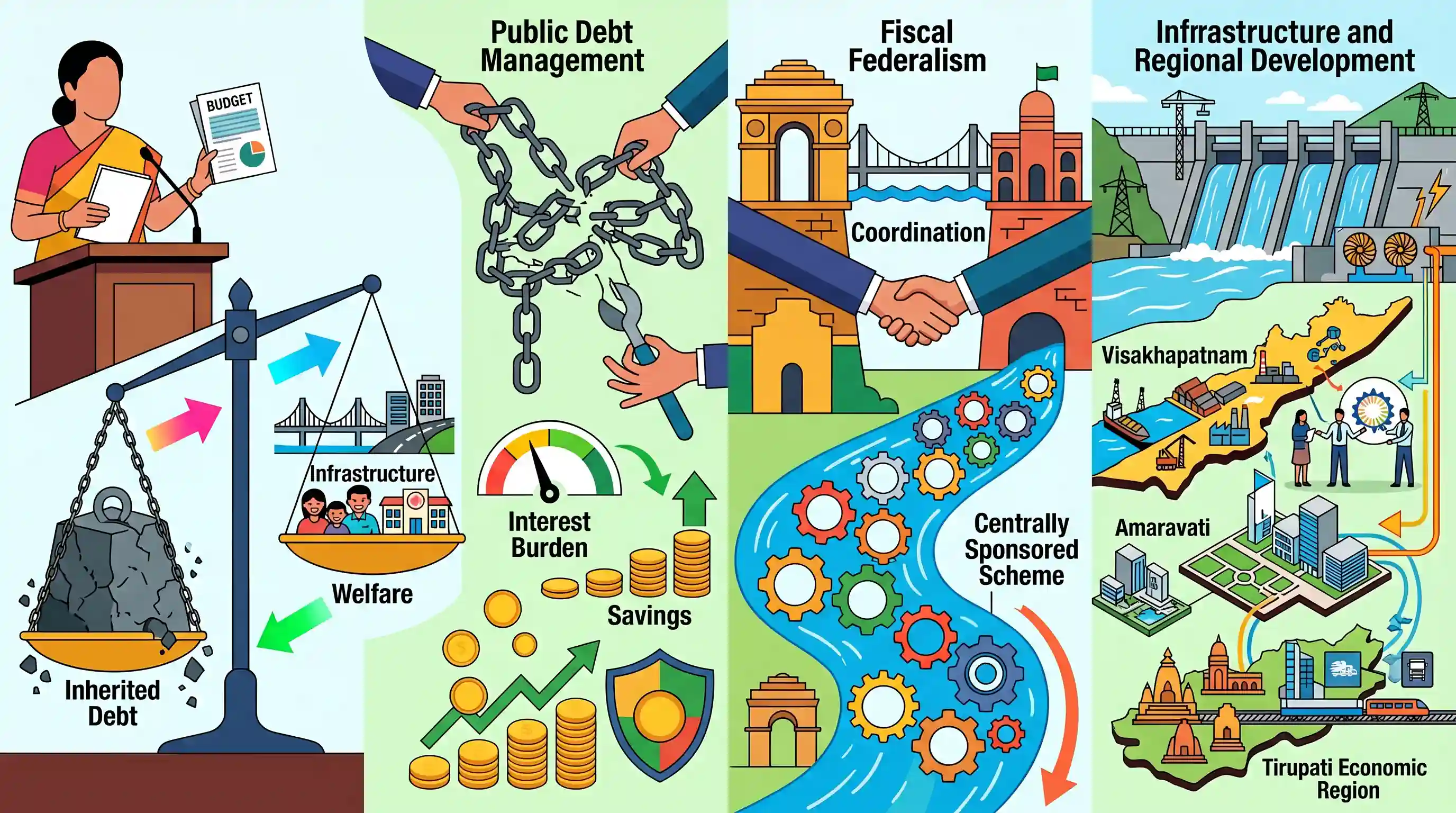
Andhra Pradesh Finance Minister Payyavula Keshav presented the 2026-27 budget, balancing the state's massive inherited debt burden with the need for infrastructure and welfare spending. Through successful debt restructuring, the state expects to save ₹2,000 crore annually on interest. Stronger Centre-State coordination enabled the revival of 85 Centrally Sponsored Schemes. The budget heavily emphasizes regional growth, featuring masterplans for Visakhapatnam (drafted with NITI Aayog), Amaravati, and Tirupati Economic Regions, and renewed momentum on the Polavaram project.
Key Points
- Andhra Pradesh Finance Minister presented the state budget focusing on all-round progress, navigating a significant inherited public debt of ₹9.74 lakh crore.
- The state successfully renegotiated loan terms, which is expected to save ₹2,000 crore annually in interest payments.
- Eighty-five Centrally Sponsored Schemes were revived with an allocation of ₹18,700 crore as the state's matching share, facilitated by Central support.
- Regional development is being prioritized through masterplans for Visakhapatnam (in collaboration with NITI Aayog), Amaravati, and Tirupati Economic Regions, along with the completion of the Polavaram irrigation project.
Important Terms
Fiscal Federalism

Financial relations and distribution of taxing/spending powers between the Union and States under the Indian Constitution (Articles 268-281).
UPSC context
GS-II: Centre-State relations. Tests knowledge of tax devolution, Finance Commission roles, and financial autonomy.
Centrally Sponsored Schemes (CSS)
Development programs jointly funded by the Centre and States (e.g., 60:40 ratio) but implemented by State governments.
UPSC context
GS-II/III: Government Policies/Budgeting. Focuses on cooperative federalism and welfare delivery mechanisms.
NITI Aayog
The premier policy think tank of India that fosters cooperative federalism through bottom-up planning and strategic policy advice.
UPSC context
GS-II: Statutory/Non-constitutional bodies. Tests the shift from centralized planning to competitive federalism.
Public Debt Management
Strategies to maintain sustainable debt levels, including restructuring interest rates or repayment terms to reduce fiscal pressure.
UPSC context
GS-III: Indian Economy. Crucial for understanding fiscal deficits, state borrowing limits, and financial stability.
Polavaram Project
A major multi-purpose national project on the Godavari River for irrigation, hydropower, and drinking water in Andhra Pradesh.
UPSC context
GS-I/III: Geography/Infrastructure. Relevant for river-linking, inter-state water disputes, and developmental challenges.
Regional Development
Strategic planning focused on specific geographic clusters (like Visakhapatnam or Amaravati) to stimulate localized economic growth.
UPSC context
GS-I/III: Urbanization/Infrastructure. Tests knowledge of balanced growth, economic corridors, and masterplanning.
Prelims Trap
"NITI Aayog provides financial allocations and tied grants for state regional masterplans."
NITI Aayog acts purely as an advisory think-tank providing technical expertise for masterplans. Financial allocations and tied grants were the hallmark of the erstwhile Planning Commission.
Static Concepts Connected
What are the constitutional limits on a State's borrowing powers?
- Domestic Limits: State executive power extends to borrowing within India upon the security of the State's Consolidated Fund, subject to state legislative limits (Article 293).
- Centre's Consent: A state cannot raise new loans without the Centre's consent if any part of a previous loan made or guaranteed by the Centre remains outstanding.
- External Borrowing: States cannot directly borrow from international markets or foreign governments; external borrowing must be legally routed through the Union Government.
How do Centrally Sponsored Schemes (CSS) impact the fiscal autonomy of States?
- Tied Expenditure: CSS mandate states to implement Centre-designed schemes, reducing local policy flexibility and imposing a 'one-size-fits-all' approach.
- Matching Share Burden: States must contribute a fixed matching percentage (e.g., 40%), which drains state revenues and limits the fiscal space available for their own capital expenditure.
- Fund Routing: To improve tracking, CSS funds are now strictly routed through the Consolidated Fund of the State rather than directly bypassing state treasuries to implementing agencies.
Cross-Topic Patterns
CSS burden + 16th Finance Commission
The massive ₹18,700 crore matching share for CSS highlights how tied grants strain state budgets, a core issue the 16th Finance Commission is evaluating for fiscal rationalization.
National Projects + Inter-state River Disputes
Polavaram's momentum links regional infrastructure to inter-state water disputes (Article 262), as its Godavari-Krishna interlinking and reservoir backwaters structurally affect neighboring Odisha and Chhattisgarh.

State borrowing limits (Art 293) and the fiscal burden of CSS matching grants are prime candidates for a Prelims 2026 conceptual question.
Linked PYQs · 5
Linked PYQs · 5
- 2025MainsGS3
Explain how the Fiscal Health Index (FHI) can be used as a tool for assessing the fiscal performance of states in India. In what way would it encourage the states to adopt prudent and sustainable fiscal policies?
- 2019MainsGS3
The public expenditure management is a challenge to the Government of India in the context of budget making during the post-liberalization period. Clarify it.
- 2025MainsGS2
Examine the evolving pattern of Centre-State financial relations in the context of planned development in India. How far have the recent reforms impacted the fiscal federalism in India?
- 2024MainsGS2
What changes has the Union Government recently introduced in the domain of Centre-State relations ? Suggest measures to be adopted to build the trust between the Centre and the States and for strengthening federalism.
- 2018MainsGS3
How are the principles followed by the NITI Aayog different from those followed by the erstwhile Planning Commission in India?
