AP assembly extends current legislative session dates
Source:The Hindu ↗
Why It Matters
Highlights the role of the Business Advisory Committee in allocating legislative time, the constitutional mechanism of replacing gubernatorial ordinances with legislative bills, and the ongoing discourse over empowering Backward Classes through local body reservations.
Summary
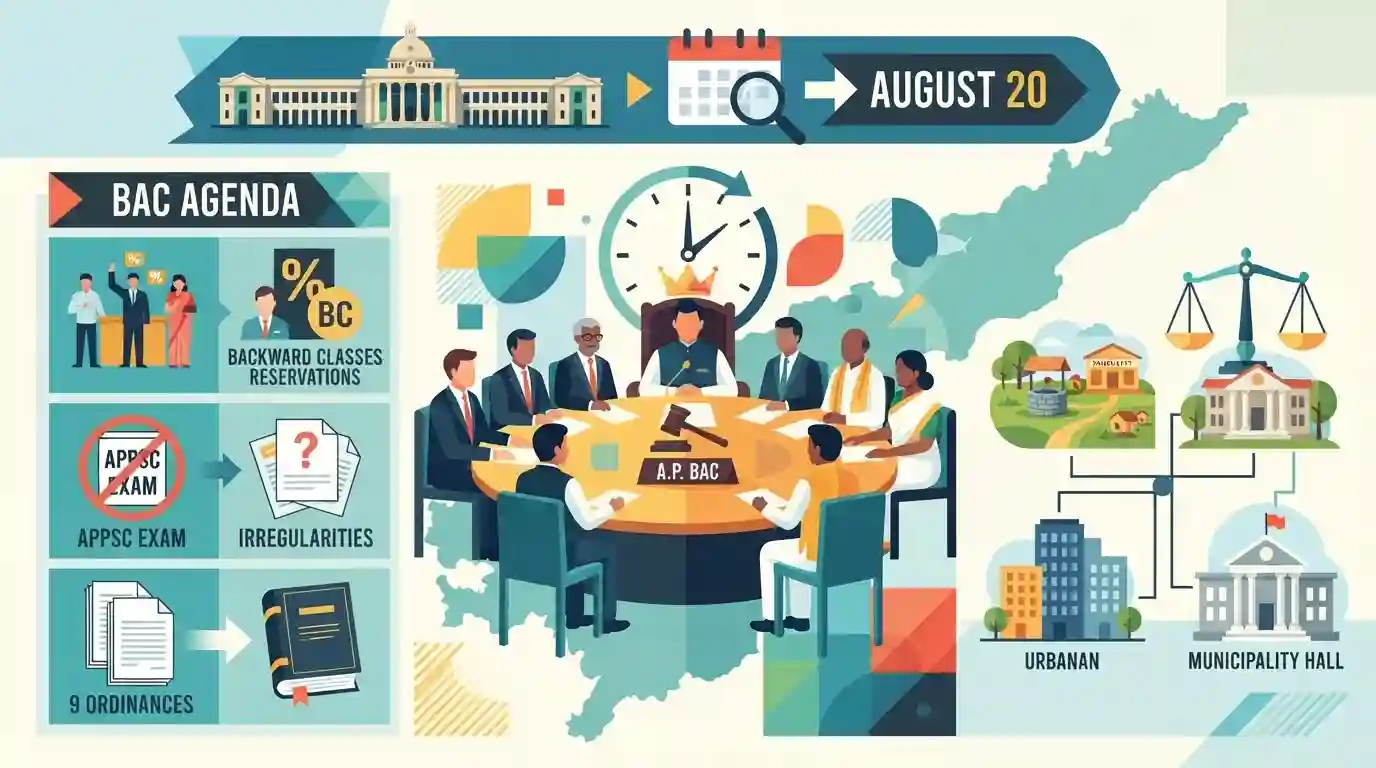
The Andhra Pradesh Legislative Assembly's Business Advisory Committee (BAC), chaired by Speaker Ch. Ayyanna Patrudu, has extended the ongoing session to August 20. Crucial discussions on the agenda include reservations for Backward Classes (BC) in local body elections and addressing alleged irregularities in the APPSC Group-I exam. The government also intends to introduce nine ordinances as formal Bills.
Key Points
- The Andhra Pradesh Assembly Business Advisory Committee (BAC) decided to extend the current legislative session until August 20.
- The session agenda features a critical discussion regarding the implementation of reservations for Backward Classes in local body elections.
- Alleged irregularities in the APPSC Group-I examination have been scheduled for legislative debate.
- The State Government will introduce nine ordinances in the form of regular Bills for legislative passage.
Important Terms
Business Advisory Committee (BAC)

A legislative committee, chaired by the Assembly Speaker, that determines the schedule and time allocated for discussing government bills and other business in the House.
UPSC context
Important for APPSC Paper II (Polity), specifically under State Legislature procedures and parliamentary committees.
Andhra Pradesh Public Service Commission (APPSC)
A constitutional body established under Article 315 of the Indian Constitution, responsible for conducting competitive examinations and advising the state government on civil service recruitment.
UPSC context
Frequently tested in APPSC exams under State Administration, constitutional bodies, and public employment rules.
Ordinance-Making Power (Article 213)
The Governor's constitutional authority under Article 213 to promulgate laws when the state legislature is not in session. These must be approved within six weeks of the legislature's reassembly.
UPSC context
Crucial for APPSC Polity questions regarding the Governor's executive powers, legislative oversight, and separation of powers.
Backward Classes (BC) Reservation in Local Bodies
Statutory quotas for Backward Classes in panchayats and municipalities. Implementing these requires fulfilling the Supreme Court's "triple test" via a dedicated commission to ensure constitutional compliance.
UPSC context
Essential for APPSC Paper II (Polity), covering Local Self-Government (73rd/74th Amendments) and social justice policies.
Prelims Trap
The Governor's ordinance lapses exactly six months after its promulgation if not passed by the Assembly.
Under Article 213, an ordinance lapses six weeks after the state legislature reassembles. Six months is merely the maximum allowed gap between two legislative sessions, not the ordinance's set lifespan.
Static Concepts Connected
What are the constitutional provisions for BC reservations in local bodies?
- Constitutional basis: Articles 243D(6) and 243T(6) empower State Legislatures to make statutory provisions for reserving seats in Panchayats and Municipalities for Backward Classes.
- Supreme Court mandate: States must fulfill the Supreme Court's "Triple Test" (empirical data, dedicated commission, and <50% overall quota limit) before implementing OBC quotas in local polls.
How does the Business Advisory Committee (BAC) function in the State Assembly?
- Composition: The Speaker of the Legislative Assembly acts as the ex-officio Chairman of the BAC. It includes nominated representatives from recognized political parties in the House.
- Primary function: It prepares the legislative agenda and allocates time for the transaction of government bills, debates, and other business during the ongoing legislative session.
Cross-Topic Patterns
Ordinance promulgation and judicial limits
The state's conversion of nine ordinances into Bills highlights Article 213 mechanics. APPSC exams frequently link this to the D.C. Wadhwa case regarding the unconstitutionality of re-promulgating ordinances.
SPSC legislative oversight
Debating APPSC irregularities in the Assembly connects to Article 323(2), under which the State Public Service Commission's annual report and advice deviations are laid before the state legislature by the Governor.

Expect a multi-statement question combining Governor's ordinance powers (Art 213) and the 'Triple Test' for local body BC reservations.
Linked PYQs · 4
Linked PYQs · 4
- 2023APPSC_PRELIMSGS1
Which of the following statements is correct with respect to the State Finance Commission ? I. It is required to appoint a State Finance Commission once in five years. II. It recommends the determination of taxes, duties, tolls and fees assigned to the Panchayats and Municipalities. III. Article 243 deals with constitution of finance commission to review financial position of Panchayats. Choose the correct answer using the codes given below :
- 2024APPSC_PRELIMSGS1
Which of the following source/sources of revenue qualifies/qualify for being given to the Panchayats? I. The tax proceeds that are assigned to the States from the Centre may be again re-distributed to the Panchayats as recommended by the Central Finance Commission. II. Loans from the State Government. III. Under Article 243-I of the Constitution of India, the State Government is empowered to devolve its own funds to the Panchayats even in the absence of the State Finance Commission's recommendations. IV. Internal Resource Generation is facilitated only in the case of Panchayats situated in Scheduled Areas as per the Fifth Schedule. Select the correct answer using the codes given below:
- 2024APPSC_PRELIMSGS1
Consider the following Assertion (A) and Reason (R) and choose the correct code : Assertion (A) : In connection with their own resource collection, the Panchayats at the village level are better placed than the Panchayats at the Intermediate and the District levels. Reason (R) : The Gram Panchayats have their own tax domain whereas the other two tiers have to depend only on tolls, fees and non-tax revenue for internal resource generation. Code :
- 2024APPSC_PRELIMSGS1
Which of the following State Bill/Bills will have to be mandatorily reserved for the President's consideration? I. A Bill that proposes to give effect to certain Directive Principles of State Policy. II. A Bill requiring prior Presidential sanction but which was however not obtained under Article 304. III. A Bill that attracts the provisions of Article 288. IV. A Bill seeking to operate a provision that belongs to one of the Concurrent List entries, but which is however repugnant to any Union law. Select the correct answer using the codes given below :
