Higher Education and Skill University Bills Passed in AP Assembly
Why It Matters
The passage of major educational bills by the Andhra Pradesh Assembly highlights critical policy shifts in higher education governance, faculty recruitment frameworks, and skill development infrastructure, which directly impact the state's socio-economic and human resource development.
Summary
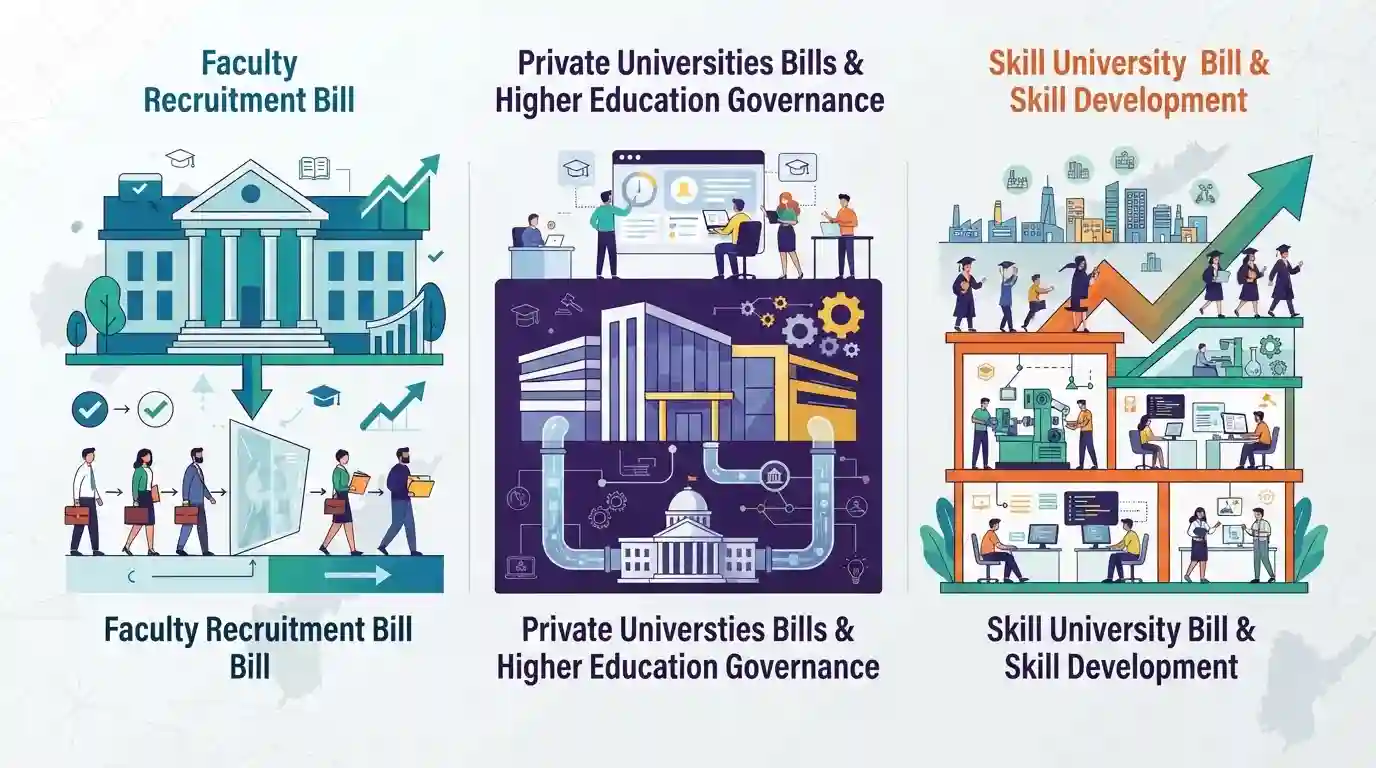
The Andhra Pradesh Assembly passed significant legislative measures including the Faculty Recruitment Bill, Private Universities Bills, and the Skill University Bill. These bills are aimed at revamping higher education governance, streamlining faculty recruitment processes, establishing specialized skill universities to enhance employability, and regulating private universities in the state.
Key Points
- The Andhra Pradesh Assembly passed crucial legislative bills including the Faculty Recruitment Bill, Private Universities Bills, and the Skill University Bill.
- These legislative changes aim to streamline faculty hiring, regulate and expand private higher education, and boost skill development and employment readiness in the state.
- The initiative aligns with the state's broader strategy to enhance human capital, technical education infrastructure, and industry-academia linkage.
Important Terms
Faculty Recruitment Bill

A legislative measure introduced to streamline and regularize faculty appointments across state universities, addressing massive vacancy backlogs through university-level recruitment and department-wise reservation.
UPSC context
APPSC Group 1/2 (State Governance & Higher Education): Tests knowledge of public policy reforms, human resource challenges in higher education, and reservation implementation.
Private Universities Bills
Legislation aimed at regulating private higher educational institutions, which includes relaxing land requirement norms from 50 acres to 10 acres in urban areas to attract academic investments.
UPSC context
APPSC Group 2 (Public Administration & Policy): Evaluates regulatory frameworks, public-private partnerships, and commercialization control in education.
Skill University Bill
A specialized bill enacted to establish skill-based universities that bridge the gap between industry requirements and workforce capabilities through vocational and technical training.
UPSC context
APPSC Group 1/2 (Economy & Skill Development): Tests policies focused on employability, youth skill enhancement, and demographic dividend utilization in AP.
Andhra Pradesh Assembly
The unicameral state legislature of Andhra Pradesh responsible for enacting state laws, debating policy matters, and passing budgetary and administrative legislation.
UPSC context
APPSC Group 1/2 (Indian Polity & Governance): Tests structural understanding of state legislature powers, legislative procedures, and state-specific governance.
Static Concepts Connected
What are the constitutional provisions and regulatory bodies governing higher education in India?
- Constitutional Basis: Concurrent List entry 25 of the Seventh Schedule empowers both Parliament and State Legislatures to legislate on education.
- Apex Regulator: University Grants Commission (UGC) under the UGC Act, 1956, maintains standards of university education in India.
- NEP 2020 Framework: National Education Policy (NEP) 2020 advocates for multi-disciplinary universities, National Higher Education Regulatory Council (NHERC), and flexible curriculum frameworks.
Cross-Topic Patterns
Skill Universities + National Employment Policy
Andhra Pradesh's skill university model mirrors the national PM-SHRI and Hub-and-Spoke higher education designs, emphasizing localized industry-academia linkage to combat structural youth unemployment.
Private Higher Education + Land Reform Economics
Relaxing land norms from 50 to 10 acres reflects the broader economic trend of incentivizing private capital in social infrastructure via liberalized regulatory frameworks.

APPSC frequently tests state legislative amendments on education: expect match-the-following on land norms, fee regulation, and faculty quotas.
Linked PYQs · 3
Linked PYQs · 3
- 2024APPSC_PRELIMSGS1
Which of the following statement/statements is/are incorrect regarding the Andhra Pradesh Industrial Policy 2023 - 27? I. To achieve a minimum contribution of 25% by industry in the State GDP II. To provide end-to-end facilitation in 2 weeks III. To envisage ten (10) priorities of accomplishment IV. To focus on becoming a 'Plug and Play State' for investments V. Ensuring land allotment by APIIC within a period of 2 weeks upon receipt of application Select the answer using the codes given below :
- 2024APPSC_PRELIMSGS1
Which of the following statement/statements is/are valid regarding the socio-economic status of Andhra Pradesh ? I. Andhra Pradesh won the Best State Award of ICAR - National Research Center for Banana (NRCB) for export promotion. II. Andhra Pradesh GSDP growth rate has been registering a decline in recent times owing to repeated lower returns in certain sub-sectors of the Service Sector. III. For the FY 2024 - 25, the Revenue Deficit is budgeted higher than the Fiscal Deficit in terms of percentage of Andhra Pradesh GSDP. IV. The technology used by the Government of Andhra Pradesh while conducting resurvey of landholdings is referred to as 'Continuously Operating Reference Stations (CORS)' technology. Select the correct answer using the codes given below :
- 2023APPSC_PRELIMSGS1
Which of the following is not a function of the Union Public Service Commission (UPSC)?
