Andhra Pradesh Assembly Passes Education and Skill Bills
Why It Matters
This development highlights critical structural and legislative reforms in Andhra Pradesh's higher education and skill development sectors, which are directly relevant to governance, social sector development, and employment policy questions in the APPSC Group 1 examination.
Summary
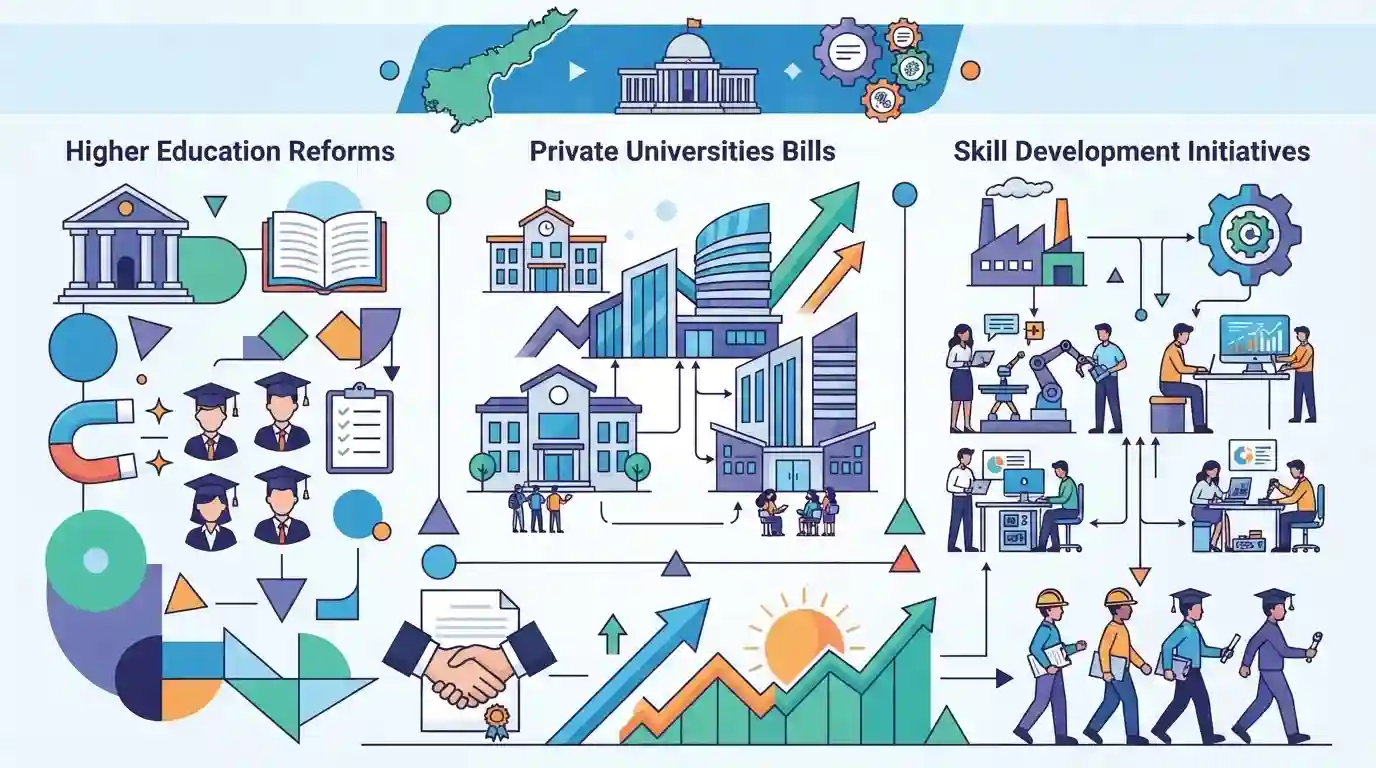
The Andhra Pradesh Legislative Assembly passed key legislative measures, including the Faculty Recruitment Bill, Private Universities Bills, and a Skill University Bill, aimed at reforming higher education, streamlining faculty appointments, and boosting skill development across the state.
Key Points
- The Andhra Pradesh Assembly passed crucial bills related to faculty recruitment, private universities, and the establishment of a skill university.
- The legislation aims to revamp higher education, streamline teaching staff appointments, and bridge the skill gap through specialized vocational and professional training institutions.
- These policy steps seek to enhance employability, promote private sector investment in education, and reform governance structures in the state's academic sector.
Important Terms
Faculty Recruitment Bill

A legislative measure designed to address long-pending faculty vacancies in state universities while establishing a legally sustainable framework for reservation norms and recruitment units.
UPSC context
Relevant for APPSC Group papers focusing on state governance, higher education reforms, and public employment policies in Andhra Pradesh.
Private Universities Bills
Amendments and laws regulating private higher educational institutions by easing criteria such as land requirements and endowment fees to attract investments and expand academic opportunities.
UPSC context
Crucial for APPSC polity and economy sections, addressing private sector participation in education, regulatory bodies, and human resource development.
Skill University Bill
Legislation establishing a framework for industry-linked skill universities—including greenfield, brownfield, and converted technical institutions—to bridge the gap between academic output and market demands.
UPSC context
Important for APPSC questions on skill development initiatives, employment generation, and economic reforms in Andhra Pradesh.
Andhra Pradesh Legislative Assembly
The unicameral state legislature of Andhra Pradesh empowered to make laws on state subjects, including public education, local governance, and financial administration.
UPSC context
Core for APPSC Indian Polity and Constitution syllabus, testing knowledge of state legislature powers, legislative procedures, and governance.
Static Concepts Connected
What are the key governance bodies and regulatory frameworks for higher education in Andhra Pradesh?
- APSCHE Mandate: Andhra Pradesh State Council of Higher Education (APSCHE) acts as the coordinating and planning body for higher education under the AP State Legislature Act.
- APHERMC Role: AP Higher Education Regulatory and Monitoring Commission (APHERMC) regulates fee structures and prevents commercialization of professional education.
- Chancellor Role: State Universities operate under specific Acts of the state legislature, with the Governor of Andhra Pradesh serving as the Chancellor.
Cross-Topic Patterns
Private Universities & Urban Land Use Norms
AP's 10-acre relaxation for private universities directly intersects with urban planning norms under CRDA and industrial corridor land allocations.
Skill Universities & National Vocational Frameworks
The German 33:66 training model links state skill initiatives with national vocational frameworks like PMKVY and industrial apprenticeships.

AP Private Universities & Skill University Bills 2026: Expect matching questions on recruitment unit changes and land/endowment relaxations.
Linked PYQs · 2
Linked PYQs · 2
- 2023APPSC_PRELIMSGS1
Part V of the Andhra Pradesh Reorganisation Act deals with
- 2024APPSC_PRELIMSGS1
Which of the following statement/statements is/are incorrect regarding the Andhra Pradesh Industrial Policy 2023 - 27? I. To achieve a minimum contribution of 25% by industry in the State GDP II. To provide end-to-end facilitation in 2 weeks III. To envisage ten (10) priorities of accomplishment IV. To focus on becoming a 'Plug and Play State' for investments V. Ensuring land allotment by APIIC within a period of 2 weeks upon receipt of application Select the answer using the codes given below :
