Andhra Pradesh building rules amendments for ease of doing business
Source:The Hindu ↗
Why It Matters
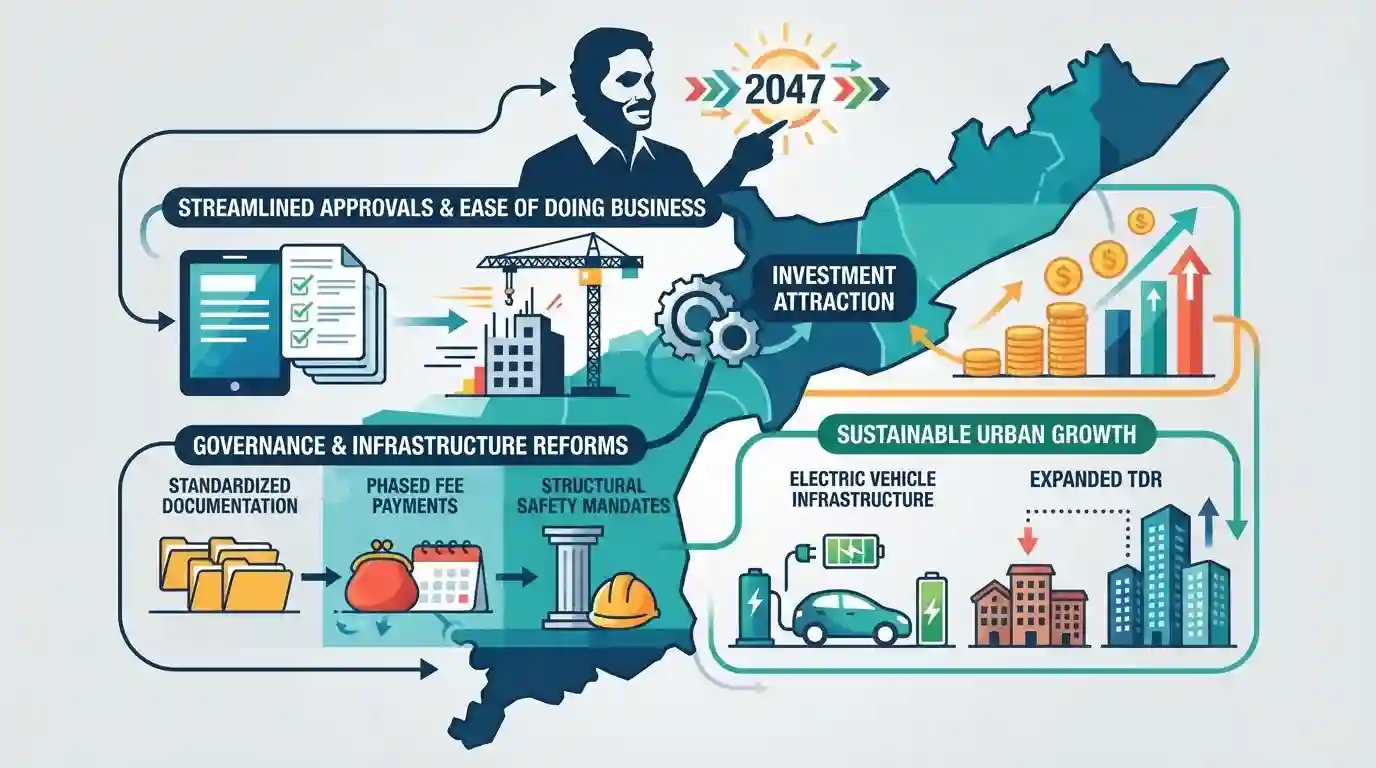
Demonstrates state-level administrative reforms to boost real estate investment, ensure structural safety, and integrate sustainable practices (like EV charging) into urban development. Relevant for questions on urbanization, infrastructure financing, and ease of doing business in India.
Summary
The Andhra Pradesh government has amended the A.P. Building Rules, 2017, to streamline construction approvals and attract investment. Aligned with Chief Minister N. Chandrababu Naidu's 'Swarna Andhra@2047' vision, the reforms introduce standardized documentation, phased infrastructure fee payments, and structural safety mandates. The updated rules also emphasize sustainable urban growth by requiring electric vehicle charging infrastructure and expanding the use of Transferable Development Rights (TDR).
Key Points
- The Andhra Pradesh government amended the A.P. Building Rules, 2017, to simplify the approval process, accelerate construction, and stimulate investment in the real estate sector.
- Buildings 24 meters or higher are now classified as high-rise, and standard operating procedures (SOPs) are mandated for issuing approvals.
- The amendments introduce a phased payment option for the City-Level Infrastructure Impact Fee, structural safety certification for buildings over 10 meters, and a mandatory 'All Risks Insurance Policy' during construction.
- Sustainable and inclusive urban development is promoted through provisions for Transferable Development Rights (TDR), EV charging infrastructure, and essential amenities like creches in major projects.
Important Terms
A.P. Building Rules, 2017

A statutory framework governing urban construction and zoning in Andhra Pradesh. Recent amendments streamlined approvals, introduced phased fire clearances, mandated EV charging infrastructure, and allowed installment-based fee payments to boost investment.
UPSC context
GS2/GS3 (Governance & Infrastructure). Tests knowledge of state-level reforms for ease of doing business and urban planning policies.
Swarna Andhra@2047
Andhra Pradesh’s strategic vision to build a $2.4 trillion economy by 2047. It focuses on achieving zero poverty, green energy, and tech-driven governance, aligning with the national Viksit Bharat goals.
UPSC context
GS2/GS3 (Economic Planning). Tests understanding of long-term state public policy, sustainable growth roadmaps, and cooperative federalism.
Transferable Development Rights (TDR)
An urban planning tool where landowners surrendering property for public infrastructure receive a certificate of development rights. These rights can be used to build additional floors elsewhere or sold for profit.
UPSC context
GS1/GS3 (Urbanization). Tests knowledge of land acquisition alternatives, urban growth management, and smart city development mechanisms.
Prelims Trap
"Transferable Development Rights (TDR) involves the government paying direct cash compensation for urban land acquisition."
TDR is explicitly a non-cash, market-based mechanism. The landowner gets a certificate for additional built-up area elsewhere (or to sell to developers), allowing local bodies to acquire land without massive cash payouts.
Static Concepts Connected
What are Transferable Development Rights (TDR) in urban planning?
- Mechanism: It allows landowners to surrender land for public purposes (like road widening) in exchange for development rights rather than direct cash compensation.
- Zoning transfer: It involves transferring development potential from restricted 'sending zones' to designated high-growth 'receiving zones'.
- Tradability: These rights are issued as certificates which can be utilized by the landowner or traded/sold in the open market to real estate developers.
What is the National Building Code (NBC) of India?
- Origin: A comprehensive building code published by the Bureau of Indian Standards (BIS) covering structural and fire safety.
- Advisory nature: It is an advisory model code. States and municipal bodies must adopt it into their respective local building bylaws to make it legally enforceable.
- Scope: It integrates guidelines for sustainable building practices, disaster-resilient structural designs, and modernized construction technologies.
Cross-Topic Patterns
TDR + Land Acquisition challenges
TDR bypasses the hurdles of the LARR Act 2013 by offering market-tradable development rights instead of lengthy cash-compensation disputes, accelerating urban infrastructure projects like metro rails and road widening.
Disaster Management + Urban Planning
Shifting structural safety mandates (geotechnical designs) and mandatory risk insurance to developers aligns with the Sendai Framework's focus on investing in disaster risk reduction upfront rather than post-disaster relief.

Expect a multi-statement Prelims question testing the mechanics of Transferable Development Rights (TDR) in urban infrastructure.
Linked PYQs · 3
Linked PYQs · 3
- 2024APPSC_PRELIMSGS1
In connection with the Urban Infrastructure Development Fund (UIDF), which of the following statement/statements is/are valid? I. The fund will be established through reserved bonds taken from the G-Sec market. II. The fund is to be exclusively availed by private agencies to create urban infrastructure in Tier 2 and Tier 3 cities. III. Eligible activities for UIDF shall be connected to the Missions and Programmes of the Ministry of Housing | Urban Affairs (MoHUA). IV. The fund will be collectively managed by a cluster of Municipal Cooperative Banks. Select the correct answer using the codes given below:
- 2024APPSC_PRELIMSGS1
The Interim Union Budget (FY25) has proposed initiatives to boost India's Green Energy Sector. Which of the following proposals are connected with developing India's Green Energy ? I. Viability Gap Funding (VGF) for utilizing solar energy projects II. To set up coal gasification and liquefaction capacity of 100MT by 2030 III. Optional blending of Compressed Bio Gas (CBG) in Compressed Natural Gas (CNG) for transport and Piped Natural Gas (PNG) for domestic purposes IV. Provision of financial assistance for procurement of biomass aggregation machinery V. Setting up of a payment security system for expanding the bio-manufacturing system in the country Select the correct answer using the codes given below :
- 2024APPSC_PRELIMSGS1
Which of the following statements are valid in connection with Andhra Pradesh Green Hydrogen and Green Ammonia Policy (2023)? I. The objective is to target Green Energy production up to the capacity of 1 MPTA (Million Tonnes Per Annum) or Green Ammonia production up to the capacity of 2-0 MTPA in the next five years. II. New and Renewable Energy Development Corporation of A.P. Ltd (NREDCAP) shall act as a Nodal Agency under this policy. III. All the Ports in the State have infrastructure for storing liquid nitrogen which can then be utilized for storing Green Hydrogen for exporting to other countries. IV. The Policy prohibits the production of Green Hydrogen/Green Ammonia by using Renewable Energy and/or Biomass from 'Third-Party/Power exchange'. Select the correct answer using the codes given below :
