Article 15 5 Reservation Mandates in Private Education
Source:The Hindu ↗
Why It Matters
Reservation policies in private educational institutions represent a critical intersection of constitutional law (Article 15), social justice, and governance. With the increasing privatization of higher education, understanding the mandate to enforce equitable access for marginalized communities—and the role of new regulatory bodies in executing this mandate—is highly relevant for GS Paper 2.
Summary
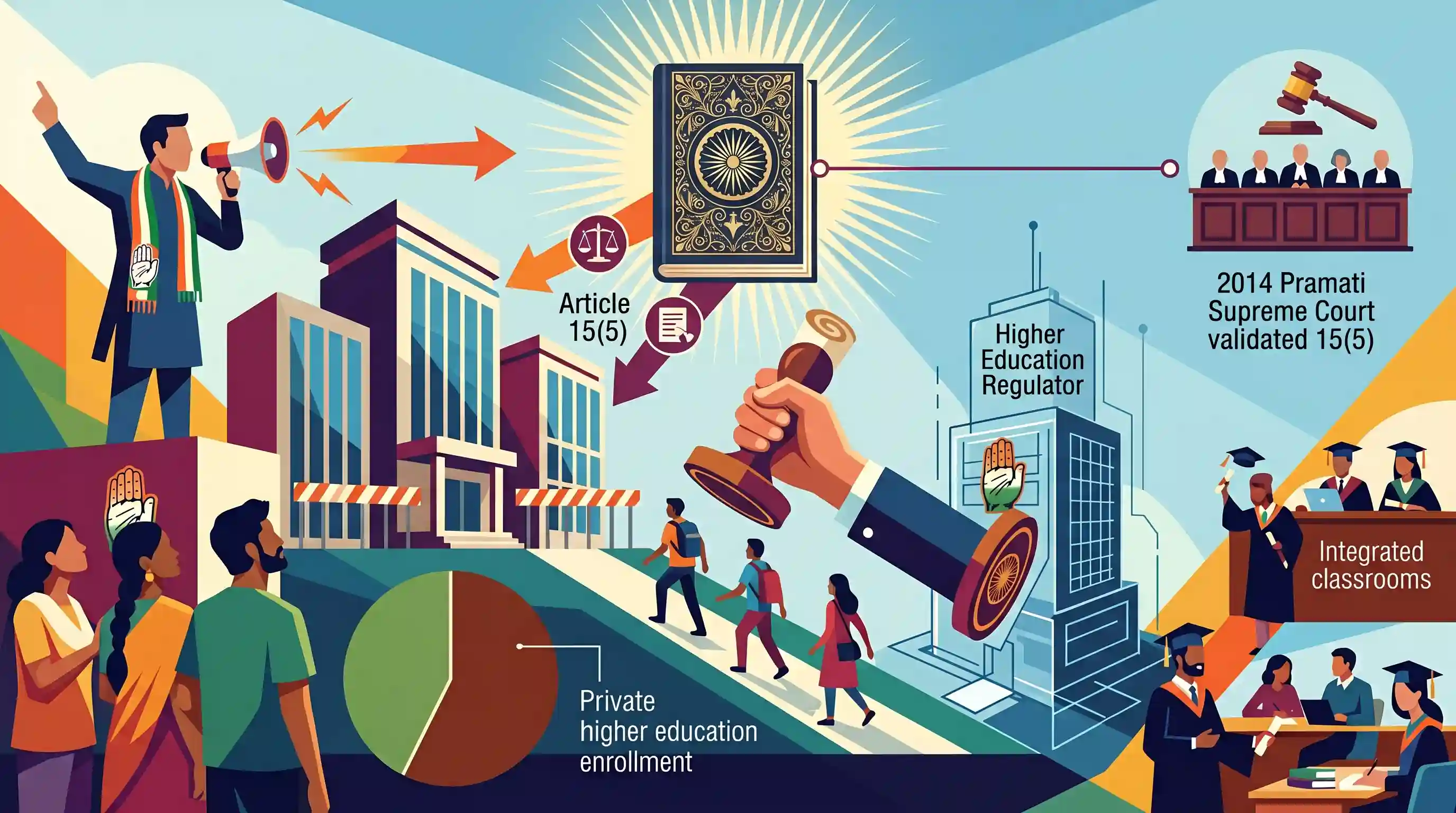
The Congress party has strongly urged the Central Government to ensure the implementation of Article 15(5) of the Constitution across all private higher education institutions. This constitutional provision, introduced by the 93rd Amendment Act, allows the State to mandate reservations for SCs, STs, and OBCs in private educational entities. The demand coincides with debates surrounding the proposed 'Viksit Bharat Shiksha Adhishthan Bill, 2025', which aims to create a single overarching higher education regulator. Highlighting that private institutions now account for 70% of higher education enrollment, Congress insists the new regulator must have explicit authority to oversee and enforce these reservations. The validity of Article 15(5) was previously affirmed by a five-judge Supreme Court bench in the 2014 Pramati Educational and Cultural Trust case.
Key Points
- The Congress party has demanded the enforcement of Article 15(5) to guarantee reservations for SCs, STs, and OBCs in private higher educational institutions.
- Article 15(5), introduced via the 93rd Constitutional Amendment Act, empowers the State to mandate affirmative action in admissions to private educational institutions, exempting minority institutions.
- The Supreme Court upheld the constitutional validity of Article 15(5) in the 2014 Pramati Educational and Cultural Trust case.
- Private universities currently host nearly 70% of higher education students, making their inclusion in affirmative action policies crucial for social equity.
- The proposed Viksit Bharat Shiksha Adhishthan Bill, 2025, which seeks to establish a single higher education regulator, is being scrutinized for whether it will explicitly empower the regulator to enforce these reservations.
Important Terms
Article 15(5) of the Constitution

A constitutional provision allowing the State to mandate reservations for SCs, STs, and OBCs in educational institutions, including private unaided ones, while excluding minority-run institutions.
UPSC context
GS Paper II: Indian Constitution and Social Justice. Crucial for understanding affirmative action and educational equity.
93rd Constitutional Amendment Act, 2005
Legislation that inserted Article 15(5) into the Constitution to enable reservations in private educational entities, effectively nullifying the Supreme Court's P.A. Inamdar (2005) ruling.
UPSC context
GS Paper II: Constitutional Amendments. Tests the evolution of reservation policy and legislative-judicial relations.
Pramati Educational and Cultural Trust vs Union of India (2014)
A landmark 2014 Supreme Court judgment that upheld the constitutional validity of the 93rd Amendment and Article 15(5), confirming the State's power to regulate private non-minority schools.
UPSC context
GS Paper II: Fundamental Rights and Judiciary. Key precedent for the 'Basic Structure' doctrine and educational rights.
Viksit Bharat Shiksha Adhishthan Bill, 2025
A proposed 2025 law aiming to establish a single, overarching regulator for higher education, replacing the UGC, AICTE, and NCTE to streamline standards and accreditation.
UPSC context
GS Paper II: Governance and Education. Relevant for reforms under NEP 2020 and regulatory restructuring.
Minority Educational Institutions
Institutions established under Article 30(1), which are constitutionally exempt from the reservation mandates of Article 15(5) to protect their right to administer their own institutions.
UPSC context
GS Paper II: Fundamental Rights. Essential for understanding the balance between social justice and minority protections.
Prelims Trap
"Article 15(5) mandates reservations for SCs, STs, and OBCs across all private educational institutions, including minority institutions."
Article 15(5) explicitly exempts minority educational institutions (covered under Article 30) from state-mandated reservations to protect their distinct administrative autonomy.
Static Concepts Connected
How did the 93rd and 103rd Constitutional Amendments expand Article 15?
- Article 15(5): Inserted by the 93rd Amendment (2005), it extends reservation in admissions to private educational institutions (aided or unaided), excluding minority institutions.
- Article 15(6): Inserted by the 103rd Amendment (2019), it provides up to 10% reservation for Economically Weaker Sections (EWS) in educational institutions, including private unaided ones.
What protections do Minority Educational Institutions enjoy under the Constitution?
- Article 30(1): Guarantees all religious and linguistic minorities the right to establish and administer educational institutions of their choice.
- RTE Exemption: As upheld in the Pramati Trust case (2014), minority institutions are exempt from providing quotas under the Right to Education (RTE) Act to preserve their autonomy.
Cross-Topic Patterns
Affirmative Action in Private Domains
The push to enforce Article 15(5) parallels recent state-level laws attempting to mandate local quotas in private sector jobs (e.g., Haryana), raising questions on the limits of state welfare vs private autonomy.
Higher Education Regulatory Overhaul
The Viksit Bharat Shiksha Adhishthan Bill embodies NEP 2020's vision of replacing fragmented bodies (UGC, AICTE) with a single "light but tight" regulator.

Expect a multi-statement prelims question testing the exact exemptions for minority institutions under Art 15(5) versus the RTE Act.
Linked PYQs · 3
Linked PYQs · 3
- 2018MainsGS2
Whether National Commission for Scheduled Castes (NCSC) can enforce the implementation of constitutional reservation for the Scheduled Castes in the religious minority institutions? Examine.
- 2014MainsGS2
Should the premier institutes like IITs/IIMs. be allowed to retain premier status, allowed more academic independence in designing courses and also decide mode/criteria of selection of students. Discuss in light of the growing challenges.
- 2015MainsGS2
For achieving the desired objectives, it is necessary to ensure that the regulatory institutions remain independent and autonomous. Discuss in the light of the experiences in recent past.
