Future Terrorist Acts Will Be Treated As Acts of War Says Government
Source:The Hindu ↗
Why It Matters
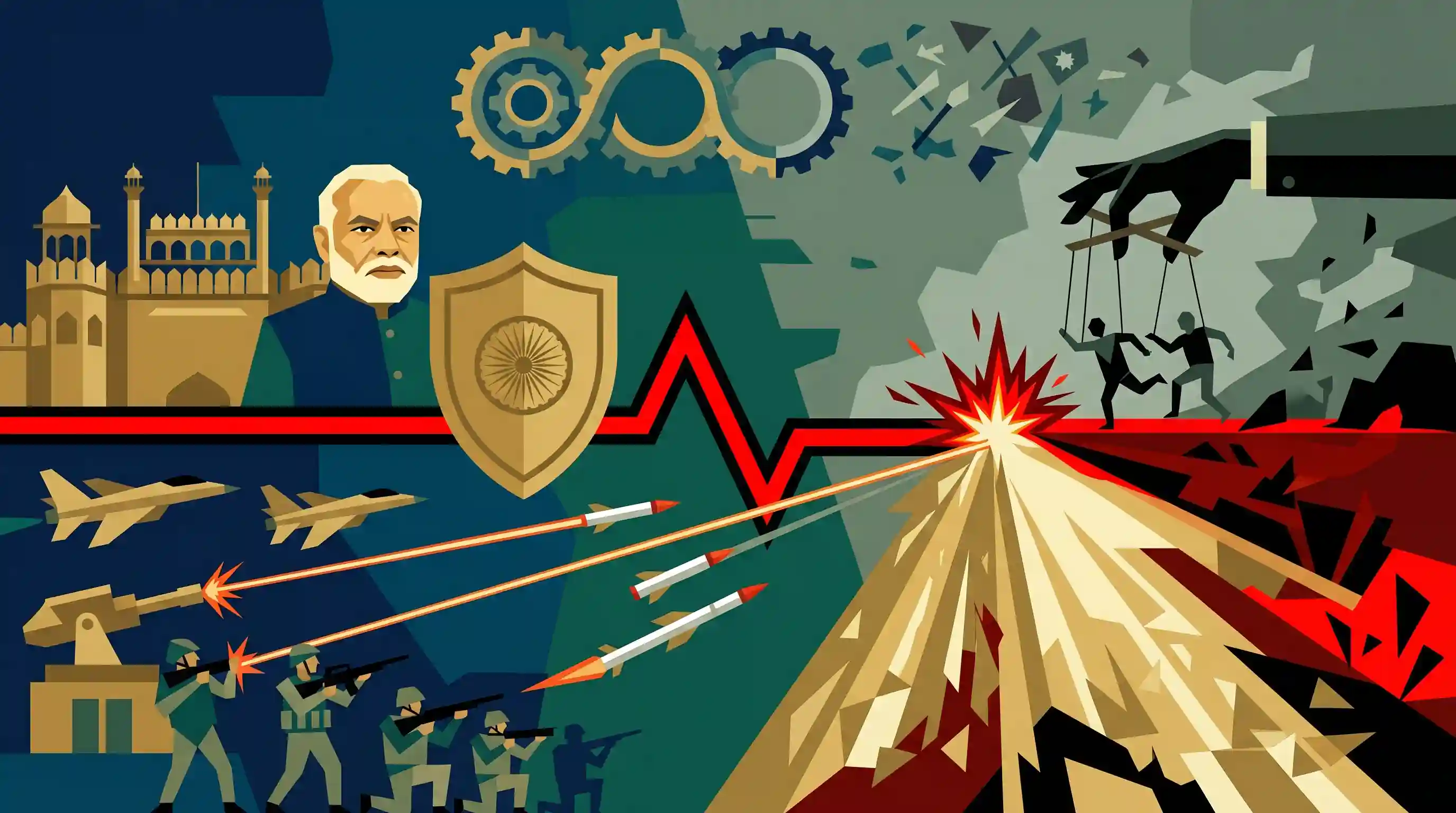
Redefining cross-border terrorism as an "act of war" marks a fundamental paradigm shift in India's strategic doctrine. It moves away from treating terror attacks solely as internal security or law-and-order issues towards framing them as triggers for conventional military conflict, fundamentally altering deterrence dynamics and the threshold for escalation with adversarial neighbors.
Summary
The Indian government has established a new strategic doctrine, declaring that any future terror act against the country will be considered an 'act of war' and met with a decisive response. Precipitated by the April 22, 2025, Pahalgam terror attack and unfolding during 'Operation Sindoor', this posture draws firm red lines aimed primarily at deterring Pakistan from utilizing proxy warfare and state-sponsored terrorism.
Key Points
- The Indian government has officially declared that any future terrorist attack in the country will be considered an "act of war".
- The policy sets a firm red line against state-sponsored terrorism and proxy warfare, guaranteeing a decisive military or strategic response to future escalations.
- This major shift in national security doctrine comes in the aftermath of the deadly April 22, 2025, Pahalgam terror attack that killed 26 civilians.
- The declaration is seen as a direct warning to Pakistan amidst the ongoing military engagement known as Operation Sindoor.
Important Terms
Operation Sindoor

A May 2025 joint military operation by the Indian Army, Air Force, and Navy, involving precision strikes on nine terror camps in Pakistan and PoK.
UPSC context
GS Paper 3: Internal Security. Tests India's shift toward conventional retaliatory responses and 'deterrence by punishment.'
Pahalgam Terror Attack (2025)
An April 22, 2025, militant attack in Jammu & Kashmir's Baisaran Valley that killed 26 civilians, primarily tourists.
UPSC context
GS Paper 3: Internal Security. Evaluates threats to civilian targets and the impact of terrorism on regional stability.
National Security Doctrine (New)
The 2025 strategic shift declaring cross-border terrorism an 'act of war,' removing the distinction between terror groups and their state sponsors.
UPSC context
GS Paper 3: Security challenges/management. Examines the evolution of India's response to state-sponsored hybrid warfare.
Proxy Warfare
A conflict where a state uses non-state actors (proxies) to attack an adversary to maintain plausible deniability and avoid direct war.
UPSC context
GS Paper 3: External state/non-state actor challenges. Crucial for understanding J&K's security dynamics and Pakistan's 'thousand cuts' policy.
The Resistance Front (TRF)
A militant group and offshoot of Lashkar-e-Taiba (LeT) that claimed responsibility for the 2025 Pahalgam attack.
UPSC context
GS Paper 3: Internal Security. Tests knowledge of specific terror outfits and their role in regional insurgencies.
Strategic Deterrence
A military-political strategy aimed at preventing an adversary's aggression by ensuring the perceived costs of action far outweigh the benefits.
UPSC context
GS Paper 3: Border management and security. Analyzes escalation control and the 'Red Lines' in nuclear-armed subcontinents.
Prelims Trap
"The 'unwilling or unable' doctrine is explicitly codified under Article 51 of the UN Charter."
Article 51 allows self-defence, but the "unwilling or unable" test is an evolving customary international law norm, not a codified clause within the UN Charter.
Static Concepts Connected
What does Article 51 of the UN Charter stipulate regarding national self-defence?
- Inherent right: Recognizes the inherent right of individual or collective self-defence if an armed attack occurs against a member state.
- UNSC reporting: Measures taken by members in the exercise of this right of self-defence must be immediately reported to the United Nations Security Council.
How does 'deterrence by punishment' differ from 'deterrence by denial'?
- By denial: Focuses on hardening targets and improving defenses (e.g., border fencing) to convince the adversary that an attack will operationally fail.
- By punishment: Threatening severe retaliatory costs (like conventional cross-border military strikes) that outweigh any potential gains from an adversary's attack.
Cross-Topic Patterns
Economic deterrence vs. Military deterrence
India is augmenting diplomatic tools like FATF greylisting (financial deterrence) with kinetic military doctrines (deterrence by punishment) to comprehensively squeeze state-sponsored proxy war machinery.
Proxy wars under a nuclear umbrella
Adversaries historically utilized sub-conventional terrorism relying on India's fear of nuclear escalation. This doctrinal shift calls the nuclear bluff by guaranteeing conventional retaliation.

GS-3 Mains 2026 will likely test the legal validity of the 'unwilling or unable' doctrine under Article 51 against non-state actors.
Linked PYQs · 4
Linked PYQs · 4
- 2016MainsGS3
The terms 'Hot Pursuit' and 'Surgical Strikes' are often used in connection with armed action against terrorist attacks. Discuss the strategic impact of such actions.
- 2016MainsGS2
Increasing cross-border terrorist attacks in India and growing interference in the internal affairs of several member-states by Pakistan are not conducive for the future of SAARC (South Asian Association for Regional Cooperation)." Explain with suitable examples.
- 2015MainsGS2
Terrorist activities and mutual distrust have clouded India-Pakistan relations. To what extent the use of soft power like sports and cultural exchanges could help generate goodwill between the two countries? Discuss with suitable examples.
- 2025MainsGS3
Terrorism is a global scourge. How has it manifested in India? Elaborate with contemporary examples. What are the counter measures adopted by the State? Explain.
