Hate Speech and Rule of Law: Legal Treatment of Politicians
Source:Indian Express ↗
Why It Matters
The article provides critical perspectives on the intersection of hate speech, freedom of expression, and the rule of law. It is highly relevant for GS2 answers dealing with Fundamental Rights, the selective application of anti-terror laws, and the judiciary's role in upholding constitutional morality without bias.
Summary
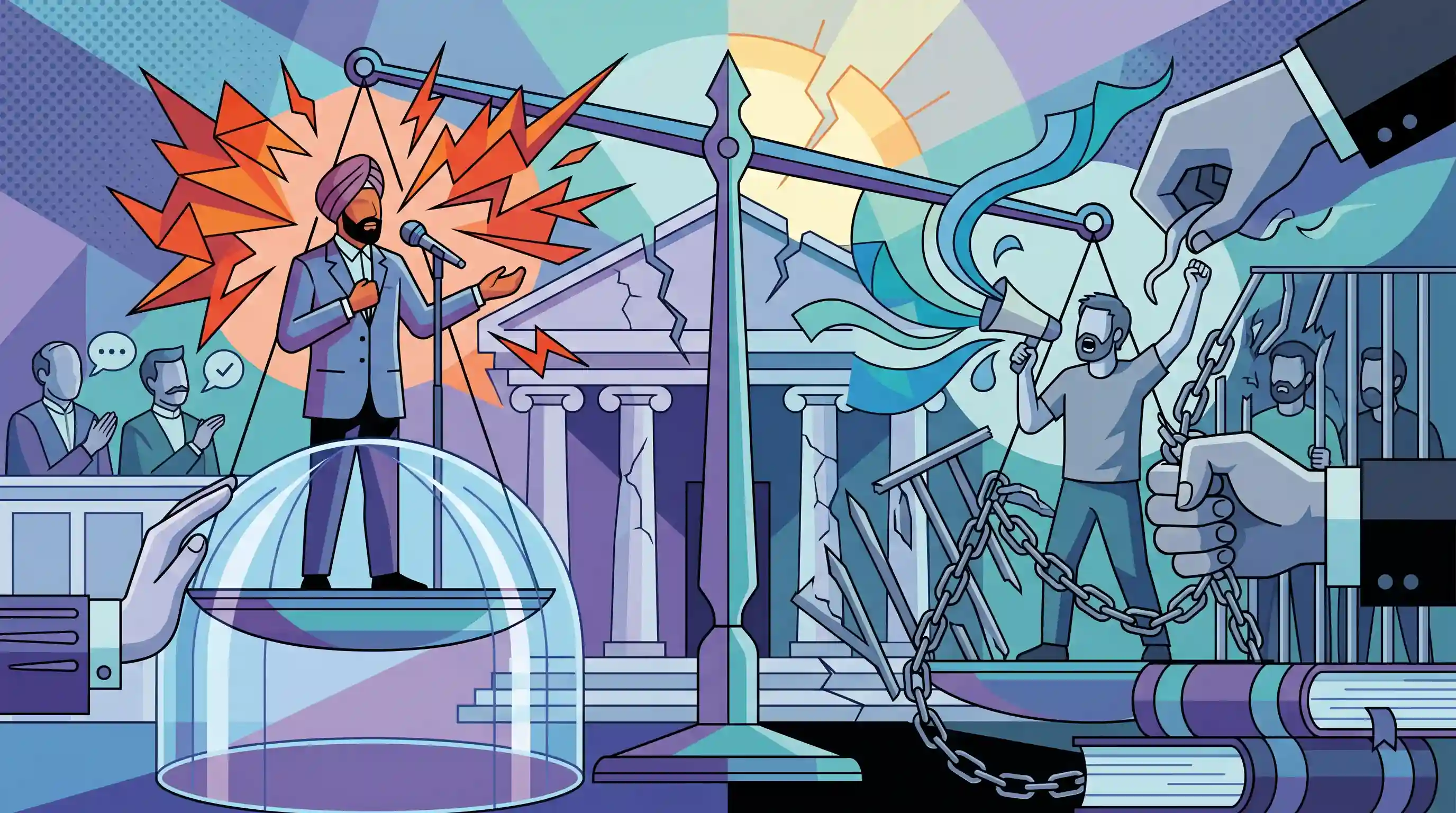
The article critiques the differential treatment of speech by the Indian legal system, contrasting the impunity enjoyed by powerful political figures with the criminalization of dissenting citizens. It points out that while ministers have faced little to no consequences for clear instances of hate speech, activists like Umar Khalid are subjected to prolonged detention under stringent anti-terror laws. The author argues that this selective application of the law, sometimes aided by lenient judicial interpretations for the powerful, severely undermines the rule of law and the constitutional guarantee of equality before the law.
Key Points
- The article highlights a dichotomy in the legal treatment of speech, arguing that the system provides impunity to political leaders while heavily penalising activists.
- Inflammatory speeches by ministers (like Anurag Thakur) have been rationalized or excused by courts, sometimes using subjective metrics like whether the statement was made with a 'smile'.
- Conversely, dissenting citizens and activists (like Umar Khalid) face prolonged incarceration under stringent laws such as UAPA for speeches critical of the state.
- This selective application of the law undermines core constitutional principles, including Article 14 (Equality before Law) and the uniform application of reasonable restrictions on Freedom of Speech under Article 19(2).
Important Terms
Unlawful Activities (Prevention) Act (UAPA)

India's primary anti-terror legislation designed to prevent activities threatening national sovereignty and integrity. It allows for extended pre-charge detention (up to 180 days) and makes bail exceptionally difficult to obtain.
UPSC context
GS Paper II (Governance) & III (Security). Tests the balance between stringent state security laws and individual fundamental rights.
Article 14 (Equality before Law)
A fundamental right ensuring the State shall not deny any person equality before the law or equal protection of the laws. It strikes at arbitrary state action.
UPSC context
GS Paper II (Fundamental Rights). Central to discussions on the "Rule of Law" and checking discriminatory executive or legislative actions.
Hate Speech
Speech intended to incite hatred, hostility, or violence against groups based on religion, race, or caste. While not specifically defined in law, it is penalized under the Bharatiya Nyaya Sanhita.
UPSC context
GS Paper II (Social Justice/Polity). Relevant for "reasonable restrictions" under Article 19(2) and maintaining communal harmony.
Rule of Law
The principle that all individuals, including government officials, are subject to and accountable to law. The Supreme Court recognizes it as part of the Constitution's "Basic Structure."
UPSC context
GS Paper II (Polity). Essential for understanding constitutionalism, judicial review, and the prevention of arbitrary governance.
Constitutional Morality
Adherence to the core values and "spirit" of the Constitution (like liberty and fraternity) rather than just its literal text, ensuring governance remains democratic and inclusive.
UPSC context
GS Paper II (Judiciary/Governance). Frequently tested in the context of judicial activism and the ethical conduct of public officials.
Article 19(1)(a)
Guarantees every citizen the right to express views freely. It is subject to "reasonable restrictions" like public order, decency, and the sovereignty and integrity of India.
UPSC context
GS Paper II. Key to analyzing the limits of free speech and the state's power to regulate dissent.
Prelims Trap
The Constitution of India explicitly defines 'Hate Speech' as a ground for restricting Freedom of Speech under Article 19(2).
'Hate speech' is neither explicitly mentioned nor defined in the Constitution. Article 19(2) uses broader terms like 'public order', 'decency', and 'morality' to restrict speech.
Static Concepts Connected
What are the reasonable restrictions on Freedom of Speech under Article 19(2)?
- Sovereignty and Integrity: Protecting the unity of India (added by the 16th Amendment).
- Public Order & Security: Maintaining public peace, tranquility, and preventing internal or external threats.
- Decency and Morality: Preventing obscenity, defamation, and incitement to an offense.
- Contempt of Court: Ensuring the authority and dignity of the courts are not undermined.
How does the UAPA bail provision (Section 43D(5)) depart from ordinary criminal law?
- Prima Facie Test: Bail must be denied if the court believes accusations are 'prima facie true' based on the police report.
- Burden of Proof: It effectively shifts the burden onto the accused to show the case is false at the bail stage itself, restricting judicial discretion.
- Exception to Rule: It deviates from the standard 'bail is rule, jail is exception' principle established in ordinary criminal jurisprudence.
Cross-Topic Patterns
Hate Speech and RPA 1951
Promoting enmity on grounds of religion or race during elections is a 'corrupt practice' under Section 123 of the Representation of the People Act, leading to potential disqualification.
Strict Bail: UAPA and PMLA
UAPA's 'prima facie true' test mirrors PMLA's 'twin conditions' for bail. Both severely restrict personal liberty and reflect a legislative trend often evaluated in GS2 Judiciary questions.

Mains 2026 GS2 will likely test the intersection of Article 14 (Rule of Law), Article 19(2), and stringent bail conditions under UAPA.
Linked PYQs · 3
Linked PYQs · 3
- 2014MainsGS2
What do you understand by the concept "freedom of speech and expression"? Does it cover hate speech also ? Why do the films in India stand on a slightly different plane from other forms of expression ? Discuss.
- 2021MainsGS2
‘Constitutional Morality’ is rooted in the Constitution itself and is founded on its essential facets. Explain the doctrine of ‘Constitutional Morality’ with the help of relevant judicial decisions.
- 2025MainsGS2
"Constitutional morality is the fulcrum which acts as an essential check upon the high functionaries and citizens alike...." In view of the above observation of the Supreme Court, explain the concept of constitutional morality and its application to ensure balance between judicial independence and judicial accountability in India.
