Anurag Thakur demands Himachal withdraw state lottery tender
Source:theprint ↗
Why It Matters
The issue highlights the tension between a state's need for revenue generation and its constitutional obligations under the Directive Principles of State Policy (Articles 38 and 47) to safeguard citizens from economically and socially injurious practices like gambling.
Summary
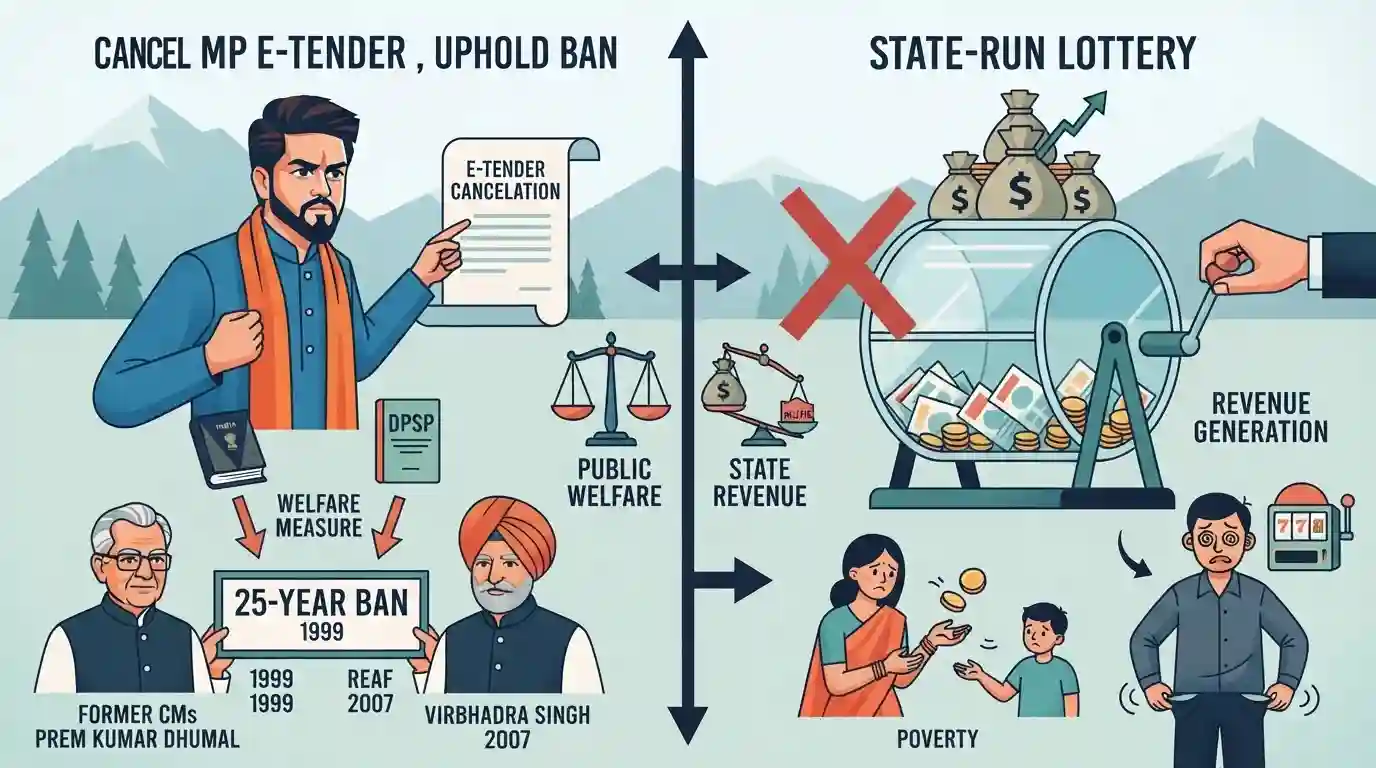
BJP MP Anurag Thakur has strongly urged Himachal Pradesh Chief Minister Sukhvinder Singh Sukhu to immediately cancel an e-tender issued by the state finance department to reintroduce state-run lotteries after a 25-year ban. Thakur pointed out that the ban, initially implemented by Prem Kumar Dhumal in 1999 and reaffirmed by Virbhadra Singh in 2007, was a crucial welfare measure. By referencing Articles 38 and 47 of the Directive Principles of State Policy, Thakur highlighted the constitutional obligation of the state to secure public welfare and prevent harmful practices. He argued that resuming the lottery to boost state revenue would ultimately impoverish the poor and foster widespread gambling addiction.
Key Points
- BJP MP Anurag Thakur demanded that Himachal Pradesh CM Sukhvinder Singh Sukhu withdraw an e-tender aimed at reintroducing state-run lotteries.
- The state finance department issued the tender to revive the lottery system, which was originally banned in 1999 by former CM Prem Kumar Dhumal and subsequently kept banned by Virbhadra Singh in 2007.
- Thakur invoked Articles 38 and 47 of the Directive Principles of State Policy (DPSP) to argue that the state has a constitutional duty to promote public welfare and prohibit injurious practices.
- He criticized the state government for attempting to raise revenue at the expense of vulnerable citizens, stating that lotteries would encourage gambling addiction and financially ruin poor families.
Important Terms
Article 38

A Directive Principle of State Policy (DPSP) mandating the State to promote public welfare by securing a social order based on justice and minimizing inequalities in income, status, and opportunities.
UPSC context
Essential for HPAS GS Paper 2 (Polity); tests understanding of the State's socio-economic obligations versus revenue generation methods like lotteries.
Article 47
A Directive Principle of State Policy (DPSP) instructing the State to raise nutrition, living standards, and public health, explicitly encouraging the prohibition of intoxicating drinks and health-injurious substances.
UPSC context
Highly relevant for GS Paper 2 (Polity); assesses the constitutional rationale for banning harmful societal practices such as gambling or alcohol.
Finance Department, Government of Himachal Pradesh
The nodal state body managing public finances, drafting budgets, overseeing debt, and floating revenue generation tenders, recently responsible for the controversial e-tender to reintroduce state-run lotteries.
UPSC context
Important for HPAS GS Paper 2 (State Administration); highlights the department's role in resource mobilization and balancing fiscal deficits against public welfare.
Constitution of India
The supreme law of the nation that establishes the framework for governance, fundamental rights, and Directive Principles of State Policy (DPSP) which guide state actions towards socio-economic justice.
UPSC context
Foundational for HPAS GS Paper 2; tests comprehensive knowledge of constitutional mandates, state powers, and the balance between revenue and welfare.
Prelims Trap
"Since the State Government is reintroducing lotteries, it falls under the State List."
While 'betting and gambling' falls under the State List (Entry 34), lotteries organized by GoI or State Governments are specifically under the Union List (Entry 40).
Static Concepts Connected
How does the 7th Schedule divide powers regarding betting and state lotteries?
- Union List (Entry 40): Lotteries organized by the Government of India or the Government of a State fall strictly under List I (Union List).
- State List (Entry 34): General betting and gambling activities fall under List II (State List), giving states power over private gambling regulations.
- Lotteries (Regulation) Act, 1998: This Central law governs how states can organize, conduct, or ban lotteries, delegating specific regulatory powers to state governments.
What are the specific mandates of DPSP Articles 38 and 47?
- Article 38: Mandates the state to secure a social order for the promotion of public welfare and to minimize inequalities in income, status, and opportunities.
- Article 47: Directs the state to raise nutrition levels, standard of living, and public health; often forms the basis for prohibiting intoxicating drinks, drugs, and injurious practices.
Cross-Topic Patterns
State revenue vs DPSP welfare mandates
The tension between augmenting state exchequer via "sin" revenues (liquor, lotteries) and fulfilling welfare mandates under Article 47 frequently features in Mains GS-2 discussions on state governance.
Fiscal stress in Himachal Pradesh
The move to revive state lotteries highlights Himachal Pradesh's severe fiscal crunch and mounting debt profile, recently exacerbated by massive committed liabilities like the Old Pension Scheme (OPS).

State lotteries (Union List) vs betting (State List) alongside DPSP Articles 38/47 is highly probable as a tricky multi-statement question.
Linked PYQs · 1
Linked PYQs · 1
- 2020HPAS_PRELIMSGS1
Match List I with List II and choose the correct answer from the given options. | List-I Constitution Articles | List-II Area of reservations | |---|---| | A. Article 15 (4) and 16 (4) | 1. Lok Sabha Seats | | B. Article 15 (6) and 16 (6) | 2. Panchayati Raj Institutions | | C. Article 243 D | 3. Other Backward Classes (OBCs) | | D. Article 330 | 4. Economically Weaker Sections (EWS) | Code: A B C D
