Role of Antioxidant Diets in Mitigating Air Pollution Risks
Source:The Hindu ↗
Why It Matters
It connects two major UPSC themes—environmental pollution (GS3) and public health/nutrition (GS2)—demonstrating how dietary resilience can combat the adverse impacts of climate and environmental stressors on vulnerable demographics.
Summary
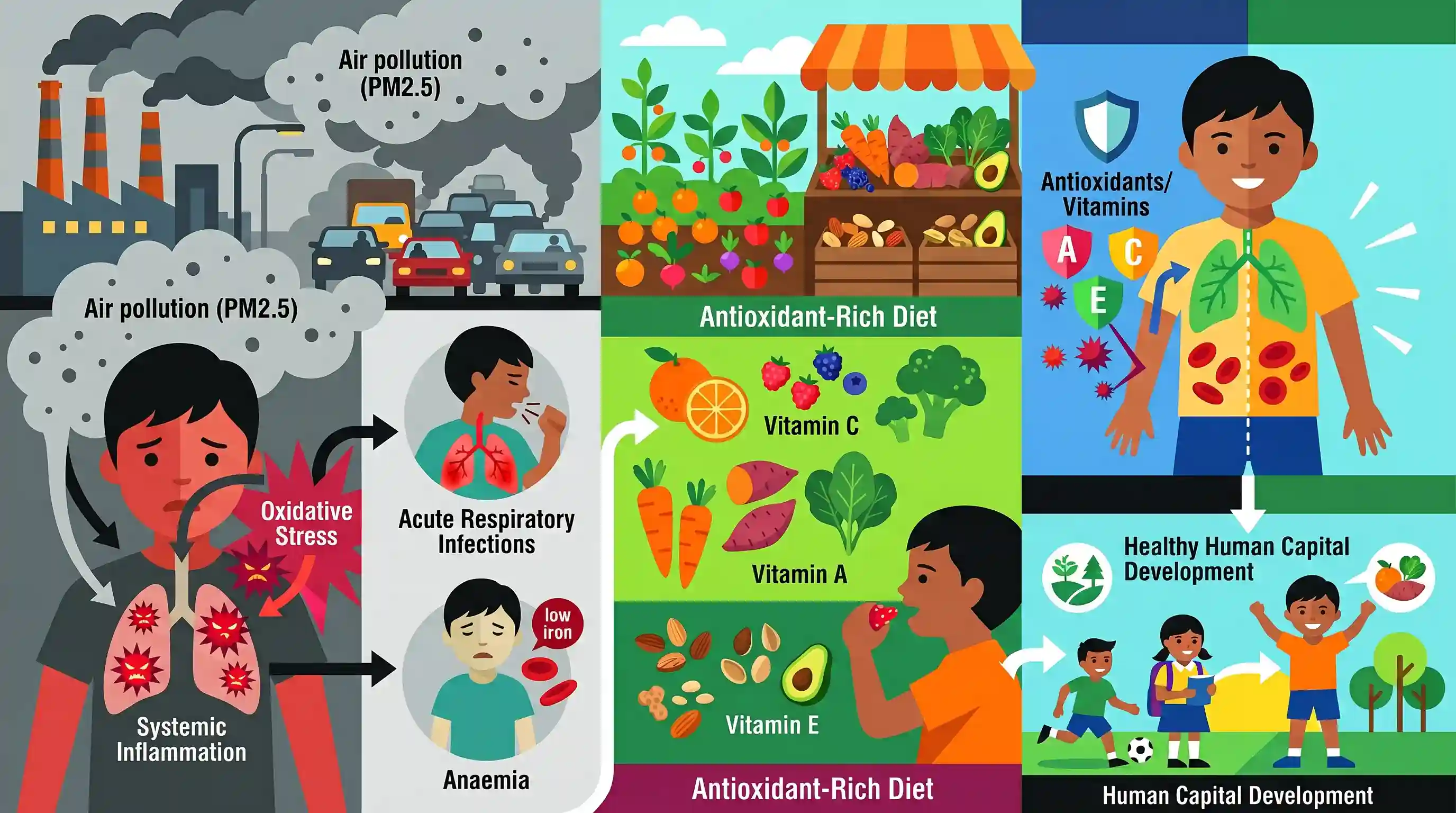
A recent study conducted in Karnataka reveals that an antioxidant-rich diet significantly reduces the risk of acute respiratory infections and anaemia in children exposed to air pollution. Pollutants like PM2.5 trigger oxidative stress and systemic inflammation, which can degrade respiratory health and disrupt iron metabolism. However, consuming foods high in antioxidants—such as vitamins A, C, and E—creates a physiological buffer that neutralizes free radicals. This research highlights the crucial intersection of environmental health and nutrition, suggesting that while combating air pollution is essential, fortifying child nutrition is an equally critical, immediate strategy to protect vulnerable populations and ensure healthy human capital development.
Key Points
- Air pollution, particularly fine particulate matter (PM2.5), exacerbates systemic inflammation and oxidative stress in children, increasing vulnerability to acute respiratory infections and anaemia.
- Dietary interventions can mitigate these effects: an antioxidant-rich diet (high in vitamins A, C, and E) helps neutralize free radicals induced by environmental pollutants.
- A recent study conducted on children in Karnataka establishes a direct correlation between improved nutritional status and reduced susceptibility to pollution-linked diseases.
- The findings emphasize the need for integrated public health policies that combine pollution mitigation with robust nutritional programs (like Poshan Abhiyaan) to safeguard child health and human capital.
Important Terms
Anaemia Mukt Bharat

Flagship strategy launched in 2018 to reduce anaemia using a 6x6x6 framework (six target groups, six interventions, and six institutional mechanisms) across the life cycle.
UPSC context
GS Paper II: Issues related to health and vulnerable sections of the population. Tests understanding of public health interventions.
National Nutrition Mission (Poshan Abhiyaan)
India's flagship programme (National Nutrition Mission) to combat malnutrition, stunting, and wasting. Now integrated into Mission Saksham Anganwadi and Poshan 2.0 with a focus on holistic health.
UPSC context
GS Paper II: Government schemes for social justice and health. Critical for understanding multi-ministerial convergence in governance.
PM2.5
Fine particulate matter with a diameter less than 2.5 micrometres. These particles penetrate deep into the respiratory tract and bloodstream, causing systemic inflammation and oxidative stress.
UPSC context
GS Paper III: Environmental pollution and degradation. Essential for topics on air quality and public health impact.
Acute Respiratory Infection (ARI)
Short-term infections of the respiratory tract that impair normal breathing. ARI is a leading cause of childhood mortality in India and is significantly exacerbated by air pollution.
UPSC context
GS Paper II: Issues relating to development and management of Social Sector/Services relating to Health.
Oxidative Stress
A physiological imbalance between the production of reactive oxygen species (free radicals) and antioxidant defenses, leading to cellular damage and inflammation.
UPSC context
GS Paper III: Science and Technology. Tests application of biological concepts to environmental health issues.
National Family Health Survey (NFHS)
A comprehensive, large-scale multi-round survey conducted throughout India that provides essential data on health and family welfare for policy formulation.
UPSC context
GS Paper II: Governance and Health. The primary data source for monitoring developmental outcomes in India.
Prelims Trap
Anaemia in India is exclusively caused by dietary deficiencies of iron, folic acid, and vitamin B12.
PM2.5 exposure induces systemic inflammation, producing cytokines that inhibit iron absorption. This causes anaemia even with adequate dietary iron, a non-obvious environmental link.
Static Concepts Connected
What is Oxidative Stress and how do Antioxidants combat it?
- Oxidative Stress: An imbalance where highly reactive molecules (free radicals) damage cells, proteins, and DNA. It is heavily exacerbated by environmental pollutants like PM2.5.
- Antioxidant Buffer: Dietary antioxidants (Vitamins A, C, and E) donate electrons to neutralize free radicals, acting as a physiological buffer to prevent cellular damage and systemic inflammation.
What are the core objectives of Poshan Abhiyaan (National Nutrition Mission)?
- Stunting & Wasting: Aims to reduce stunting and under-nutrition (underweight prevalence) in children aged 0-6 years by 2% per annum.
- Anaemia Reduction: Targets a 3% annual reduction in anaemia among young children, women, and adolescent girls, traditionally utilizing Iron and Folic Acid (IFA) supplementation.
- Convergence: Relies heavily on cross-ministerial coordination to link sanitation, safe drinking water, and targeted nutritional delivery via Anganwadis.
Cross-Topic Patterns
Environmental Anaemia and PM2.5
Links air pollution directly to public health schemes. Anaemia Mukt Bharat cannot succeed solely via Iron-Folic acid tablets if urban PM2.5 continues to block biological iron absorption.
Nutritional resilience to climate stress
Highlights diet as a climate adaptation strategy. Fortifying diets acts as an immediate buffer for human capital against the health impacts of localized environmental degradation.

Expect a 2026 Prelims multi-statement question linking PM2.5 exposure to non-dietary causes of anaemia via systemic inflammation.
Linked PYQs · 4
Linked PYQs · 4
- 2022PrelimsGS1
In the context of WHO Air Quality Guidelines, consider the following statements: 1. The 24-hour mean of PM2.5 should not exceed 15 µg/m³ and annual mean of PM2.5 should not exceed 5 µg/m³. 2. In a year, the highest levels of ozone pollution occur during the periods of inclement weather. 3. PM10 can penetrate the lung barrier and enter the bloodstream. 4. Excessive ozone in the air can trigger asthma. Which of the statements given above are correct?
- 2023PrelimsGS1
Consider the following statements in the context of interventions being undertaken under Anaemia Mukt Bharat Strategy: 1. It provides prophylactic calcium supplementation for pre-school children, adolescents and pregnant women. 2. It runs a campaign for delayed cord clamping at the time of child-birth. 3. It provides for periodic deworming to children and adolescents. 4. It addresses non-nutritional causes of anaemia in endemic pockets with special focus on malaria, hemoglobinopathies and fluorosis. How many of the statements given above are correct?
- 2017PrelimsGS1
Which of the following are the objectives of 'National Nutrition Mission'? 1. To create awareness relating to malnutrition among pregnant women and lactating mothers. 2. To reduce the incidence of anaemia among young children, adolescent girls and women. 3. To promote the consumption of millets, coarse cereals and unpolished rice. 4. To promote the consumption of poultry eggs. Select the correct answer using the code given below:
- 2024MainsGS2
Poverty and malnutrition create a vicious cycle, adversely affecting human capital formation. What steps can be taken to break the cycle ?
