Rising Carbapenem Resistant Infections Threaten Healthcare in India
Source:Indian Express ↗
Why It Matters
Antimicrobial resistance (AMR) is recognized globally and nationally as a silent pandemic. Understanding the drivers and public health consequences of carbapenem resistance is critical for aspirants targeting GS Paper 3 (Health and S&T issues).
Summary
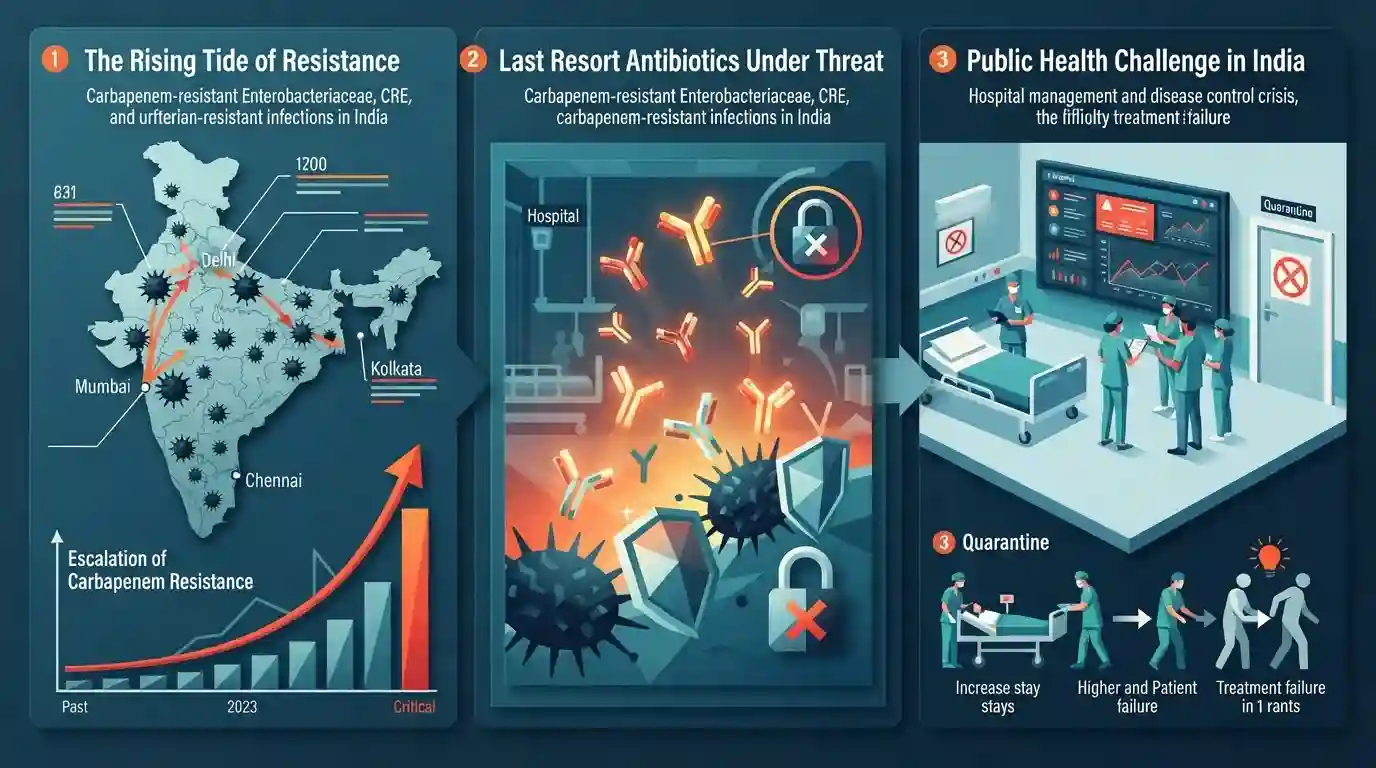
The article discusses the escalating threat of antimicrobial resistance (AMR) in India, specifically focusing on the rise of carbapenem-resistant infections. Carbapenems are critical antibiotics of last resort, and their declining efficacy due to bacterial resistance presents severe public health challenges for hospital management and disease control in India.
Key Points
- Carbapenem-resistant infections are rising significantly in India, posing a major threat as carbapenems are considered antibiotics of last resort.
- Overuse and misuse of broad-spectrum antibiotics in healthcare settings and agriculture are primary drivers of antimicrobial resistance (AMR).
- The spread of carbapenem resistance complicates hospital-acquired infections (HAIs), leading to longer hospital stays, higher medical costs, and increased mortality.
- Addressing the AMR crisis requires robust infection control practices, restricted over-the-counter availability of antibiotics, and enhanced surveillance networks.
Important Terms
National Action Plan on Antimicrobial Resistance

India's comprehensive multi-sectoral framework designed to combat antimicrobial resistance across human health, animal husbandry, agriculture, and environmental sectors using a One Health approach.
UPSC context
Mains Paper II (Health Policies & Governance) and Paper III (Science & Technology - Awareness in Bio-Technology); tests policy response to AMR.
Indian Council of Medical Research
Apex biomedical research body in India under the Ministry of Health and Family Welfare, actively monitoring drug-resistant infections and tracking antimicrobial resistance trends nationwide.
UPSC context
Prelims and Mains: Evaluates institutional mechanisms for disease surveillance, medical research, and health data generation in India.
World Health Organization
The specialized international public health agency of the United Nations that leads global strategies, priority pathogen lists, and action plans to contain antimicrobial resistance.
UPSC context
Mains Paper II / International Relations: Important for understanding global health governance, standard-setting, and multilateral health frameworks.
Prelims Trap
antimicrobial resistance in India is exclusively driven by the clinical overuse of antibiotics in human healthcare settings
Aspirants often assume AMR is solely caused by human clinical overuse, ignoring the massive contribution of animal husbandry, poultry farming, and agricultural pesticide/antibiotic use.
Static Concepts Connected
What is the WHO AWaRe classification of antibiotics and India's National Action Plan on AMR?
- AWaRe Groups: Categorizes antibiotics into Access, Watch, and Reserve groups to optimize clinical use and curb resistance.
- Reserve Category: Reserve group includes last-resort antibiotics like carbapenems, meant for confirmed multi-drug resistant infections only.
- NAP-AMR 2017: India's NAP-AMR (2017) adopts a One Health approach, integrating human health, animal husbandry, and environmental sectors.
Cross-Topic Patterns
AMR, Pharma Effluents, and Environmental Regulation
AMR is accelerated by agricultural antibiotic use and pharma effluent discharge, linking public health directly to environmental governance and pollution regulation under the EPA 1986.
AMR and Public Health Infrastructure Gaps
Rising hospital-acquired infections caused by superbugs expose critical gaps in public health infrastructure and out-of-pocket expenditure trends under Indian federalism.

AMR + National Action Plan + WHO AWaRe categorization is high-yield for both Prelims statements and Mains health governance questions.
Linked PYQs · 2
Linked PYQs · 2
- 2014MainsGS3
Can overuse and free availability of antibiotics without Doctor's prescription, be contributors to the emergence of drug-resistant diseases in India? What are the available mechanisms for monitoring and control? Critically discuss the various issues involved.
- 2019PrelimsGS1
Which of the following are the reasons for the occurrence of multi-drug resistance in microbial pathogens in India? 1. Genetic predisposition of some people 2. Taking incorrect doses of antibiotics to cure diseases 3. Using antibiotics in livestock farming 4. Multiple chronic diseases in some people Select the correct answer using the code given below.
