Kulgam Anti Terror Operation and Security Forces Strategy
Source:The Hindu ↗
Why It Matters
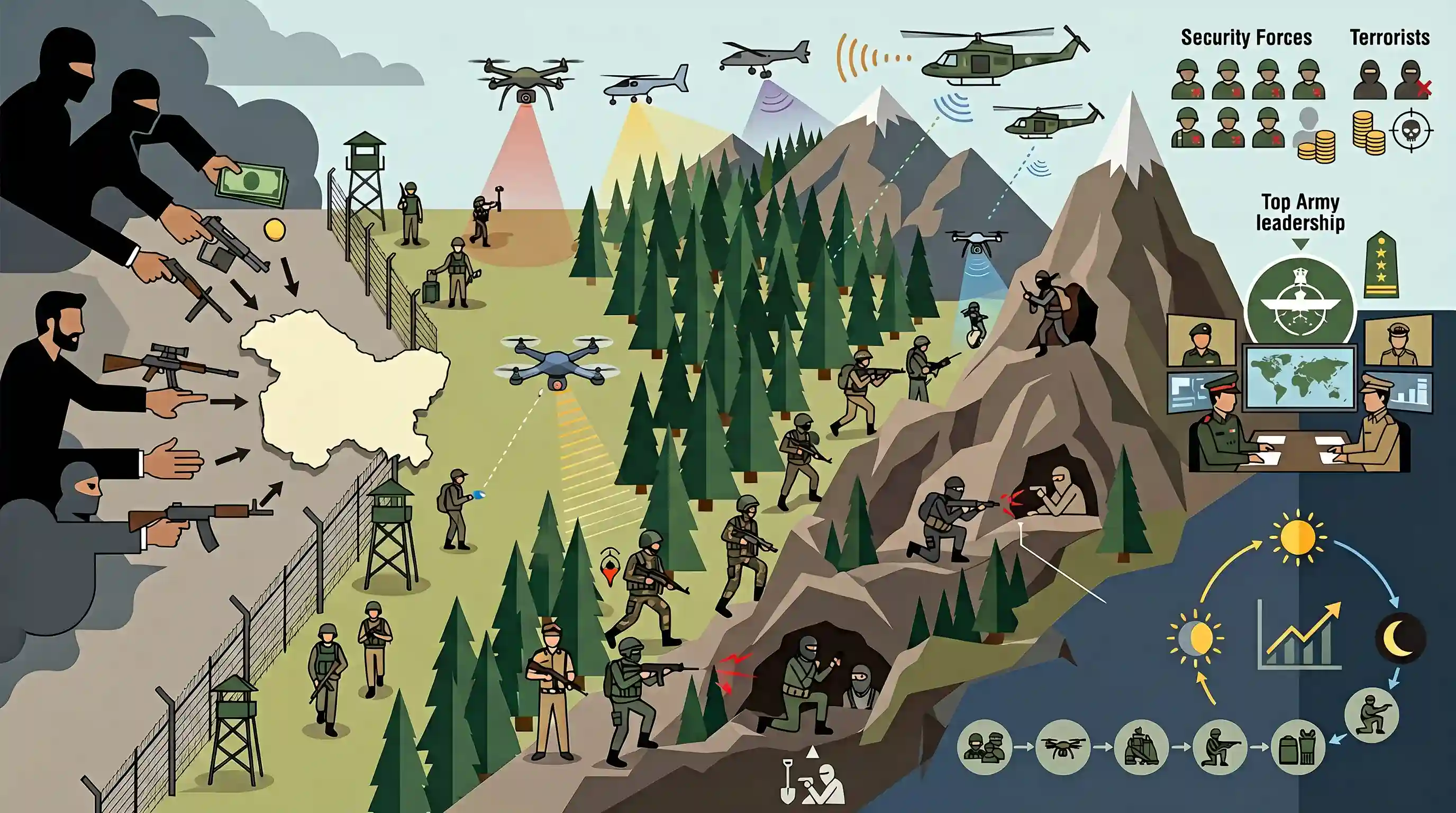
This ongoing operation is a practical case study for GS Paper 3 (Internal Security). It illustrates the operational and logistical challenges security forces face in difficult terrains (deep forests) and the evolving tactical use of modern technology (drones, helicopters) in counter-terrorism. It also highlights the persistent internal security threats and the coordinated response mechanisms between the Army, Police, and specialized forces.
Summary
A massive anti-terror operation in the deep forests of Kulgam, Jammu and Kashmir, has entered its eighth day, highlighting the severe challenges of counter-insurgency in hostile terrains. The operation, overseen by top Army and J&K Police leadership, reflects the heavy reliance on technology—such as drones and helicopters—and specialized forces like Para commandos to track down well-entrenched terrorists. With two terrorists killed and seven security personnel injured, the prolonged encounter underscores the persistent threat of cross-border infiltration and terrorism in the Kashmir valley, testing the endurance and strategic preparedness of the security grid.
Key Points
- An anti-terror operation in Kulgam district of Jammu and Kashmir entered its eighth day, marking one of the longest such operations in recent times in the valley.
- The operation involves intense gunfights in difficult deep forest terrain, with security forces utilizing drones and helicopters to track terrorists.
- Para commandos are assisting in neutralizing the hidden ultras.
- Two terrorists have been killed, and seven security personnel sustained injuries during the prolonged encounter.
- Top security officials, including J&K Police chief Nalin Prabhat and Army's Northern Commander Lt. Gen. Pratik Sharma, reviewed the counter-terrorism grid and the ongoing operation.
Important Terms
Counter-Insurgency (COIN)

Comprehensive military and political actions taken by a government to defeat an insurgency and reclaim state authority in a region.
UPSC context
GS Paper III: Internal Security. Tests understanding of strategies to neutralize domestic threats and maintain regional stability.
Para (Special Forces)
Elite special operations units of the Indian Army's Parachute Regiment specialized in unconventional warfare, surgical strikes, and high-altitude counter-terrorism.
UPSC context
GS Paper III: Security Forces and their Mandate. Tests knowledge of specialized capabilities within India's military framework.
Jammu and Kashmir Police (JKP)
The primary law enforcement agency in J&K, acting as the 'eyes and ears' of security forces through local intelligence (HUMINT) and joint operations.
UPSC context
GS Paper III: Role of external and internal actors. Tests the importance of local policing in counter-terrorism.
Cross-border Terrorism
A form of proxy warfare where terrorists utilize foreign soil to plan and launch attacks against India to destabilize the nation.
UPSC context
GS Paper III: Internal Security. A recurring theme regarding threats from neighboring state and non-state actors.
Overground Workers (OGWs)
Individuals who provide logistical support, intelligence, and hideouts to active terrorists while maintaining a facade of normal civilian life.
UPSC context
GS Paper III: Challenges to internal security. Essential for understanding the terrorist support ecosystem and radicalization.
Prelims Trap
"The Unified Headquarters for counter-insurgency operations in J&K is chaired by the Army's Northern Commander."
The Unified Command in J&K is chaired by the civilian head (Chief Minister or Lieutenant Governor), ensuring democratic oversight over security operations.
Static Concepts Connected
What is the structure of the Unified Command in J&K?
- Objective: Brings the Army, CAPFs, state police, and intelligence agencies (IB, R&W) under a single umbrella to eliminate operational silos.
- Civilian Authority: Chaired by the Chief Minister or Lieutenant Governor, establishing clear civilian supremacy over internal security deployments.
- Regional Grids: Operationally divided into regional grids, traditionally managed by respective Army Corps Commanders (e.g., 15 Corps for Kashmir).
How do the mandates of Army Special Forces and CAPFs differ?
- Ministry Control: Army and Para Special Forces operate under the Ministry of Defence, whereas CAPFs (like CRPF, BSF) operate under the Ministry of Home Affairs.
- Operational Role: Para SF executes surgical, high-risk tactical counter-terror ops; CAPFs focus on broad internal security, crowd control, and border guarding.
Cross-Topic Patterns
UAV integration in counter-insurgency
The shift from conventional infantry cordons to drone-assisted deep-forest mapping links GS-3 Security (Counter-insurgency) directly with GS-3 Science & Tech (Defense indigenization and drone applications).
Topography of proxy wars
Rugged terrains like Kulgam and the Pir Panjal range physically dictate infiltration routes and operational timelines, blending GS-1 Physical Geography with GS-3 Border Management.

Mains 2026 GS-3 is highly likely to feature a question on how hostile topography and UAV technology are reshaping counter-insurgency tactics.
Linked PYQs · 3
Linked PYQs · 3
- 2023MainsGS3
Winning of 'Hearts and Minds' in terrorism-affected areas is an essential step in restoring the trust of the population. Discuss the measures adopted by the Government in this respect as part of the conflict resolution in Jammu and Kashmir.
- 2023MainsGS3
The use of unmanned aerial vehicles (UAVs) by our adversaries across the borders to ferry arms/ammunitions, drugs, etc., is a serious threat to the internal security. Comment on the measures being taken to tackle this threat.
- 2019MainsGS3
Cross-border movement of insurgents is only one of the several security challenges facing the policing of the border in North-East India. Examine the various challenges currently emanating across the India-Myanmar border. Also, discuss the steps to counter the challenges.
