Supreme Court examines constitutional validity of anti-conversion law
Source:The Hindu ↗
Why It Matters
Anti-conversion laws frequently appear in legal and political discourse. They represent a significant point of tension between individual religious freedom (Article 25) and the State's police power to prevent forced or fraudulent conversions. The Supreme Court's stance will be a crucial precedent regarding the boundaries of personal liberty, the right to privacy, and religious autonomy under the Indian Constitution.
Summary
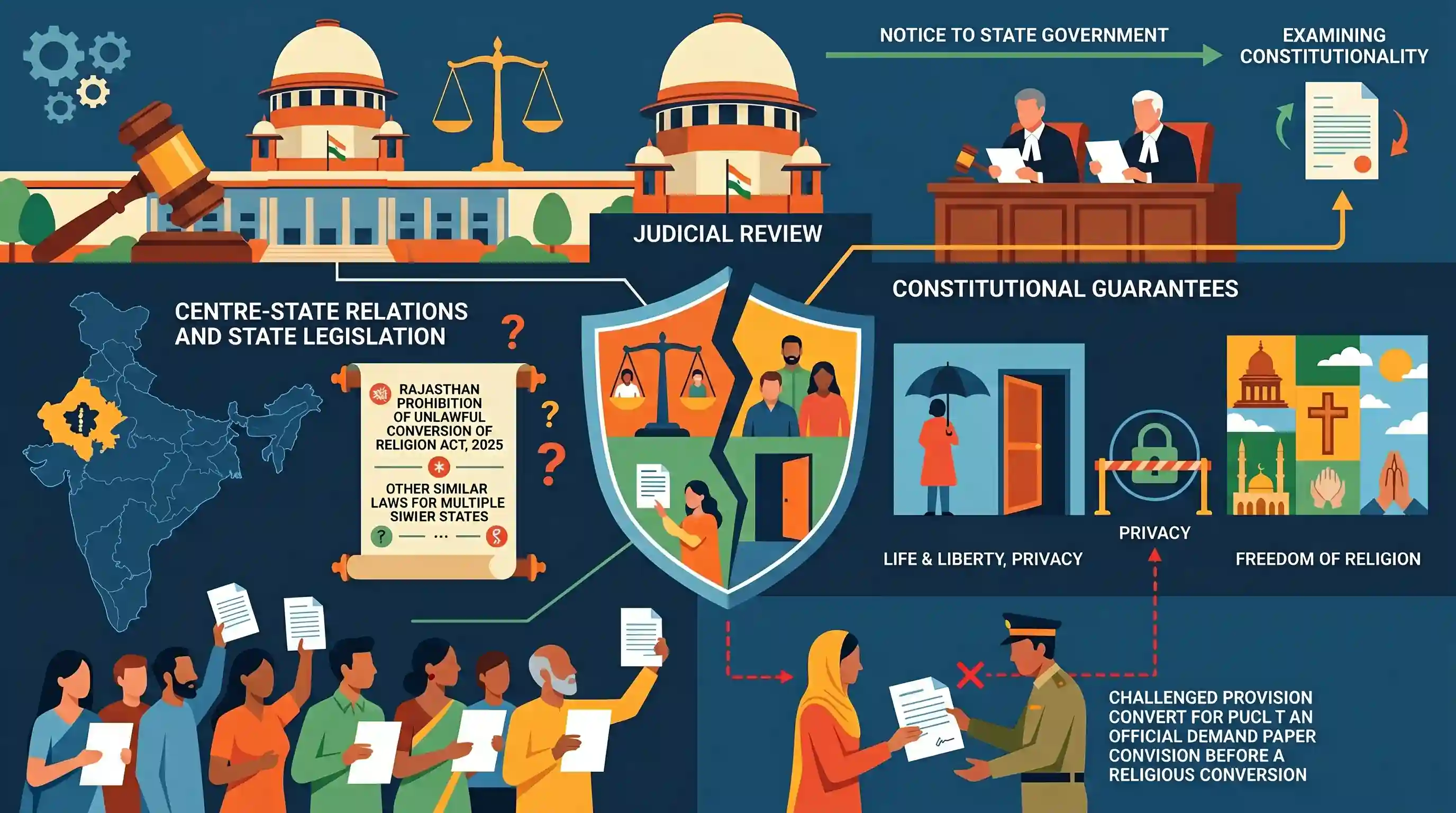
The Supreme Court of India is examining the constitutional validity of the Rajasthan Prohibition of Unlawful Conversion of Religion Act, 2025, after issuing a notice to the state government. A petition filed by PUCL and others alleges the law violates fundamental rights guaranteed under Articles 14, 21, and 25 of the Constitution. The petitioners particularly challenge provisions requiring prior declaration for religious conversion, arguing they infringe on the right to privacy and personal liberty. This case highlights the ongoing judicial scrutiny of anti-conversion laws recently adopted by multiple states across India.
Key Points
- The Supreme Court has asked the Rajasthan government to respond to a petition challenging the newly enacted Rajasthan Prohibition of Unlawful Conversion of Religion Act, 2025.
- Petitioners, including the People's Union for Civil Liberties (PUCL), argue the law is arbitrary and violates constitutional provisions including Articles 14 (equality), 21 (right to life and privacy), and 25 (freedom of religion).
- The plea contends that requiring individuals to give prior declarations of their intent to convert infringes upon their right to privacy and personal autonomy.
- Several other Indian states, including UP, MP, and Gujarat, have enacted similar anti-conversion legislations, raising broader constitutional questions around state interference in religious freedom.
Important Terms
Rajasthan Prohibition of Unlawful Conversion of Religion Act, 2025

A 2025 state law regulating religious conversion by prohibiting force, fraud, or allurement. It prescribes severe penalties, including life imprisonment and property demolition, and requires prior administrative notice for conversion.
UPSC context
GS Paper II: State Legislature and Fundamental Rights. Tests the balance between state regulatory powers and individual liberty.
People’s Union for Civil Liberties (PUCL)
One of India's oldest human rights organizations, formed in 1976. It advocates for democratic rights and civil liberties through litigation and activism, notably challenging laws deemed unconstitutional.
UPSC context
GS Paper II: Role of civil society and NGOs in the Indian polity and constitutional protection.
Article 25 (Freedom of Religion)
A Fundamental Right guaranteeing freedom of conscience and the right to freely profess, practice, and propagate religion. It is subject to public order, morality, and health.
UPSC context
GS Paper II: Fundamental Rights. Essential for understanding secularism and the limits of state interference in religious faith.
Right to Privacy
Interpreted by the Supreme Court (notably in the Puttaswamy case) as a Fundamental Right under Article 21, protecting an individual's autonomy over personal choices, including faith and marriage.
UPSC context
GS Paper II: Judiciary and Fundamental Rights. Key ground for challenging mandatory disclosure requirements in state laws.
Rev. Stanislaus vs. State of Madhya Pradesh (1977)
A landmark 1977 judgment where the Supreme Court ruled that the "right to propagate" religion under Article 25 does not include a fundamental right to convert another person.
UPSC context
GS Paper II: Constitutional Law. The foundational precedent cited by states to justify the validity of anti-conversion legislations.
Judicial Review
The power of the Judiciary to examine the constitutionality of legislative acts and executive orders, ensuring they do not violate the Basic Structure or Fundamental Rights.
UPSC context
GS Paper II: Structure, organization, and functioning of the Judiciary. Critical for the "checks and balances" aspect of the syllabus.
Prelims Trap
The Constitution explicitly guarantees the right to convert another person as part of the freedom to propagate religion under Article 25.
In the 1977 Rev. Stainislaus case, the Supreme Court clarified that Article 25 protects the right to transmit tenets but does not grant a fundamental right to convert another person.
Static Concepts Connected
What are the explicit constitutional limitations on Article 25?
- Public Order: The State can restrict religious practices if they threaten public peace. This is the primary constitutional justification used by states to enact anti-conversion laws.
- Morality and Health: Religious freedom cannot be invoked to protect practices deemed immoral or hazardous to general public health.
- Other Fundamental Rights: Article 25 is explicitly subject to other provisions of Part III, meaning religious freedom cannot violate fundamental rights like equality (Art 14) or life (Art 21).
How do states possess the legislative competence to pass anti-conversion laws?
- Public Order Justification: State governments enact these legislations under "Public Order," which is enumerated as Entry 1 of the State List (List II) in the Seventh Schedule.
- Judicial Precedent: While religious conversion is not explicitly listed, courts have previously upheld that forced or fraudulent conversions can disrupt societal peace, making it a valid state subject.
Cross-Topic Patterns
Right to Privacy vs Public Order
Requiring advance notice to authorities for religious conversion tests the limits of the Puttaswamy judgment (informational privacy and autonomy) against the state's power to regulate public order.
Inter-faith unions and Article 21
Anti-conversion laws heavily intersect with the Special Marriage Act. The Supreme Court (e.g., Shafin Jahan case) safeguards the right to choose a life partner as a core component of Article 21 liberty.

A 2026 question will likely pit the Rev. Stainislaus ruling (no right to convert) against the Puttaswamy privacy doctrine on prior notices.
Linked PYQs · 5
Linked PYQs · 5
- 2024MainsGS2
Right to privacy is intrinsic to life and personal liberty and is inherently protected under Article 21 of the constitution. Explain. In this reference discuss the law relating to D.N.A. testing of child in the womb to establish its paternity.
- 2017MainsGS2
Examine the scope of Fundamental Rights in the light of the latest judgement of the Supreme Court on Right to Privacy.
- 2021PrelimsGS1
'Right to Privacy' is protected under which Article of the Constitution of India?
- 2020PrelimsGS1
Consider the following statements: 1. The Constitution of India defines its 'basic structure' in terms of federalism, secularism, fundamental rights and democracy. 2. The Constitution of India provides for 'judicial review' to safeguard the citizens' liberties and to preserve the ideals on which the Constitution is based. Which of the statements given above is/are correct?
- 2019PrelimsGS1
Which Article of the Constitution of India safeguards one's right to marry the person of one's choice?
