Law Enforcement Operations Against Synthetic Drug Trafficking
Source:Indian Express ↗
Why It Matters
The proliferation of 'chitta' (synthetic heroin) in northern Indian states exemplifies the severe internal security and social challenges posed by drug trafficking. For UPSC aspirants, this highlights the practical enforcement of the NDPS Act, the operationalization of new legal frameworks like BNSS, and the intersection of youth welfare, organized crime, and modern policing methods.
Summary
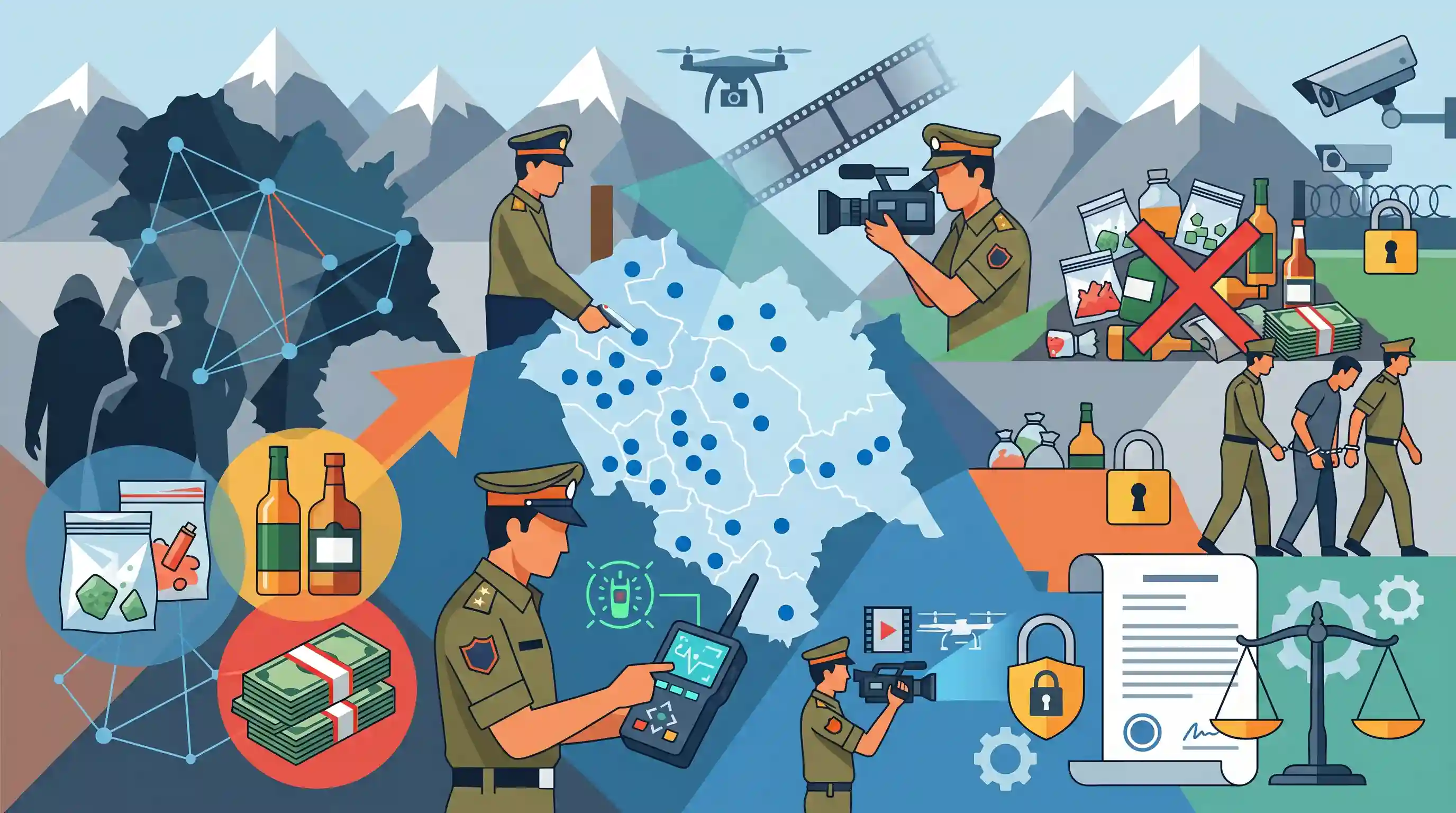
Himachal Pradesh Police launched an aggressive state-wide 'Anti-Chitta' campaign, conducting intelligence-led raids at 145 locations to combat the growing drug menace. The operations resulted in significant seizures of contraband including heroin (chitta), charas, and illicit liquor, alongside multiple arrests under the NDPS and Excise Acts. Notably, police integrated technological and procedural modernizations such as utilizing drug detection kits and ensuring complete videography of search and seizure operations, aligning with the compliance requirements of the newly implemented Bharatiya Nagarik Suraksha Sanhita (BNSS).
Key Points
- The Himachal Pradesh Police executed widespread, intelligence-based raids across 145 locations under the state-wide 'Anti-Chitta' campaign to curb the drug menace.
- Authorities seized significant quantities of chitta (heroin), charas, poppy husk, and illicit liquor, registering cases under the NDPS and Excise Acts.
- Law enforcement employed modern evidentiary methods, including drug detection kits and end-to-end videography (from search to arrest), ensuring compliance with the new Bharatiya Nagarik Suraksha Sanhita (BNSS).
Important Terms
Narcotic Drugs and Psychotropic Substances (NDPS) Act

A comprehensive 1985 law prohibiting the production, possession, and sale of narcotics. It features a graded punishment system based on the quantity of drugs seized.
UPSC context
GS Paper III: Internal Security. Vital for understanding organized crime, drug trafficking, and law enforcement frameworks.
Bharatiya Nagarik Suraksha Sanhita (BNSS)
The 2023 law replacing the Code of Criminal Procedure (CrPC). It modernizes criminal justice through mandatory videography of searches and technology-driven investigations.
UPSC context
GS Paper II: Polity and Governance. Tests knowledge of judicial reforms and criminal justice system modernization.
Excise Act
A state-specific law regulating the manufacture, sale, and licensing of intoxicating liquors and other goods, primarily used to combat illicit liquor trade.
UPSC context
GS Paper II: Federalism and State Revenue. Relates to state-level regulatory powers over public health and taxation.
Arms Act, 1959
Legislative framework regulating the acquisition, possession, and manufacture of firearms and ammunition to curb illegal weapons and associated violence.
UPSC context
GS Paper III: Internal Security. Relevant for discussing illegal arms proliferation and border management.
Anti-Chitta Campaign
A targeted law enforcement initiative in Himachal Pradesh aimed at eradicating synthetic drugs, specifically heroin (locally called 'Chitta'), from the state.
UPSC context
GS Paper III: Security/Social Issues. Example of state-level strategies to combat the drug menace and organized crime.
Prelims Trap
The 'Golden Crescent' comprises Myanmar, Thailand, and Laos, directly fueling the drug crisis in Northwest India.
This traps aspirants by swapping the Golden Crescent (Afghanistan, Iran, Pakistan—affecting the Northwest) with the Golden Triangle (Myanmar, Thailand, Laos—affecting the Northeast).
Static Concepts Connected
What makes India geographically vulnerable to illicit drug trafficking networks?
- Golden Crescent: Located to India's Northwest, comprising Afghanistan, Iran, and Pakistan. It is the primary source of heroin/chitta smuggling into Punjab, J&K, and Himachal Pradesh.
- Golden Triangle: Located to India's East, comprising Myanmar, Thailand, and Laos. It fuels drug trafficking and insurgency primarily in India's Northeastern states.
- Narco-terrorism nexus: The nexus between drug cartels and terrorist networks, where illicit drug revenues are used to finance cross-border terrorism and destabilize border regions.
What are the key evidence-gathering mandates under the Bharatiya Nagarik Suraksha Sanhita (BNSS), 2023?
- Mandatory Videography: Mandates complete audio-video recording (videography) of search and seizure operations to prevent evidence tampering and enhance transparency.
- Forensic Integration: Requires mandatory visits by forensic experts to crime scenes for offenses punishable by imprisonment of seven years or more.
- Digital Evidence: Explicitly accords electronic and digital records the same legal validity and enforceability as traditional physical documents.
Cross-Topic Patterns
Tech-enabled policing under BNSS
The shift from CrPC to BNSS emphasizes digital evidence. Linking anti-drug raids with mandatory videography (Section 105) showcases the practical, on-the-ground rollout of India's new criminal codes.
Golden Crescent's spillover to Himalayas
The infiltration of synthetic heroin (chitta) into Himachal highlights how international smuggling routes (Pakistan/Afghanistan) bypass border defenses, morphing into a socio-economic and internal security crisis in non-border states.

Expect a paired prelims question linking India's proximity to the Golden Crescent/Triangle with the new BNSS digital evidence mandates.
Linked PYQs · 3
Linked PYQs · 3
- 2018MainsGS3
India's proximity to two of the world's biggest illicit opium-growing states has enhanced her internal security concerns. Explain the linkages between drug trafficking and other illicit activities such as gunrunning, money laundering and human trafficking. What counter-measures should be taken to prevent the same?
- 2024MainsGS3
Explain how narco-terrorism has emerged as a serious threat across the country. Suggest suitable measures to counter narco-terrorism.
- 2023MainsGS3
The use of unmanned aerial vehicles (UAVs) by our adversaries across the borders to ferry arms/ammunitions, drugs, etc., is a serious threat to the internal security. Comment on the measures being taken to tackle this threat.
