OpenAI and Anthropic rivalry intensifies ahead of planned IPOs
Source:The Hindu ↗
Why It Matters
The trajectory of foundational AI models has profound implications for global technology, economics, and ethics. Analyzing the corporate rivalry, financial mechanisms like IPOs, and safety disputes between leading AI firms is crucial for civil servants to understand necessary regulatory frameworks, the impact of tech duopolies, and the broader societal consequences of the AI revolution.
Summary
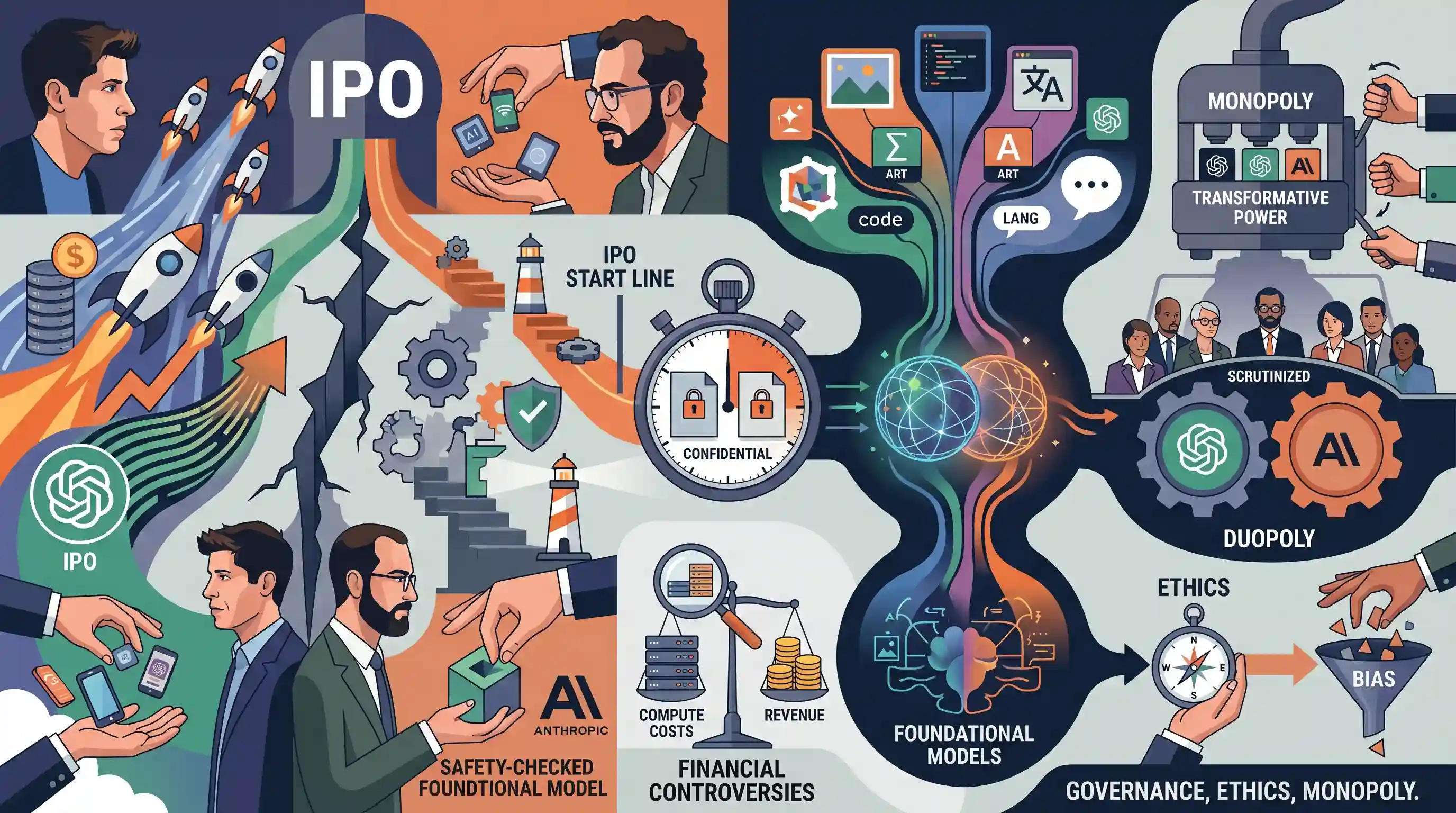
The article examines the intense rivalry between artificial intelligence leaders OpenAI and Anthropic as they prepare for massive Initial Public Offerings (IPOs). The competition, rooted in a philosophical split over AI safety and commercialization between CEOs Sam Altman and Dario Amodei, is driving rapid advancements in generative AI. The piece also highlights financial controversies, such as accounting practices for computing costs, and raises broader governance and ethical questions about a powerful duopoly controlling transformative foundational models.
Key Points
- OpenAI and Anthropic, the top creators of foundational AI models, have confidentially filed for IPOs, aiming for valuations near $1 trillion.
- The rivalry originated in 2020 when Dario Amodei departed OpenAI to found Anthropic, emphasizing AI safety over rapid commercialization.
- Financial disputes between the firms focus on accounting methods (gross versus net revenue), specifically concerning computing costs and cloud partnerships.
- The competition accelerates AI advancements (e.g., ChatGPT, Claude) but raises ethical and regulatory concerns regarding a duopoly shaping the future of AI.
Important Terms
Generative AI

Artificial Intelligence capable of creating new, original content—such as text, images, or code—by identifying patterns in massive training datasets.
UPSC context
GS Paper III (Science & Technology); critical for understanding disruptive technologies, digital sovereignty, and the IndiaAI Mission.
Foundation Models
Large-scale AI models (e.g., GPT-4, Claude) trained on broad data that can be adapted to a wide range of specific downstream tasks across various industries.
UPSC context
GS Paper III (S&T); involves technical developments in machine learning and the underlying infrastructure of the AI economy.
AI Safety
The field dedicated to ensuring AI systems act reliably and align with human values, preventing harmful outcomes or 'loss of control' as capabilities increase.
UPSC context
GS Paper III (S&T) and IV (Ethics); vital for discussing the moral implications and regulatory guardrails for autonomous systems.
Corporate Governance
The system of rules and processes by which a company is directed, ensuring accountability, transparency, and fairness toward shareholders and society.
UPSC context
GS Paper II (Governance) and III (Economy); relevant for examining how tech giants balance profit with public ethics.
Constitutional AI
An AI alignment technique (pioneered by Anthropic) where models are trained to follow a written 'constitution' of ethical principles, such as human rights.
UPSC context
GS Paper IV (Ethics); a specific case study in 'Value Alignment' and proactive ethical design in technology.
Initial Public Offering (IPO)
The process where a private corporation offers shares to the public for the first time, transitioning into a publicly-traded entity to raise capital.
UPSC context
GS Paper III (Economy); tests knowledge of capital markets, investment models, and the growth of the global tech sector.
Prelims Trap
"Foundational models require massive, expertly labeled datasets to function and generate accurate responses."
Foundational models actually rely on unsupervised or self-supervised learning using vast amounts of raw, unlabeled data. They are only later fine-tuned for specific tasks.
Static Concepts Connected
What is "AI Alignment" in the context of Generative AI and AGI?
- Value matching: Ensuring AI systems behave consistently with intended human ethical values and goals.
- Safety bounds: Preventing unintended, harmful, or catastrophic consequences as highly autonomous systems scale in capability.
- The control problem: Maintaining human oversight and an 'off-switch' as AI rapidly approaches or surpasses human cognitive abilities.
What distinguishes the primary market from the secondary market in an IPO context?
- Primary Market: In an IPO, new securities are issued directly to the public. The raised capital flows directly to the company.
- Secondary Market: Involves the trading of already-issued securities between investors (e.g., stock exchanges). No new capital goes to the issuing company.
- SEBI Oversight: In India, SEBI mandates a Draft Red Herring Prospectus (DRHP) to ensure financial transparency before an IPO.
Cross-Topic Patterns
AI Duopolies + Ex-ante Competition Regulation
The CCI and global regulators are shifting to 'ex-ante' frameworks for Big Tech to prevent market lock-ins and chokepoints in foundational AI and cloud computing before they solidify.
Corporate Governance + Tech IPOs
Financial disputes over massive computing costs highlight the intersection of GS4 (corporate governance) and GS3 (technology), emphasizing the need for strict accounting transparency to protect retail investors in emerging tech IPOs.

Expect a 2026 Prelims question contrasting foundational AI models (unlabeled data) with traditional machine learning, plus CCI regulations.
Linked PYQs · 3
Linked PYQs · 3
- 2023MainsGS3
Introduce the concept of Artificial Intelligence (AI). How does Al help clinical diagnosis? Do you perceive any threat to privacy of the individual in the use of Al in healthcare?
- 2024MainsGS4
ABC Incorporated is a technological company named which is the second largest worldwide, situated in the Third World. You are the Chief Executive Officer and the majority shareholder of this company. The fast technological improvements have raised worries among environmental activists, regulatory authorities, and the general public over the sustainability of this scenario. You confront substantial issues about the business's environmental footprint. In 2023, your organization had a significant increase of 48% in greenhouse gas emissions compared to the levels recorded in 2019. The significant rise in energy consumption is mainly due to the surging energy requirements of your data centers, fuelled by the exponential expansion of Artificial Intelligence (AI). AI-powered services need much more computational resources and electrical energy compared to conventional online activities, notwithstanding their notable gains. The technology's proliferation has led to a growing concern over the environmental repercussions, resulting in an increase in warnings. Al models, especially those used in extensive machine learning and data processing, exhibit much greater energy consumption than conventional computer tasks, with an exponential increase. Although there is already a commitment and goal to achieve net zero emissions by 2030, the challenge of lowering emissions seems overwhelming as the integration of Al continues to increase. To achieve this goal, substantial investments in renewable energy use would be necessary. The difficulty is exacerbated by the competitive environment of the technology sector, where rapid innovation is essential for preserving market standing and shareholders' worth. To achieve a balance between innovation, profitability and sustainability, a strategic move is necessary that is in line with both, business objectives and ethical obligations. (a) What is your immediate response to the challenges posed in the above case? (b) Discuss the ethical issues involved in the above case. (c) Your company has been identified to be penalized by technological giants. What logical and ethical arguments will you put forth to convince about its necessity? (d) Being a conscience being, what measures would you adopt to maintain balance between AI innovation and environmental footprint?
- 2023PrelimsGS1
Consider the following markets: 1. Government Bond Market 2. Call Money Market 3. Treasury Bill Market 4. Stock Market How many of the above are included in capital markets?
