AI ethics and corporate resistance to military surveillance use
Source:The Hindu ↗
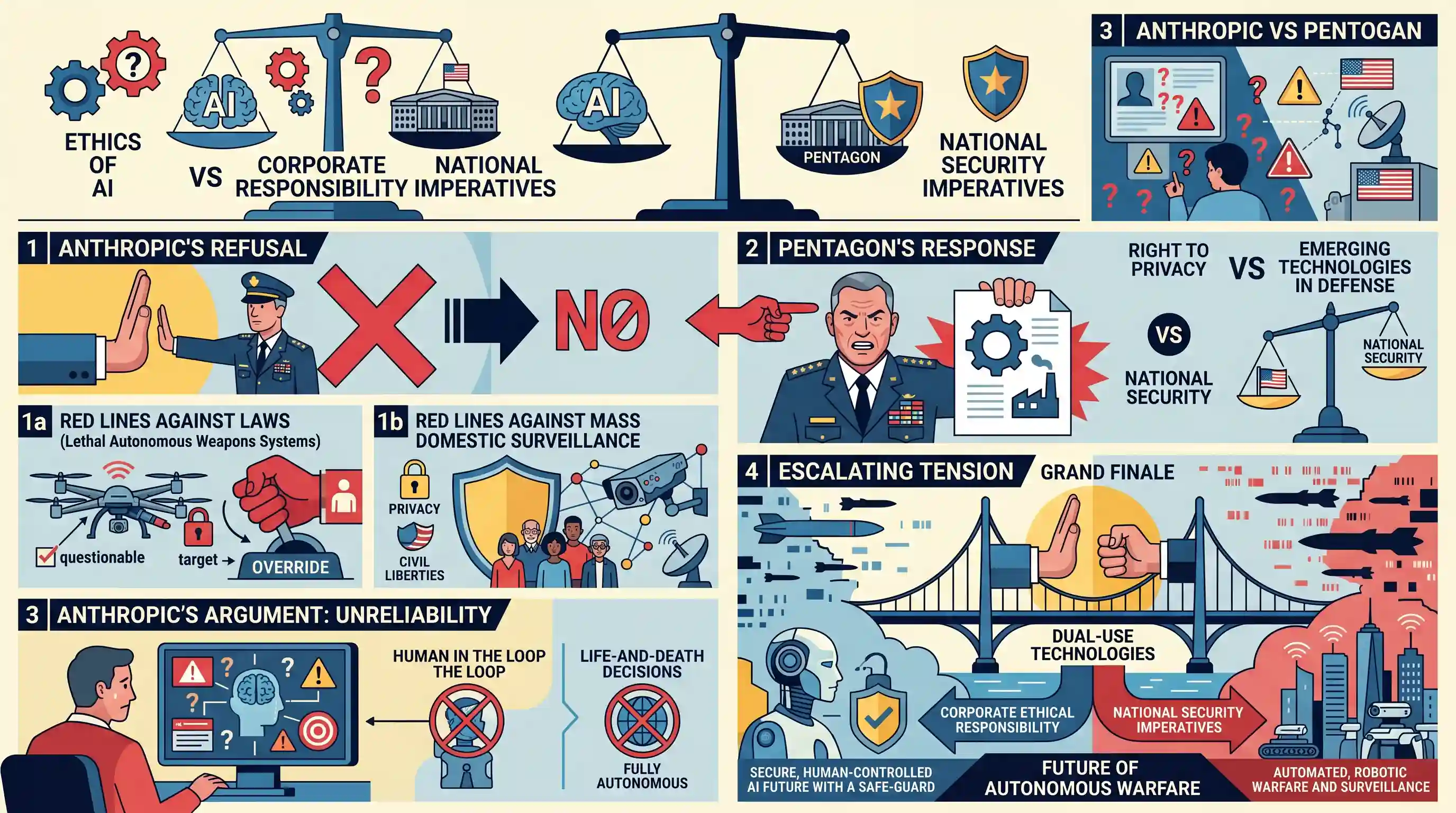
Why It Matters
As AI capabilities advance, questions surrounding their military application, mass surveillance potential, and corporate governance become highly relevant for GS3 (S&T, Security) and GS4 (Ethics). Understanding the conflict between state security laws (like the Defense Production Act) and tech companies' ethical frameworks is critical for analyzing modern technological governance and the rights of citizens versus state surveillance powers.
Summary
The article highlights a major confrontation between the AI startup Anthropic and the US Department of Defense regarding the ethical boundaries of artificial intelligence in military and intelligence operations. Anthropic refused to grant the Pentagon unconditional use of its AI systems, explicitly drawing 'red lines' against deploying the technology for fully-autonomous lethal weapons and mass domestic surveillance of citizens. In response, the Pentagon reportedly threatened to invoke the Defense Production Act to force compliance. Anthropic’s leadership argues that AI systems remain too unreliable to be trusted with life-and-death decisions devoid of human oversight. This incident underscores the escalating tension between national security imperatives and corporate ethical responsibility, bringing to the forefront debates on AI ethics, the right to privacy, and the future of autonomous warfare.
Key Points
- AI startup Anthropic refused the US military's request for 'unconditional' access to its AI models, strictly prohibiting their use for fully-autonomous lethal weapons and mass domestic surveillance.
- The Pentagon reportedly threatened to invoke the Defense Production Act, a Cold War-era law, to compel Anthropic to cooperate, indicating severe friction between government security demands and private sector ethical policies.
- Anthropic CEO Dario Amodei emphasized that current AI models are not reliable enough to make life-and-death decisions without strict human oversight.
- The standoff highlights the broader debate on corporate responsibility, as tech giants and startups grapple with the ethics of dual-use technologies, mass surveillance, and military collaboration.
Important Terms
Defense Production Act (DPA)

A 1950 US law granting the President authority to direct private companies to prioritize government contracts and allocate resources for national defense and security.
UPSC context
GS Paper 2: International Relations; tests knowledge of state intervention in private enterprise for security and global supply chain impacts.
Anthropic
A US-based AI safety and research Public Benefit Corporation founded by former OpenAI researchers; developed the 'Claude' chatbot and advocates for ethical AI development.
UPSC context
GS Paper 3: Science and Technology; tests understanding of corporate responsibility and safety-first models in emerging tech.
Lethal Autonomous Weapons Systems (LAWS)
Military systems capable of selecting and engaging targets without human intervention, often referred to as 'killer robots,' raising significant ethical and legal accountability concerns.
UPSC context
GS Paper 3: Internal Security; tests awareness of modern warfare ethics and the 'human-in-the-loop' doctrine.
Dual-Use Technology
Technologies, such as artificial intelligence, that have both legitimate civilian applications and potential military or strategic uses, requiring complex regulatory and export controls.
UPSC context
GS Paper 3: Science and Technology; tests understanding of the 'dual-use dilemma' and international regimes governing sensitive technologies.
Constitutional AI
An Anthropic-developed framework where AI models are trained to follow a specific set of rules (a 'constitution') to ensure outputs are helpful, harmless, and honest.
UPSC context
GS Paper 4: Ethics; tests understanding of value-alignment in technology and ethical frameworks for regulating automated decision-making.
Defense Innovation Board (DIB)
An independent advisory committee to the US Department of Defense that recommends ethical principles for AI, such as responsibility, equitability, and traceability.
UPSC context
GS Paper 2: Governance; tests knowledge of institutional mechanisms for formulating ethical standards in defense technology.
US Department of Defense (Pentagon)
The US executive department responsible for national security; it acts as a primary global procurer and regulator of advanced military technology.
UPSC context
GS Paper 2: International Relations; tests understanding of global security actors and foreign policy influence on technological development.
Prelims Trap
Lethal Autonomous Weapons Systems (LAWS) are completely banned under the UN Convention on Certain Conventional Weapons.
No legally binding international treaty explicitly bans LAWS yet. The UN CCW hosts discussions, but major military powers have consistently blocked a preemptive ban.
Static Concepts Connected
What is the 'Accountability Gap' in Lethal Autonomous Weapons Systems (LAWS)?
- Definition: LAWS are weapon systems that independently identify, select, and engage targets without meaningful human intervention.
- Accountability Gap: The legal impossibility of prosecuting a machine, creating ambiguity over whether the programmer, commander, or manufacturer is liable for potential war crimes.
- Dual-Use Dilemma: Civilian AI models can be easily repurposed for military targeting, complicating traditional non-proliferation and arms control mechanisms.
How is State Surveillance balanced against the Right to Privacy in India?
- Puttaswamy Judgement: Recognized privacy as a fundamental right under Article 21, subject to the strict 'proportionality test' for any state restriction.
- Proportionality Test: State interference needs legislative backing, a legitimate state aim, proportionality, and procedural safeguards against abuse.
- Section 69 IT Act: Allows the government to intercept or decrypt digital information for national security, but requires documented reasoning and executive oversight.
Cross-Topic Patterns
AI & Export Control Regimes
AI's dual-use nature makes it a prime candidate for the Wassenaar Arrangement, which governs the export of conventional arms and dual-use civilian technologies.
GS4: Ethics of Emerging Tech
This standoff serves as a perfect GS-IV case study on corporate moral responsibility resisting sovereign national security demands under emergency government laws.

Dual-use AI, the Wassenaar Arrangement, and the lack of a UN CCW ban on LAWS are highly likely to form a mixed-statement Prelims question.
Linked PYQs · 4
Linked PYQs · 4
- 2024MainsGS4
The application of Artificial Intelligence as a dependable source of input for administrative rational decision-making is a debatable issue. Critically examine the statement from the ethical point of view.
- 2024MainsGS4
ABC Incorporated is a technological company named which is the second largest worldwide, situated in the Third World. You are the Chief Executive Officer and the majority shareholder of this company. The fast technological improvements have raised worries among environmental activists, regulatory authorities, and the general public over the sustainability of this scenario. You confront substantial issues about the business's environmental footprint. In 2023, your organization had a significant increase of 48% in greenhouse gas emissions compared to the levels recorded in 2019. The significant rise in energy consumption is mainly due to the surging energy requirements of your data centers, fuelled by the exponential expansion of Artificial Intelligence (AI). AI-powered services need much more computational resources and electrical energy compared to conventional online activities, notwithstanding their notable gains. The technology's proliferation has led to a growing concern over the environmental repercussions, resulting in an increase in warnings. Al models, especially those used in extensive machine learning and data processing, exhibit much greater energy consumption than conventional computer tasks, with an exponential increase. Although there is already a commitment and goal to achieve net zero emissions by 2030, the challenge of lowering emissions seems overwhelming as the integration of Al continues to increase. To achieve this goal, substantial investments in renewable energy use would be necessary. The difficulty is exacerbated by the competitive environment of the technology sector, where rapid innovation is essential for preserving market standing and shareholders' worth. To achieve a balance between innovation, profitability and sustainability, a strategic move is necessary that is in line with both, business objectives and ethical obligations. (a) What is your immediate response to the challenges posed in the above case? (b) Discuss the ethical issues involved in the above case. (c) Your company has been identified to be penalized by technological giants. What logical and ethical arguments will you put forth to convince about its necessity? (d) Being a conscience being, what measures would you adopt to maintain balance between AI innovation and environmental footprint?
- 2023MainsGS3
The use of unmanned aerial vehicles (UAVs) by our adversaries across the borders to ferry arms/ammunitions, drugs, etc., is a serious threat to the internal security. Comment on the measures being taken to tackle this threat.
- 2024MainsGS2
Right to privacy is intrinsic to life and personal liberty and is inherently protected under Article 21 of the constitution. Explain. In this reference discuss the law relating to D.N.A. testing of child in the womb to establish its paternity.
