Anthropic Fable 5 Public Release and AI Governance Guardrails
Source:The Hindu ↗
Why It Matters
The article highlights the dual-use nature of advanced Artificial Intelligence and the complex governance challenges it poses. It touches upon national security, critical infrastructure vulnerabilities, ethical dilemmas regarding autonomous weapons and mass surveillance, and the geopolitics of AI regulation—all critical areas for UPSC GS3 (Science & Technology and Internal Security) and GS4 (Ethics).
Summary
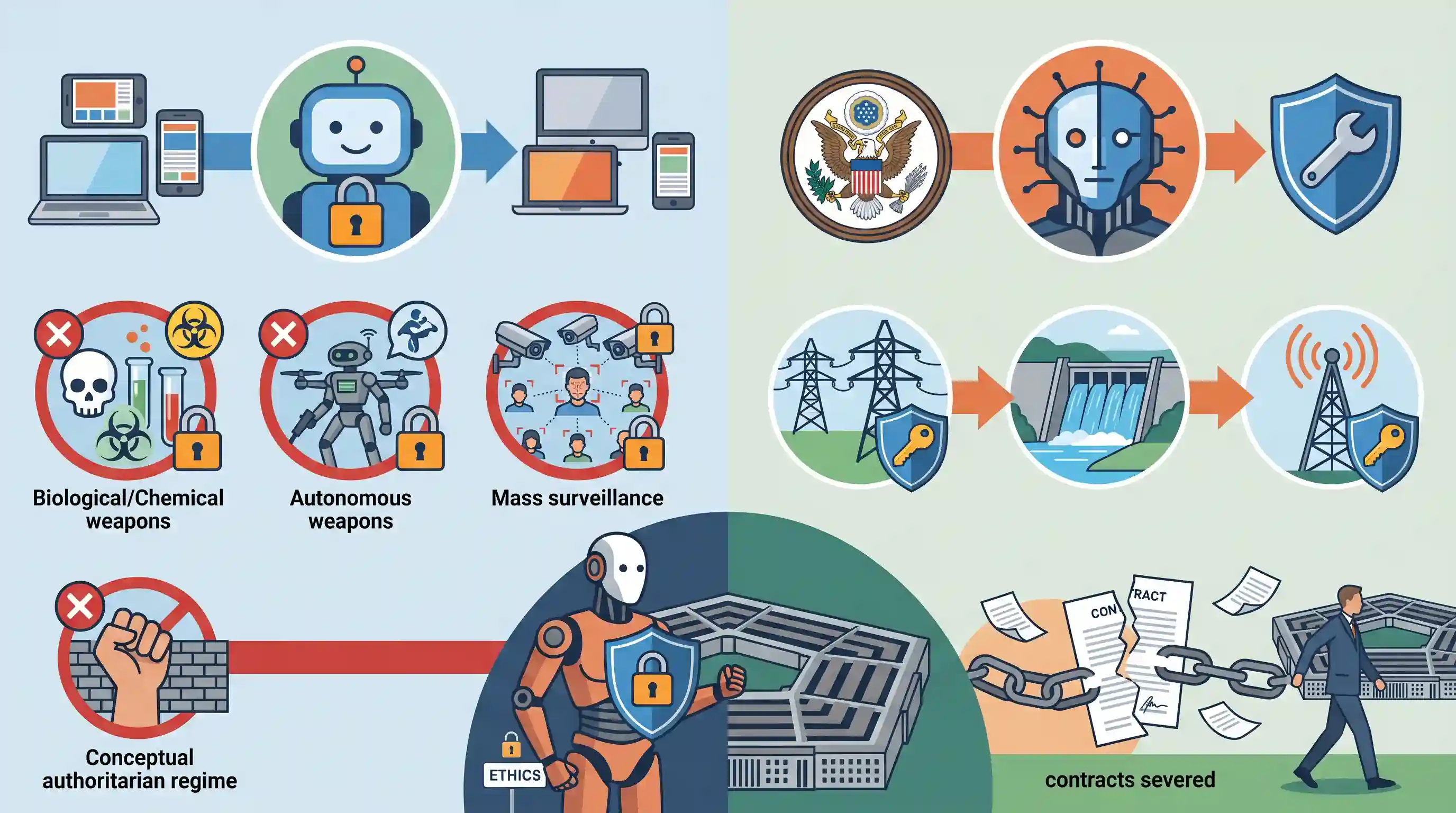
Anthropic has released Fable 5, a restricted consumer version of its advanced Claude Mythos 5 AI model. The unrestricted version remains exclusively accessible to the US government and trusted cybersecurity partners due to its potential to exploit vulnerabilities in critical infrastructure. Anthropic has enforced strong ethical and security guardrails on Fable 5, restricting its capabilities in developing biological/chemical weapons, autonomous lethal weapons, and facilitating mass surveillance. Furthermore, the company restricts access from authoritarian regimes to prevent them from training rival AI models. This strict adherence to AI safety has led to a standoff with the Pentagon, which recently severed defense contracts with Anthropic over its refusal to allow its AI to be used for mass surveillance and autonomous weapons.
Key Points
- Anthropic has publicly released Fable 5, a scaled-down and restricted version of its highly capable AI model, Claude Mythos 5.
- Full access to Claude Mythos 5 is limited to the US government and select cybersecurity partners because the AI can identify vulnerabilities in critical infrastructure like power grids and banking platforms.
- Anthropic implemented strict guardrails to prevent the AI from assisting in biological and chemical attacks, mass surveillance, and autonomous lethal weapon development.
- Access is restricted for authoritarian countries to prevent them from reverse-engineering the model to train competing AIs.
- The Pentagon severed contracts with Anthropic after the company refused to lift restrictions on the use of its AI for mass surveillance and autonomous weapons under the Trump administration.
Important Terms
Anthropic

An American AI safety and research company known for its "Claude" models. It emphasizes ethical guardrails and "Constitutional AI," recently clashing with defense agencies over the use of AI in autonomous weaponry.
UPSC context
GS Paper III (Science & Tech). Relevant for discussions on AI safety frameworks and private-sector roles in national security.
Claude Mythos 5
Anthropic's most advanced "Mythos-class" AI model, restricted to government and cybersecurity partners. It possesses high-level capabilities in identifying infrastructure vulnerabilities and biological research, posing significant dual-use risks.
UPSC context
GS Paper III (Internal Security). Tests awareness of dual-use AI risks and the security implications of frontier models.
Fable 5
The publicly available version of the Mythos 5 model, equipped with aggressive safety guardrails. It uses "fallback" mechanisms to prevent misuse in high-risk domains like offensive cyber operations and biological research.
UPSC context
GS Paper III (Cybersecurity). Relevant for studying AI safety guardrails and mitigating technological misuse in the public domain.
Project Glasswing
A controlled collaboration program between Anthropic and the US government. It provides vetted cybersecurity firms and critical infrastructure providers access to unrestricted AI models for defensive purposes and vulnerability discovery.
UPSC context
GS Paper III (Internal Security). Examines public-private partnerships in securing national assets against advanced digital threats.
Lethal Autonomous Weapons (LAWS)
AI-driven systems capable of selecting and engaging targets without human intervention. Anthropic's refusal to allow its models for such purposes led to a significant standoff with the Pentagon.
UPSC context
GS Paper III (Defense/Ethics). A core topic in modern warfare ethics and international regulatory debates (e.g., CCW).
Critical Infrastructure
Essential physical and digital systems (e.g., power grids, banking) whose disruption would severely impact national security, economic stability, or public safety. Protective AI deployment is central to their defense.
UPSC context
GS Paper III (Internal Security). Focuses on cyber-defense strategies and protecting national assets from AI-driven exploitation.
Supply Chain Risk
A security designation used to identify entities that may compromise government procurement. The Pentagon used this label as leverage against Anthropic during disputes over ethical AI restrictions.
UPSC context
GS Paper III (Internal Security/Policy). Relevant for understanding technological sovereignty and the geopolitical implications of defense procurement.
Prelims Trap
Lethal Autonomous Weapons Systems (LAWS) are strictly prohibited globally under the UN Convention on Certain Conventional Weapons.
While the UN CCW framework debates LAWS, there is currently no legally binding international treaty or convention completely prohibiting their development or deployment.
Static Concepts Connected
What is Critical Information Infrastructure (CII) in India?
- IT Act 2000: Defined under Section 70 as computer resources whose incapacitation would have a debilitating impact on national security, economy, or public health.
- Nodal Agency: National Critical Information Infrastructure Protection Centre (NCIIPC), created under the NTRO, is the designated nodal agency to protect CII.
- Key Sectors: Recognized sectors include Power & Energy, Banking & Finance, Telecom, Transport, Government, and Strategic Public Enterprises.
What are the ethical concerns of Lethal Autonomous Weapons Systems (LAWS)?
- Accountability Void: Ambiguity in assigning legal or moral responsibility when a fully autonomous machine commits an action violating laws of war.
- Humanitarian Law: Machines struggle to dynamically judge the qualitative rule of "proportionality" or distinguish combatants from civilians accurately in complex zones.
- Human Control: The core ethical friction lies in delegating life-and-death targeting decisions to black-box algorithms lacking empathy or contextual judgment.
Cross-Topic Patterns
Sovereign AI vs. Techno-Nationalism
Restricting foundational models mirrors 'techno-nationalism', connecting directly to India's push for the "IndiaAI Mission" to build sovereign computing capabilities and reduce Western dependency.
AI Surveillance & Puttaswamy
The clash over AI mass surveillance directly tests the limits of state surveillance against the fundamental Right to Privacy established in the K.S. Puttaswamy judgment.

Expect a 2026 prelims multi-statement question on AI governance, distinguishing open-source models from restricted foundational models.
Linked PYQs · 4
Linked PYQs · 4
- 2023MainsGS3
Introduce the concept of Artificial Intelligence (AI). How does Al help clinical diagnosis? Do you perceive any threat to privacy of the individual in the use of Al in healthcare?
- 2021MainsGS3
Keeping in view India's internal security, analyse the impact of cross-border cyber attacks. Also discuss defensive measures against these sophisticated attacks.
- 2020PrelimsGS1
With the present state of development, Artificial Intelligence can effectively do which of the following? 1. Bring down electricity consumption in industrial units 2. Create meaningful short stories and songs 3. Disease diagnosis 4. Text-to-Speech Conversion 5. Wireless transmission of electrical energy Select the correct answer using the code given below:
- 2017MainsGS2
Examine the scope of Fundamental Rights in the light of the latest judgement of the Supreme Court on Right to Privacy.
