Artificial intelligence automation threatens outsourcing model
Source:Indian Express ↗
Why It Matters
This topic is highly relevant for GS-3 (Technology and Economy) and GS-1 (Urbanization and Society) as it highlights the intersection of emerging technologies (AI) with employment trends, urging a structural shift in India's critical IT export sector.
Summary
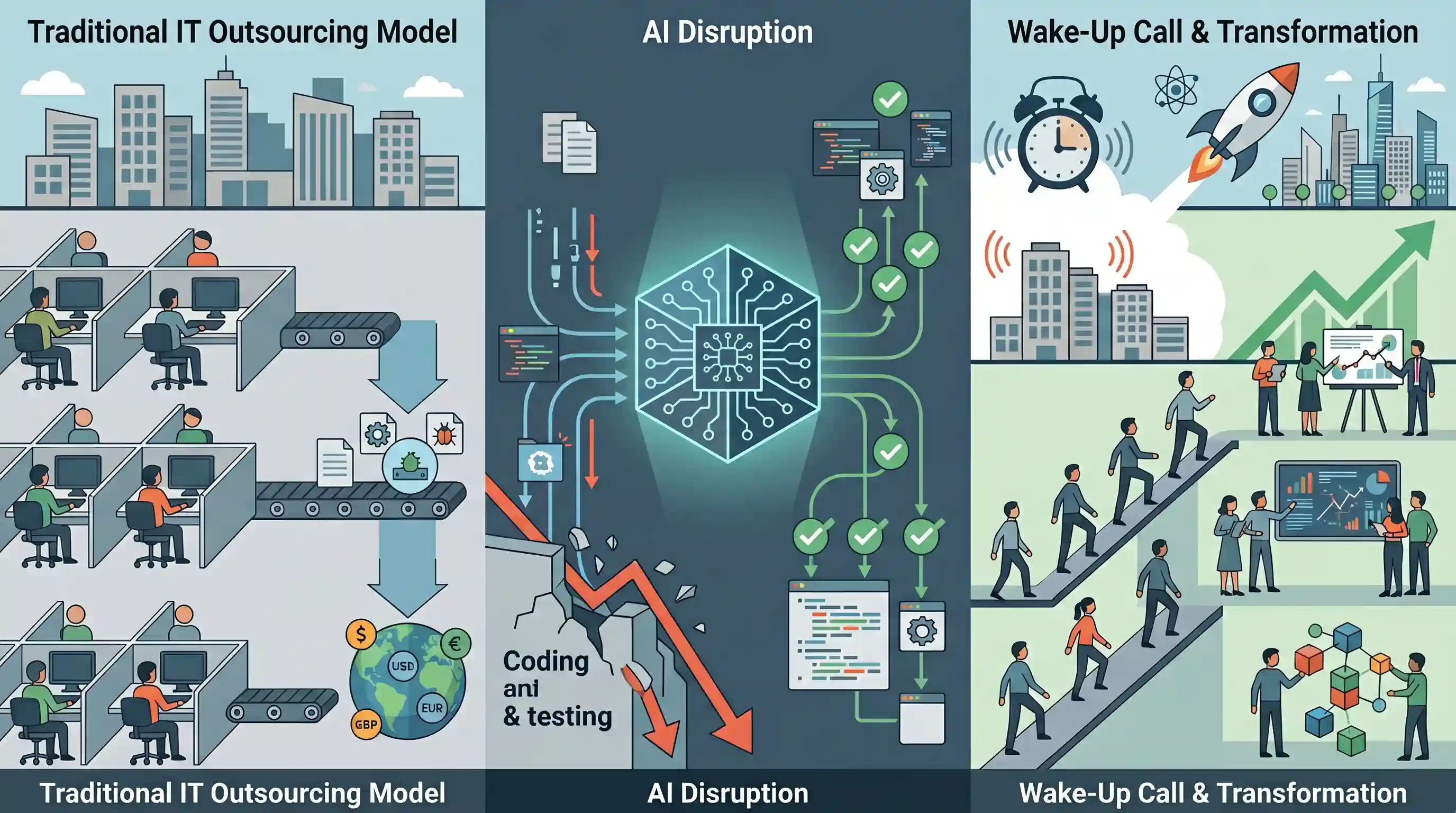
The editorial discusses the existential threat posed to Bengaluru's traditional IT outsourcing model by advanced AI agents developed by companies like Anthropic. With new AI capabilities able to autonomously execute software engineering tasks, the era of relying on labor cost arbitrage for basic coding and testing is rapidly ending. The piece serves as a wake-up call for India's IT sector to transition from back-office services to high-value innovation, emphasizing the urgent need to upskill the workforce to survive the AI-driven Fourth Industrial Revolution.
Key Points
- Recent AI breakthroughs by Anthropic, which enable AI models to autonomously perform software engineering and computer tasks, signal a major disruption for the global IT industry.
- Bengaluru's traditional IT outsourcing model, which has historically relied on labor cost arbitrage for basic coding, maintenance, and testing, is highly vulnerable to AI automation.
- As AI agents drive the marginal cost of software development towards zero, the massive workforce advantage of Indian IT firms faces an existential threat.
- To survive this technological shift, Indian IT hubs must pivot from being back-office service providers to leading in deep tech innovation, AI product development, and complex problem-solving.
- There is an urgent need for large-scale upskilling and reskilling of the IT workforce to prevent significant job losses and sustain India's position in the global digital economy.
Important Terms
Anthropic

A leading American AI safety and research company, creator of the 'Claude' models. Its expansion into Bengaluru signals a shift toward agentic AI that can autonomously perform complex software tasks.
UPSC context
GS III: Science & Technology; relevant for understanding the global AI landscape and its direct impact on India's digital economy.
Indian IT Majors
Refers to large, global software exporters like TCS, Infosys, and Wipro. These firms form the backbone of India's services exports but face structural risks from AI-driven automation.
UPSC context
GS III: Indian Economy; concerns the stability of India’s $250B+ IT sector and the 'SaaSpocalypse' threat to export revenues.
Labor Cost Arbitrage
An economic strategy where firms exploit wage differences between countries by outsourcing labor-intensive tasks to lower-cost regions like India. AI is rapidly eroding this traditional competitive advantage.
UPSC context
GS III: Effects of liberalization; specifically how technological disruption changes global trade dynamics and India’s comparative advantage in services.
AI Agents
Advanced AI systems capable of autonomous reasoning, planning, and task execution (e.g., coding, legal review) without constant human prompts, moving beyond simple conversational interfaces.
UPSC context
GS III: Science & Technology; highlights the transition from 'human-in-the-loop' automation to fully autonomous digital workforces.
Fourth Industrial Revolution (4IR)
The current era of technological transformation characterized by a fusion of digital, physical, and biological systems, driven by AI, robotics, and the Internet of Things.
UPSC context
GS III: Economic Development & Tech; essential for discussing industrial policy, 'Industry 4.0', and the future of work in India.
Prelims Trap
Agentic AI requires continuous human prompting to execute step-by-step software tasks.
Agentic AI is defined by autonomy. It independently plans, reasons, and interacts with operating systems to execute complex tasks without constant human intervention.
Static Concepts Connected
What characterizes technological and structural unemployment in the 4IR context?
- Technological Unemployment: Job losses directly caused by automation, robotics, and AI replacing human labor in tasks previously deemed secure.
- Structural Mismatch: Occurs when workers lack the new skills (e.g., AI orchestration, deep tech) demanded by the evolving economic structure.
- Cost Arbitrage Erosion: When capital-intensive AI becomes cheaper than low-cost labor, nullifying developing nations' traditional outsourcing advantages.
How does the Fourth Industrial Revolution (4IR) differ from previous phases?
- Earlier Phases: The first three revolutions focused on mechanization (steam), mass production (electricity), and basic automation (electronics/IT).
- Cyber-Physical Systems: 4IR is characterized by the fusion of technologies that blur the boundaries between the physical, digital, and biological spheres.
- Autonomous Intelligence: A shift from human-programmed execution to autonomous decision-making and continuous learning by machines (e.g., Agentic AI).
Cross-Topic Patterns
Demographic Dividend vs. AI Automation
India's youth bulge coincides with the rise of autonomous AI. Without rapid upskilling, this demographic window risks becoming a socio-economic liability due to massive technological unemployment.
Single-Sector Urban Vulnerability
Bengaluru's urban economy is anchored to the IT-BPM sector. AI-induced job displacements could trigger a cascading municipal crisis, mirroring the historic deindustrialization of automobile-dependent Detroit.

GS3 2026 will likely feature a 15-marker linking Agentic AI advancements to structural unemployment and India's demographic dividend.
Linked PYQs · 4
Linked PYQs · 4
- 2019MainsEssay
Rise of Artificial Intelligence: the threat of jobless future or better job opportunities through reskilling and upskilling
- 2021MainsGS1
What are the main socio-economic implications arising out of the development of IT industries in major cities of India?
- 2017MainsGS1
"The growth of cities as I.T. hubs has opened up new avenues of employment, but has also created new problems." Substantiate this statement with examples.
- 2023MainsGS3
Introduce the concept of Artificial Intelligence (AI). How does Al help clinical diagnosis? Do you perceive any threat to privacy of the individual in the use of Al in healthcare?
