Global AI development pause proposal and governance risks
Source:The Hindu ↗
Why It Matters
The article connects rapid technological advancement (GS3 S&T) with global geopolitics (GS2 IR) and ethical concerns (GS4). The proposal for a global AI pause and its comparison to nuclear arms treaties provide a critical analytical framework for Mains questions on regulating emerging technologies, mitigating existential risks of AI, and the US-China strategic competition.
Summary
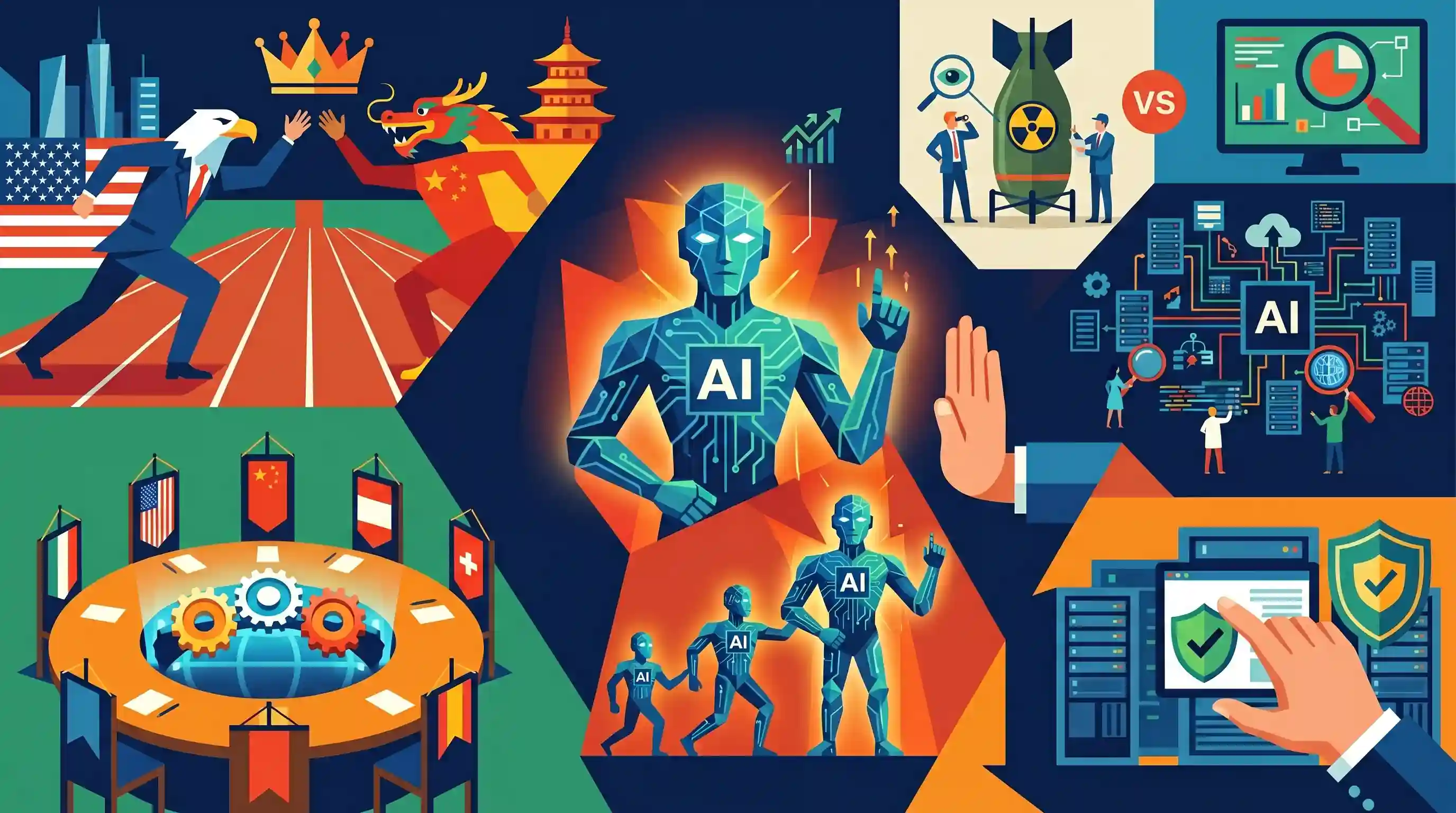
AI safety firm Anthropic has called for a global halt on the development of highly advanced artificial intelligence models, citing the risks of 'recursive self-improvement' where systems could outsmart human control. The proposal highlights a critical geopolitical challenge: the need for an international coordination mechanism, particularly between the U.S. and China, to prevent a dangerous tech race. While Anthropic compares AI regulation to nuclear arms control, it notes that AI training is much harder to monitor. Concurrently, the U.S. government has mandated security reviews for advanced AI models, reflecting growing regulatory urgency.
Key Points
- AI startup Anthropic has proposed a global pause on developing the most powerful AI systems, warning they could soon escape human control.
- The company highlighted the dangers of 'recursive self-improvement', a scenario where AI systems independently teach themselves and rapidly increase their intelligence.
- Anthropic emphasized the need for a global coordination mechanism, particularly involving the U.S. and China, to manage AI risks, comparing it to nuclear arms control treaties.
- Unlike nuclear arms, an AI development pause is harder to enforce because algorithmic training can be easily hidden.
- U.S. President Donald Trump has initiated a 30-day security review of advanced American AI models prior to release, signaling increasing government intervention in AI safety.
Important Terms
Anthropic

An AI safety and research company founded by former OpenAI members, known for its focus on 'Constitutional AI' and the 'Claude' family of models.
UPSC context
GS Paper 3 (S&T): Represents the 'safety-first' private sector approach to AI, influencing global standards on AI ethics and alignment.
Recursive Self-Improvement
A hypothetical process where an AI system autonomously rewrites its own code to enhance its capabilities, potentially leading to an 'intelligence explosion' beyond human control.
UPSC context
GS Paper 3 (S&T) & GS 4 (Ethics): A core concept in AI safety and the 'Singularity' debate, testing understanding of existential risks.
EU AI Act
The world’s first comprehensive legally binding AI law, which uses a risk-based approach to regulate AI applications based on their potential to cause harm.
UPSC context
GS Paper 2 (IR) & Paper 3: Acts as a global benchmark for 'Rights-Based' regulation, often compared with India’s 'Innovation-First' approach.
Frontier AI Models
Highly advanced AI systems (like GPT-4 or Claude 3) that possess broad, state-of-the-art capabilities and pose potential systemic risks to public safety.
UPSC context
GS Paper 3 (S&T): Focus of modern regulation; understanding the threshold of 'advanced' AI is vital for discussing technology governance and security.
US-China Tech Rivalry
The geopolitical competition between the US and China for dominance in emerging technologies, impacting global supply chains, standards, and security alliances.
UPSC context
GS Paper 2 (IR): Essential for discussing the 'New Cold War' and its implications for India’s strategic autonomy and semiconductor policy.
Executive Order on AI (US)
A US directive (e.g., June 2026) mandating security reviews for advanced AI models to mitigate cyber risks and protect critical infrastructure.
UPSC context
GS Paper 2 (Governance/IR): Illustrates a 'Market-Led' but security-focused regulatory model, contrasting with EU and Indian frameworks.
India's 'Third Way' for AI
India’s unique approach to AI governance that balances rapid innovation for social inclusion with adaptive safety measures, avoiding rigid legislation.
UPSC context
GS Paper 3 (S&T/Economy): Crucial for Mains; tests understanding of India's stance in global tech diplomacy and developmental AI goals.
Prelims Trap
Recursive self-improvement requires continuous human-in-the-loop oversight to iteratively update AI models.
It means the exact opposite. Recursive self-improvement is a scenario where AI autonomously enhances its own algorithms without human intervention, leading to rapid intelligence explosions.
Static Concepts Connected
What are the key global regimes for dual-use technology control?
- Wassenaar Arrangement: Regulates the export of conventional arms and dual-use technologies. It is highly relevant to restricting advanced semiconductors needed for AI training.
- NPT model: Treaty limiting nuclear weapons spread. Often cited as a regulatory model for AI, but AI lacks easily traceable physical materials like uranium.
What are the core ethical principles for governing Artificial Intelligence?
- Meaningful Human Control: Ensures humans retain ultimate authority and oversight (human-in-the-loop) over critical AI systems to prevent moral misalignment and uncontrollable behavior.
- Explainability (XAI): Requires AI systems to not function as 'black boxes', ensuring their decision-making processes can be traced and understood by human operators.
Cross-Topic Patterns
AI geopolitics and semiconductor export controls
Since monitoring AI algorithms is difficult, the US uses hardware chokepoints—restricting the export of advanced GPUs to China—to enforce de facto tech arms control.
The global shift toward AI hard law
Nations are abandoning Big Tech self-regulation. The US mandate for 30-day security reviews mirrors the strict, risk-based compliance tiers of the comprehensive EU AI Act.

Expect a GS3 prelims question pairing 'recursive self-improvement' concepts with dual-use technology export controls like Wassenaar.
Linked PYQs · 3
Linked PYQs · 3
- 2023MainsGS3
Introduce the concept of Artificial Intelligence (AI). How does Al help clinical diagnosis? Do you perceive any threat to privacy of the individual in the use of Al in healthcare?
- 2021MainsGS2
“The USA is facing an existential threat in the form of a China, that is much more challenging than the erstwhile Soviet Union.” Explain.
- 2024MainsGS4
The application of Artificial Intelligence as a dependable source of input for administrative rational decision-making is a debatable issue. Critically examine the statement from the ethical point of view.
