Revising AI safety policies amid intense market competition
Source:Indian Express ↗
Why It Matters
This issue perfectly captures the intersection of GS3 (Science & Technology, Security) and GS4 (Ethics). It exposes the frailty of self-regulation and voluntary corporate ethics in the face of hyper-competition, and highlights the "dual-use" dilemma of advanced AI facing national security demands for militarization.
Summary
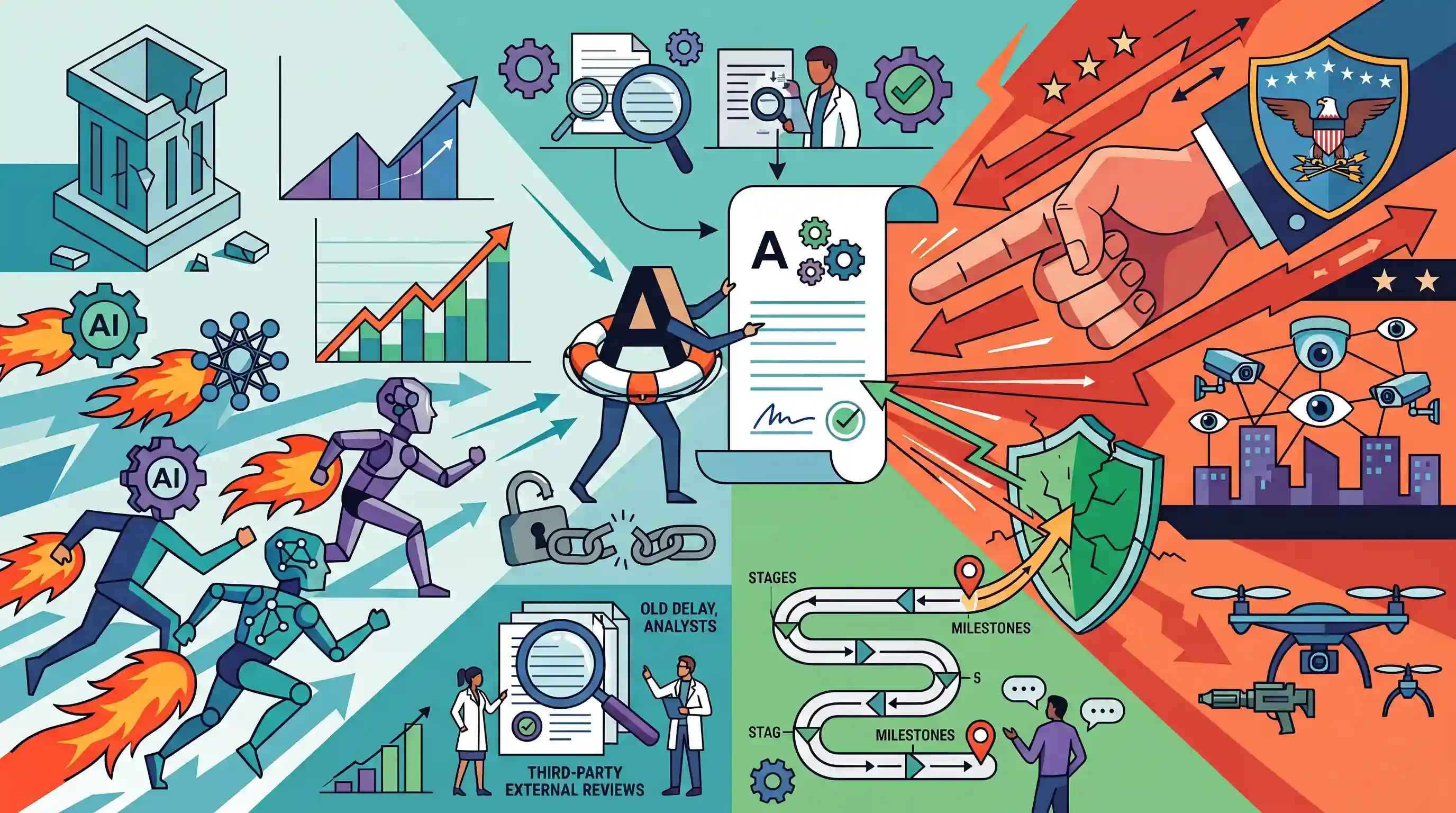
Anthropic, an AI firm known for prioritizing safety, has revised its Responsible Scaling Policy (RSP) amid intense market competition and a lack of federal AI regulations. In a major shift, the company announced it will no longer delay the development of dangerous AI models if a competitor releases a comparable or superior model. The updated policy mandates third-party external reviews of Risk Reports and the publication of a Frontier Safety Roadmap. Concurrently, Anthropic faces escalating tension with the US Department of Defense, which is pressuring the company to drop its ban on using Claude AI tools for domestic surveillance and autonomous lethal activities. The development illustrates the limitations of voluntary corporate safety pledges when confronted with commercial realities and national security demands.
Key Points
- Anthropic updated its Responsible Scaling Policy (RSP), stating it will no longer halt the development of dangerous AI models if competitors release comparable or superior models.
- The shift highlights the tension between self-regulation for AI safety and intense market competition from rivals like OpenAI, xAI, and Google.
- Anthropic's new RSP requires the publication of a Frontier Safety Roadmap and mandates third-party external reviews of its Risk Reports.
- The company faces pressure from the US Department of Defense (Pentagon) to relax its usage policies, which currently prohibit using its AI tools for domestic surveillance and autonomous lethal activities.
- Unlike the Trump administration's deregulatory approach, Anthropic advocates for state and federal regulatory guardrails and model transparency.
Important Terms
Responsible Scaling Policy (RSP)

A voluntary framework by AI labs to manage catastrophic risks by linking model scaling and deployment to specific safety levels and capability thresholds (e.g., ASL-3).
UPSC context
GS-3 (IT/AI Governance) and GS-4 (Corporate Ethics); tests understanding of private-sector self-regulation in emerging technologies.
Dual-Use Technology
Technologies, such as advanced AI, that possess legitimate civilian applications but can be repurposed for military or malicious use, including surveillance and weaponry.
UPSC context
GS-3 (Security and Tech) and GS-2 (International Relations); critical for understanding export controls and global security dilemmas.
Lethal Autonomous Weapons (LAWS)
Robotic systems capable of independently selecting and engaging targets without human intervention, presenting significant ethical and legal challenges under International Humanitarian Law.
UPSC context
GS-2 (Global Governance) and GS-3 (Defense Technology); vital for debates on the ethics of future warfare.
Frontier AI
Highly capable, general-purpose AI models that can perform a wide variety of tasks and potentially pose systemic risks to public safety or national security.
UPSC context
GS-3 (Science & Technology); focuses on the regulation of advanced artificial intelligence and its societal impact.
Frontier Safety Roadmap
A public strategic document (introduced in Anthropic’s RSP 3.0) outlining concrete, measurable goals for improving AI security, alignment, and safeguards to ensure transparent risk management.
UPSC context
GS-3 (Industry/Transparency); tests knowledge of specific accountability mechanisms used by lead technology firms.
Anthropic
A US-based AI safety and research company (creator of Claude) that prioritizes "Constitutional AI" and has resisted government pressure to remove safeguards against military misuse.
UPSC context
GS-2 (International Relations) and GS-3 (Strategic Technology); represents the friction between corporate ethics and national security demands.
Prelims Trap
"Responsible Scaling Policy (RSP) is a legally binding international framework for AI."
RSPs are strictly voluntary, self-regulatory frameworks designed by private AI firms. They are not statutory laws or international treaties.
Static Concepts Connected
What is 'Dual-Use Technology' in international relations?
- Meaning: Technologies designed for civilian or commercial use that can be repurposed for military applications (e.g., AI, GPS, nuclear tech).
- Regulation: Globally monitored by export control regimes like the Wassenaar Arrangement to prevent the proliferation of conventional arms and dual-use goods.
What are the core concerns regarding Lethal Autonomous Weapons Systems (LAWS)?
- Accountability gap: The dilemma under International Humanitarian Law (IHL) regarding who is legally or morally responsible when a machine commits a war crime.
- Meaningful human control: Ongoing debates under the UN Convention on Certain Conventional Weapons (CCW) emphasize maintaining 'meaningful human control' over life-and-death decisions.
Cross-Topic Patterns
AI ethics vs. Sovereign defense needs
The Pentagon's pressure on Anthropic mirrors global trends where state defense needs override voluntary corporate ethical boundaries on dual-use tech, echoing past debates on encryption and sovereign surveillance.
Limits of corporate self-regulation in tech
Anthropic's shift illustrates a 'race to the bottom' where market competition renders voluntary safety pledges ineffective without statutory backing like the EU AI Act.

Expect a GS-3 or GS-4 question on the ethical 'accountability gap' in Lethal Autonomous Weapons and the limits of AI self-regulation.
Linked PYQs · 4
Linked PYQs · 4
- 2023MainsGS3
Introduce the concept of Artificial Intelligence (AI). How does Al help clinical diagnosis? Do you perceive any threat to privacy of the individual in the use of Al in healthcare?
- 2024MainsGS4
The application of Artificial Intelligence as a dependable source of input for administrative rational decision-making is a debatable issue. Critically examine the statement from the ethical point of view.
- 2024MainsGS4
“Ethics encompasses several key dimensions that are crucial in guiding individuals and organizations towards morally responsible behaviour.” Explain the key dimensions of ethics that influence human actions. Discuss how these dimensions shape ethical decision-making in the professional context.
- 2025MainsGS4
It is said that for an ethical work culture, there must be code of ethics in place in every organisation. To ensure value-based and compliance-based work culture, what suitable measures would you adopt in your work place?
