Anthropic AI Copyright Settlement and Generative Training Precedent
Source:The Hindu ↗
Why It Matters
The settlement sets a major legal precedent regarding how generative AI models are trained on copyrighted materials. For civil servants and policymakers, it illustrates the complex regulatory challenge of balancing technological innovation with the protection of intellectual property rights, a dynamic that will heavily influence global tech governance and copyright frameworks.
Summary
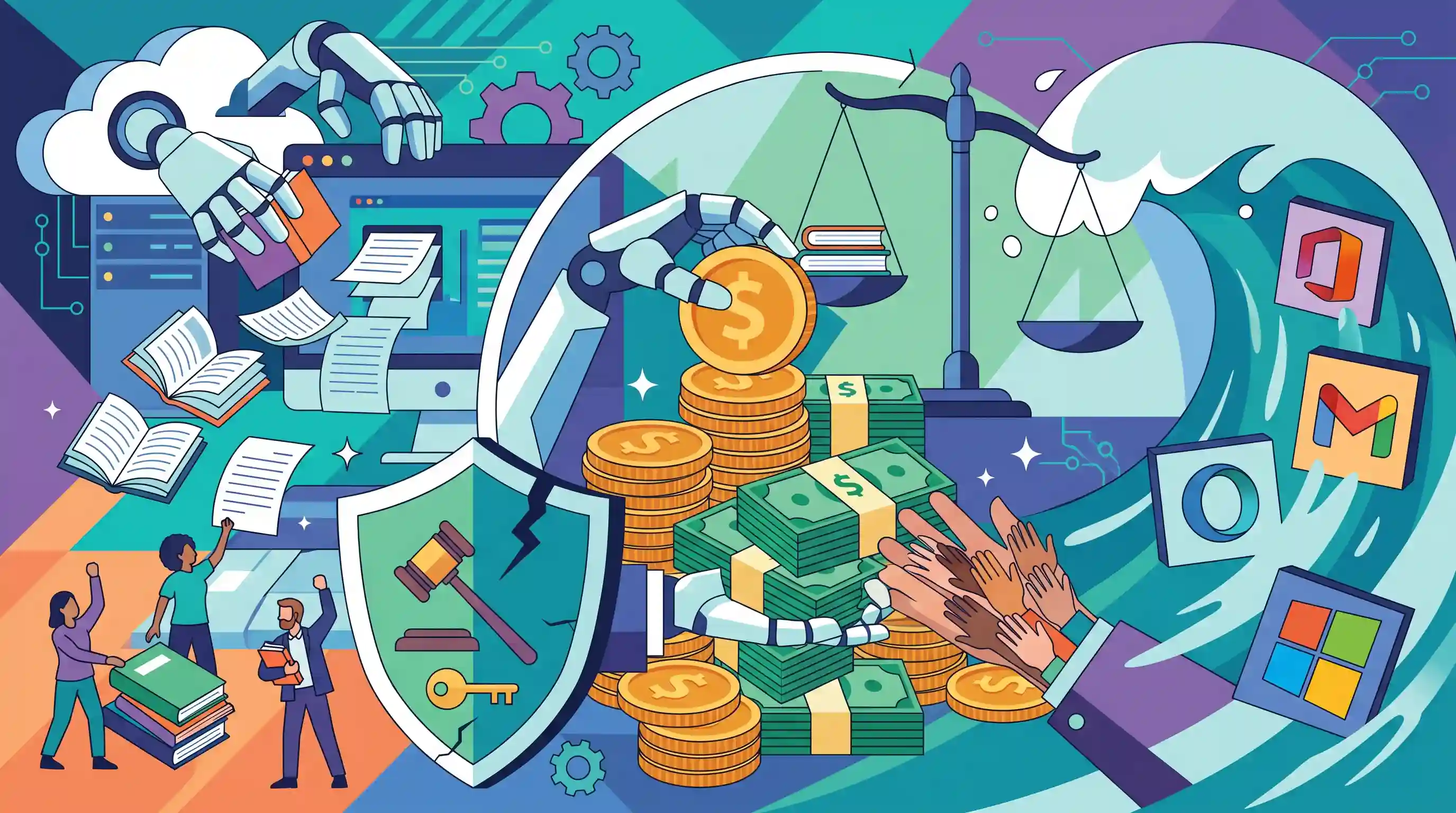
Anthropic has agreed to a historic $1.5 billion settlement in a class-action lawsuit filed by authors who alleged their copyrighted books were pirated to train the AI chatbot Claude. While Anthropic did not admit liability and tech companies maintain that AI data training constitutes "fair use," the settlement underscores the escalating legal and ethical conflicts between generative AI development and intellectual property rights. The outcome sets a major precedent amid a wave of similar copyright infringement lawsuits against tech giants like OpenAI, Microsoft, and Meta.
Key Points
- Anthropic has agreed to a historic $1.5 billion settlement to resolve a class-action lawsuit over using pirated books to train its AI chatbot, Claude.
- The lawsuit reflects a broader wave of litigation against tech giants like OpenAI and Meta by authors, artists, and news outlets defending their intellectual property.
- A core legal debate in these cases is whether using copyrighted data to train machine learning models qualifies as "fair use" under copyright law.
- As part of the settlement, Anthropic did not admit liability but agreed to destroy downloaded copies of the pirated books from its central library.
- This case sets a significant precedent for AI governance, highlighting the urgent need to balance rapid technological innovation with the protection of creators' intellectual property rights.
Important Terms
Anthropic

An AI safety and research firm that developed the Claude chatbot; it is a central figure in landmark legal cases regarding the use of copyrighted data for AI training.
UPSC context
GS Paper-III (S&T, IPR); tests knowledge of AI governance, ethics, and the legal challenges of datasets in machine learning.
Authors Guild
The oldest and largest professional organization for U.S. writers; it leads collective legal actions to protect authors' intellectual property rights against unauthorized AI training practices.
UPSC context
GS Paper-III (IPR); relates to the protection of creative rights and the impact of technological innovation on creator livelihoods.
OpenAI
An AI research lab and creator of ChatGPT; it faces extensive copyright litigation for allegedly using massive datasets of protected works without permission to train its models.
UPSC context
GS Paper-III (S&T); tests awareness of industry leaders in generative AI and the legal risks of large-scale data ingestion.
Microsoft
A global technology giant and major partner of OpenAI; it is a co-defendant in multiple copyright lawsuits concerning the commercialization of generative AI services.
UPSC context
GS Paper-III (Economy/S&T); involves the role of multinational corporations in AI infrastructure and legal liabilities from collaborative tech ventures.
Meta Platforms
The parent company of Facebook and developer of Llama AI models; it has faced legal challenges over training its AI on unauthorized datasets like "Books3."
UPSC context
GS Paper-III (S&T, IPR); concerns data ethics, corporate accountability, and the regulatory environment for open-source AI.
Alphabet
The parent company of Google and a major investor in Anthropic; its strategic funding highlights the financial and competitive stakes of big tech in the AI landscape.
UPSC context
GS Paper-III (S&T, Economic Development); relevant for understanding market structures and the financial backing of emerging high-tech sectors.
Amazon
A global e-commerce and cloud giant that invested billions in Anthropic; its role underscores the integration of cloud infrastructure with generative AI model development.
UPSC context
GS Paper-III (S&T, Infrastructure); tests knowledge of the digital economy and the partnerships driving high-compute AI innovation.
Prelims Trap
"India's Copyright Act includes an explicit 'Text and Data Mining' (TDM) exception to permit commercial AI training."
India's 'Fair Dealing' doctrine lacks an explicit TDM exception and is restricted to non-commercial private research, leaving commercial AI scraping in a legal grey area.
Static Concepts Connected
What distinguishes Moral Rights from Economic Rights under India's Copyright Act?
- Economic Rights: These grant creators the exclusive right to derive financial reward from the use of their works, such as through reproduction, translation, or broadcasting.
- Moral Rights: Under Section 57, these are inalienable rights of paternity (authorship) and integrity (preventing distortion), protecting a creator's reputation even after economic rights expire or are transferred.
How does India's 'Fair Dealing' differ from the 'Fair Use' doctrine?
- Exhaustive vs Flexible: India's Fair Dealing features a closed, explicit list of exceptions. The US Fair Use doctrine is an open-ended, multi-factor balancing test adaptable to new technologies.
- Commercial Limitations: Indian law strictly permits unauthorized use primarily for non-commercial private research or criticism, making its application to industrial-scale AI data scraping highly contested.
Cross-Topic Patterns
WIPO Treaties + AI Algorithmic Ingestion
The AI data scraping debate forces a re-examination of the TRIPS Agreement and WIPO Copyright Treaty, which were designed for human authorship rather than industrial-scale machine ingestion.
IndiaAI Mission + DPIIT Blanket Licensing
India's pursuit of sovereign AI datasets connects directly to the DPIIT's proposed 'Statutory Blanket Licensing', aiming to fuel domestic AI without stunting innovation through individual copyright disputes.

Expect a Prelims question differentiating India's 'Fair Dealing' from global 'Fair Use' or TDM exceptions in the context of AI training.
Linked PYQs · 2
Linked PYQs · 2
- 2014MainsGS3
In a globalized world, Intellectual Property Rights assume significance and are a source of litigation. Broadly distinguish between the terms-Copyrights, Patents and Trade Secrets.
- 2023MainsGS3
Introduce the concept of Artificial Intelligence (AI). How does Al help clinical diagnosis? Do you perceive any threat to privacy of the individual in the use of Al in healthcare?
