Wildlife Conservation Lapses in Nagarjunasagar Srisailam Tiger Reserve
Source:The Hindu ↗
Why It Matters
It highlights the administrative challenges and on-ground lapses in forest management that undermine flagship conservation initiatives like Project Tiger. Events in significant ecosystems like the NSTR are highly relevant for AP-specific environmental questions.
Summary
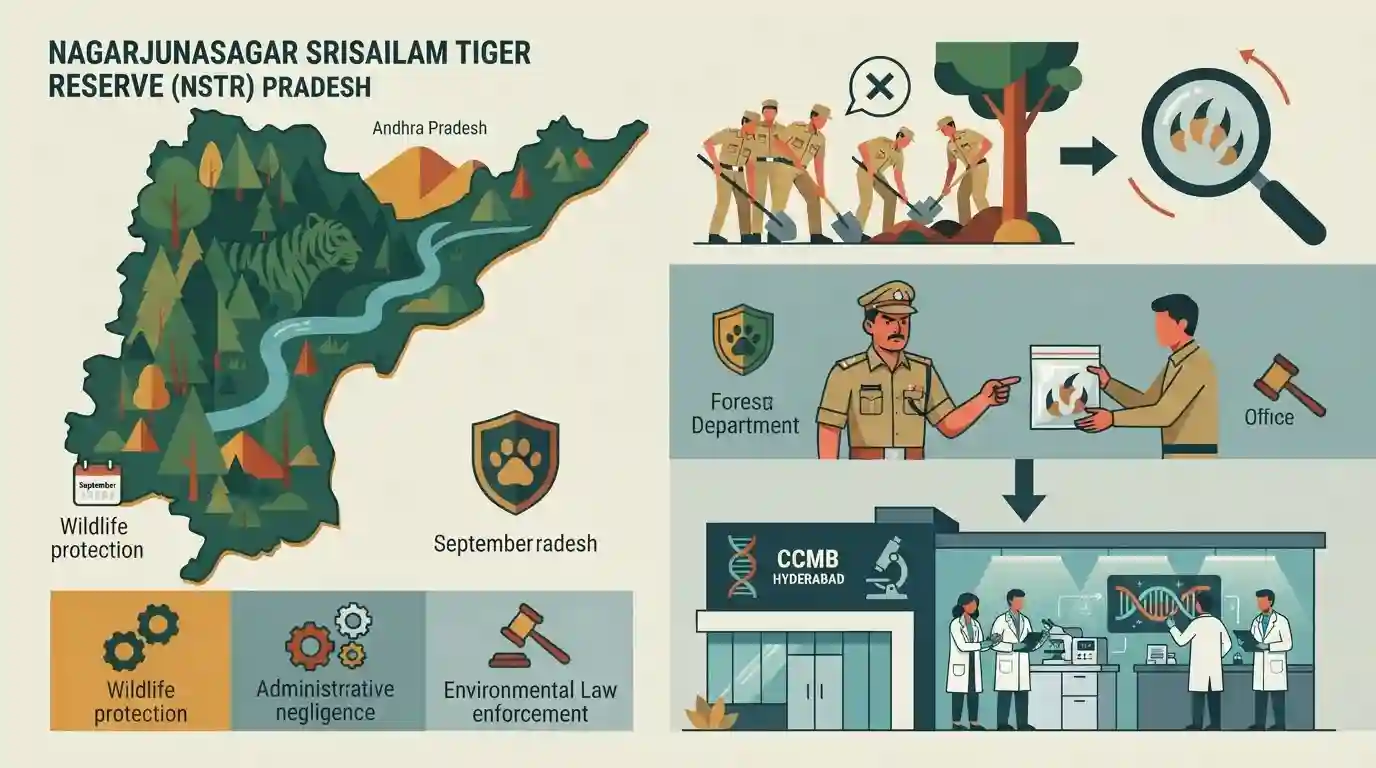
A tiger death in Andhra Pradesh's Nagarjunasagar Srisailam Tiger Reserve (NSTR) has led to the suspension of a Forest Section Officer after it emerged that field staff concealed the mortality instead of reporting it. The incident, which occurred in September, came to light during an investigation, following which seized tiger claws were sent to the Centre for Cellular and Molecular Biology (CCMB) in Hyderabad for forensic analysis. The cover-up raises serious concerns about administrative negligence and the effectiveness of wildlife protection monitoring in the reserve.
Key Points
- A tiger death in the Nagarjunasagar Srisailam Tiger Reserve (NSTR) went unreported after field staff secretly disposed of the carcass in September.
- A Forest Section Officer was suspended for negligence and failing to report the wildlife mortality.
- Tiger claws seized from the location have been sent to the Centre for Cellular and Molecular Biology (CCMB) in Hyderabad for DNA and forensic analysis.
- The incident points to critical lapses in monitoring and anti-poaching protocols within one of India's largest tiger habitats.
Important Terms
Nagarjunasagar Srisailam Tiger Reserve (NSTR)

India's largest tiger reserve by core area, located in Andhra Pradesh's Nallamala Hills. Spans the Krishna River basin and houses diverse biodiversity, serving as a critical habitat for Bengal Tigers.
UPSC context
GS Paper III (Environment & Biodiversity); tests knowledge of key protected areas, geographical features, and conservation challenges in the Eastern Ghats.
Project Tiger
A centrally sponsored scheme launched in 1973 to ensure a viable population of Bengal tigers in India through scientific habitat management, anti-poaching measures, and core-buffer zoning in designated tiger reserves.
UPSC context
GS Paper III (Biodiversity & Conservation); tests conservation programs, administrative frameworks, and successful flagship initiatives for wildlife protection.
Wildlife (Protection) Act, 1972
India's principal legislation for protecting wild animals, birds, and plants. It establishes schedules of protection, outlaws hunting, restricts illegal trade, and provides the statutory framework for declaring protected areas and tiger reserves.
UPSC context
GS Paper III (Environmental Legislation); tests statutory frameworks, legal schedules, amendments, and enforcement mechanisms for combating wildlife crimes.
Centre for Cellular and Molecular Biology (CCMB)
A premier CSIR research institute in Hyderabad. Through its specialized wing, LaCONES, it uses advanced DNA-based forensic technology and 'Universal Primers' to identify species from tiny biological samples in wildlife crime cases.
UPSC context
GS Paper III (Science & Tech / Environment); tests role of biotechnology, DNA forensics, and research institutions in enforcing conservation laws.
National Tiger Conservation Authority (NTCA)
A statutory body under the Ministry of Environment, Forest and Climate Change, constituted under the Wildlife (Protection) Act, 1972, to oversee Project Tiger, approve conservation plans, and monitor tiger reserves.
UPSC context
GS Paper III (Environmental Governance); tests institutional bodies, statutory oversight, center-state accountability, and guidelines for managing endangered ecosystems.
Prelims Trap
"CCMB and its wildlife forensics lab (LaCONES) operate under the administrative control of the MoEFCC."
While LaCONES performs crucial wildlife forensics for anti-poaching, CCMB is a constituent lab of CSIR, which falls under the Ministry of Science and Technology.
Static Concepts Connected
What are the key geographical and ecological features of Nagarjunasagar Srisailam Tiger Reserve (NSTR)?
- Topography: Situated in the Nallamala Hills of the Eastern Ghats, making it India's largest tiger reserve by core area.
- Hydrology: The Krishna River cuts directly through the reserve's basin, hosting both the Srisailam and Nagarjunasagar multipurpose reservoirs.
- Vegetation: The ecosystem is primarily characterized by Southern Tropical Dry Deciduous forests, adapted to the region's rainfall patterns.
What is the statutory framework governing tiger mortality investigations in India?
- NTCA Mandate: Established under the Wildlife (Protection) Act, 1972, the NTCA is the statutory body enforcing mandatory Standard Operating Procedures (SOPs) across reserves.
- Default Poaching Assumption: Under NTCA SOP, every tiger death must be treated as a poaching case by default until autopsy and forensic evidence definitively prove natural mortality.
- Forensic Validation: State forest departments rely on recognized nodal agencies like LaCONES (CCMB) for DNA analysis to identify individuals and prosecute wildlife crimes.
Cross-Topic Patterns
Biotech applied to Wildlife Crime
The use of DNA barcoding by CSIR-CCMB (LaCONES) to identify seized wildlife products reflects a recurring UPSC theme: applied biotechnology crossing over into environmental law enforcement and anti-poaching protocols.
Tiger Reserves and River Basins
UPSC increasingly tests protected areas via their hydrological markers. NSTR's direct association with the Krishna River mirrors past geography questions on Pakke (Kameng River) and Corbett (Ramganga).

Expect a 2026 multi-statement question pairing NSTR's Eastern Ghats/Krishna basin geography with NTCA's statutory tiger mortality SOPs.
Linked PYQs · 3
Linked PYQs · 3
- 2023APPSC_PRELIMSGS1
Match the following Tiger Reserves with their States (location) : | Tiger Reserves | States | |---|---| | a. Periyar | I. Chhattisgarh | | b. Sariska | II. Rajasthan | | c. Buxa | III. West Bengal | | d. Indravati | IV. Kerala | Choose the correct answer using the codes given below : Code: a b c d
- 2024APPSC_PRELIMSGS1
Match the following : | List-I (Wildlife Sanctuary in Andhra Pradesh) | List-II (Region) | |---|---| | A. Coringa | I. Kurnool | | B. Gundla Brahmeswaram | II. Kadapa | | C. Rollapadu | III. East Godavari | | D. Sri Lankamalleswara | IV. Kurnool and Prakasam | Choose the correct answer using the codes given below : Code: A B C D
- 2023APPSC_PRELIMSGS1
According to the Indian Forest Act, 1927, which of the following is the most appropriate sequence which shows the degree of protection between different forest types ?
