ISRO Resolves Polar Satellite Launch Vehicle Third Stage Anomaly
Source:The Hindu ↗
Why It Matters
This article highlights ISRO's technical challenges with its workhorse PSLV and the subsequent failure analysis process. For UPSC, candidates must understand the technical distinctions between PSLV and GSLV, the significance of Earth Observation Satellites (EOS) for socio-economic development, and the importance of resilience in India's space program.
Summary
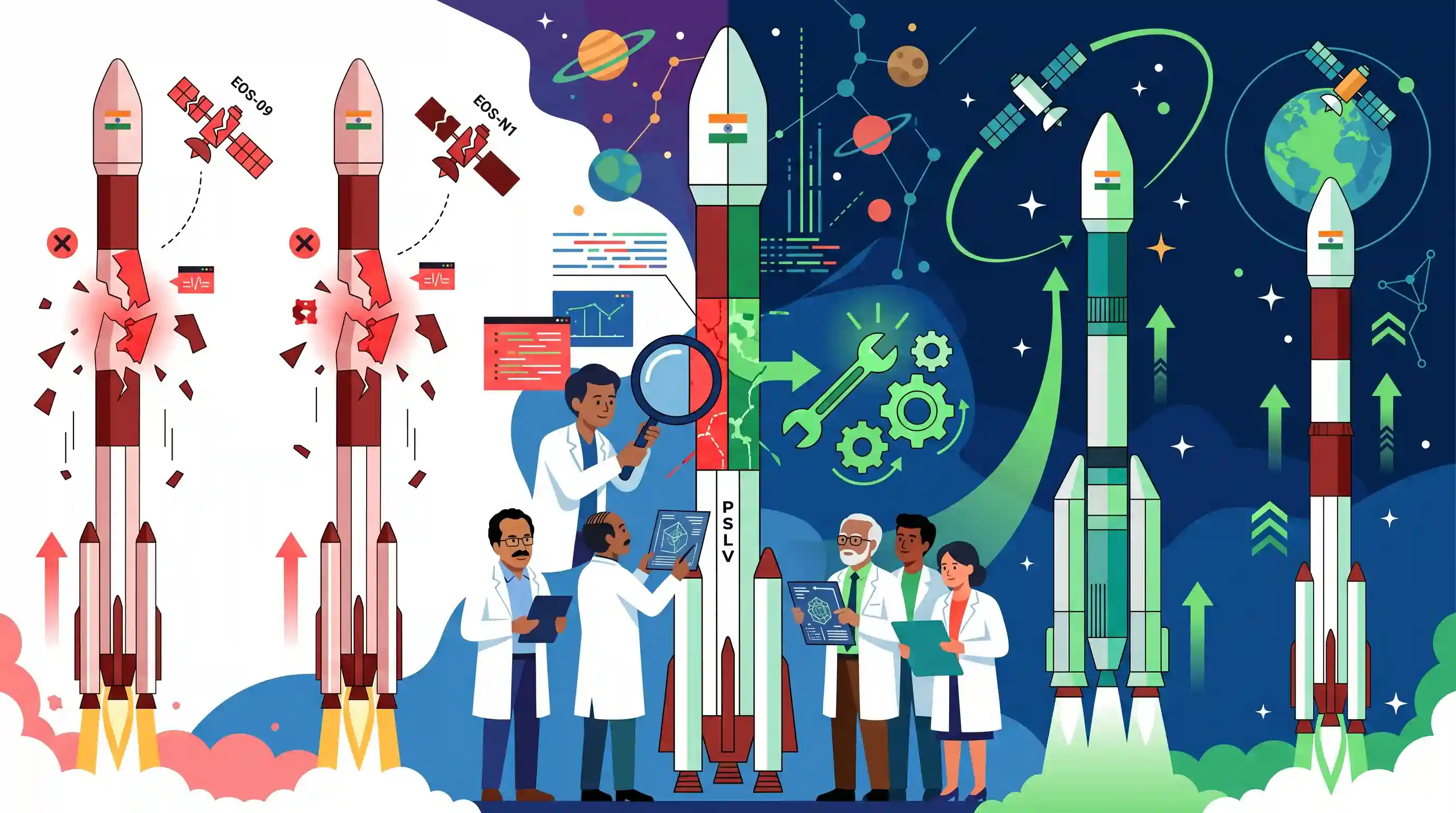
Union Minister Jitendra Singh announced that a national expert committee has successfully detected and resolved the anomaly in the Polar Satellite Launch Vehicle (PSLV). The issue, traced to the launch vehicle's third stage, resulted in two consecutive mission failures: the PSLV-C61 carrying the EOS-09 satellite in May 2025, and the PSLV-C62 carrying the EOS-N1 satellite in January 2026. Following the rectification, ISRO is now gearing up to resume launches, starting with a GSLV mission in July 2026, followed by a return to flight for the PSLV. The expert committee included notable scientists like K. Vijay Raghavan and ISRO Chairman S. Somanath.
Key Points
- A national-level expert committee has identified and resolved an anomaly in the third stage of ISRO's Polar Satellite Launch Vehicle (PSLV).
- The anomaly had caused the back-to-back failures of the PSLV-C61 mission in May 2025 (carrying EOS-09) and the PSLV-C62 mission in January 2026 (carrying EOS-N1).
- With the issue rectified, ISRO is preparing for a GSLV mission in July, followed by another PSLV launch.
- The swift identification and resolution process underscores ISRO's robust failure analysis mechanisms and institutional resilience.
Important Terms
ISRO (Indian Space Research Organisation)

India's primary space agency under the Department of Space, responsible for space-based applications, exploration, and the development of indigenous launch vehicles and satellite technologies.
UPSC context
GS Paper III (Science & Technology); focuses on institutional achievements, indigenous technology development, and international space cooperation.
Polar Satellite Launch Vehicle (PSLV)
Known as ISRO's 'workhorse,' this four-stage expendable launcher uses solid and liquid stages alternately to deliver satellites into Sun-Synchronous Polar Orbits.
UPSC context
GS Paper III (Space Technology); involves understanding launch vehicle tiers, historical reliability, and recent technical challenges/failures.
Geosynchronous Satellite Launch Vehicle (GSLV)
A heavy-lift launcher designed to place satellites in Geostationary Transfer Orbit (GTO) and Geosynchronous Orbit, utilizing a cryogenic upper stage.
UPSC context
GS Paper III (Space Technology); crucial for understanding India's capability to launch communication satellites and heavy deep-space missions.
Earth Observation Satellites (EOS)
Satellites equipped with remote sensing technology (like SAR) to monitor the Earth’s surface for agriculture, disaster management, and strategic surveillance.
UPSC context
GS Paper III (S&T and Disaster Management); tests knowledge of space applications for socio-economic development and national security.
Failure Analysis Committee (FAC)
A specialized body constituted to investigate technical anomalies and mission failures, identifying root causes to suggest corrective measures for future flight stability.
UPSC context
GS Paper III (S&T); relates to quality assurance, accountability, and the robustness of India's space program.
Synthetic Aperture Radar (SAR)
An active sensor technology used in EOS (like EOS-09) that provides high-resolution, all-weather, day-and-night imaging by using the motion of the radar antenna.
UPSC context
GS Paper III (Space Technology); specifically covers advanced imaging techniques used in strategic and environmental monitoring missions.
Prelims Trap
"The anomaly in PSLV's third stage was traced to its liquid propulsion Vikas engine."
PSLV utilizes alternating solid and liquid stages (Solid-Liquid-Solid-Liquid). The third stage (PS3), where the recent anomaly occurred, is a solid-fuelled motor, not liquid.
Static Concepts Connected
How do PSLV and GSLV differ in their propulsion stages?
- PSLV Stages: Features four stages with alternating propellants: Solid (PS1), Liquid (PS2 - Vikas engine), Solid (PS3), and Liquid (PS4).
- GSLV Stages: Features three stages: a Solid booster stage, a Liquid second stage (Vikas), and a Cryogenic Upper Stage (CUS) using liquid hydrogen and liquid oxygen.
Why are Earth Observation Satellites (EOS) typically placed in Sun-Synchronous Polar Orbits (SSPO)?
- Consistent Lighting: The satellite passes over a given latitude at the same local solar time, ensuring uniform shadows and illumination for accurate remote sensing and optical imaging.
- Global Coverage: Because the orbit crosses near the poles while the Earth rotates beneath it, the satellite can eventually scan the entire surface of the globe.
Cross-Topic Patterns
ISRO-DRDO strategic synergy
The loss of EOS-N1 (Anvesha), a DRDO hyperspectral satellite, highlights the growing inter-agency reliance and dual-use nature of India's space assets for border surveillance and strategic defense.
Institutional failure analysis mechanisms
ISRO expanded its post-failure reviews beyond technical glitches to probe procurement and quality assurance. This mirrors the broader push for strict manufacturing standardization in India's indigenization drives.

Expect a 2026 Prelims multi-statement question contrasting PSLV/GSLV stage propellants (Solid/Liquid vs Cryogenic) and target orbits.
Linked PYQs · 2
Linked PYQs · 2
- 2018PrelimsGS1
With reference to India's satellite launch vehicles, consider the following statements: 1. PSLVs launch the satellites useful for Earth resources monitoring whereas GSLVs are designed mainly to launch communication satellites. 2. Satellites launched by PSLV appear to remain permanently fixed in the same position in the sky, as viewed from a particular location on Earth. 3. GSLV Mk III is a four-staged launch vehicle with the first and third stages using solid rocket motors; and the second and fourth stages using liquid rocket engines. Which of the statements given above is/are correct?
- 2016MainsGS3
Discuss India's achievements in the field of Space Science and Technology. How the application of this technology has helped India in its socio-economic development?
